
🛒 Where to Buy
⚠️ Golden Rule of Retro Handhelds: Throw away the cheap MicroSD card that comes in the box — it will fail. And never use a high-wattage PD “Fast Charger” on these devices; it can damage the battery. Use a standard 5V/1.5A brick.
Device Overview: PowKiddy RGB10MAX3 Pro
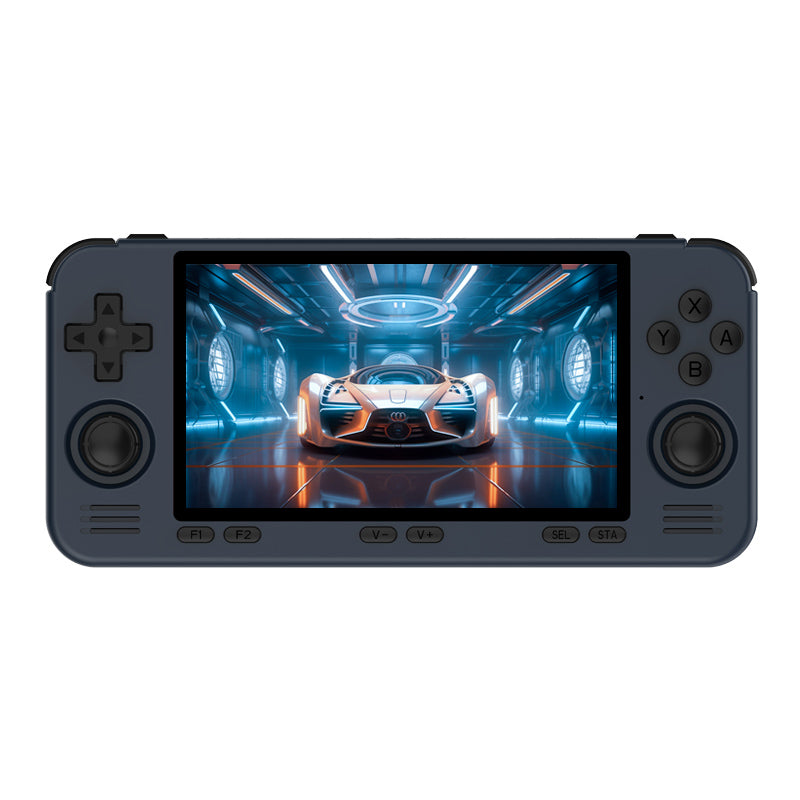
The “Pro” in RGB10MAX3 Pro is not marketing garnish bolted onto the base RGB10 MAX 3 — it is a different machine with a different brain. The standard MAX 3 runs a Rockchip RK3566 (quad Cortex-A55 at 1.8 GHz, Mali-G52 2EE), 1 GB of RAM, and a sharp 1280×720 5-inch panel. The Pro throws the RK3566 out entirely and drops in the Amlogic A311D: a six-core chip pairing four Cortex-A53 cores with two faster Cortex-A73 cores, backed by a Mali-G52 MP4 GPU. It doubles the memory to 2 GB of LPDDR4X and adds 16 GB of internal eMMC that the base model lacks. The one place the Pro goes backward is the screen: it ships a 5-inch IPS panel at 854×480 (480p), noticeably lower resolution than the base’s 720p display. So this is a genuine trade-off, not a clean upgrade — you gain a much stronger SoC, more RAM, and onboard storage, and you give up pixel density.
Against Anbernic, the comparison is direct. Anbernic’s RK3566 devices (RG353-series, RG503) sit at the same tier as the base MAX 3. The A311D in the Pro is the same silicon family that powered the older Odroid Go Super and several Amlogic handhelds, and in practice it lands roughly where the Unisoc T618 does — meaning the Pro out-muscles every RK3566 handheld and slots just below Anbernic’s newer RK3576 and the T820/D9 class machines. For its price, that is a strong position.
Emulation performance, generation by generation
The A311D’s two A73 cores are what make this device interesting. Everything up to and including the fifth generation runs without drama: NES, SNES, Genesis, Game Boy, GBA, PS1, and N64 are all comfortable, with N64 (Mupen64Plus) handling the bulk of the library at full speed rather than the per-game gamble you get on weaker chips. PSP via PPSSPP is the real strength here — most of the catalog runs well at native or 2x resolution, with only the heaviest 3D titles needing settings tweaks. Dreamcast (Flycast) is essentially solved. Sega Saturn, historically a CPU-bound nightmare, is largely playable thanks to those A73 cores. The ceiling sits at GameCube: Dolphin runs many games at or near full speed, though demanding titles will chug. PS2 is the honest stopping point — only the lightest, easiest-to-emulate games are playable, and you should not buy this expecting a PS2 machine. That is a high ceiling for a sub-$120 handheld.
Screen, build and controls
The 854×480 panel is the headline compromise. It is a good IPS display — bright, with strong color — but at 5 inches the pixel density is low (around 196 ppi versus the base model’s 294), and you will see it on sharper 2D content. For 3D systems the lower resolution matters less, since you are upscaling low-poly source material anyway. The chassis measures 183 x 84.5 x 18 mm and weighs 254 g — a flat, wide slab in the tradition of the RGB10 MAX line, comfortable in two hands but pocket-hostile. It has two analog sticks, but they are conventional potentiometer sticks, not Hall-effect — PowKiddy chose cost over drift-proofing. The d-pad, face buttons, and L1/L2/R1/R2 shoulders are all present and feel fine, if a touch less refined than Anbernic’s. Note there are no rear bumpers, so the back will pick up scratches sitting on a desk. Audio comes from dual-chamber speakers, with a 3.5 mm jack and Mini HDMI out for docked play on a TV.
Software and setup
The Pro ships with JELOS, a Linux-based retro distribution, and an Android build is also available for the hardware. Most owners will want to stay on Linux. JELOS is mature but no longer actively developed; its successor ROCKNIX officially supports the RGB10 MAX 3 Pro and is the firmware to install today — it boots to a clean EmulationStation front end, installs to the internal eMMC, and keeps games on a microSD card. The older Amlogic-focused The Retro Arena is also supported. Setup is the standard routine: flash the image to a card, boot, optionally install to internal storage, then load your legally-owned ROMs. Critically, there is no built-in Wi-Fi or Bluetooth, so you cannot scrape box art over the air or stream — everything moves by SD card, and a wired or USB-tethered workflow is mandatory. For some buyers that is a genuine deal-breaker.
Price, value and who it’s for
The Pro launched at $114.99, with a $134.99 regular price and optional microSD bundles. At the launch price it is one of the cheapest ways to get reliable Dreamcast, PSP, Saturn, and entry-level GameCube emulation in a horizontal form factor. The people it suits: anyone who wants a stronger-than-RK3566 emulator on a budget, plays mostly 3D-era systems where the 480p screen hurts least, and does not need wireless. The people it does not suit: anyone who prioritizes a crisp screen for 2D libraries (buy the base 720p MAX 3 or an Anbernic alternative), wants Hall sticks, or needs Wi-Fi for netplay and scraping. Within those limits, the A311D makes the Pro a real value rather than a renamed base model.
📐 Size & Pocketability
🔋 Real-World Battery Estimator
⭐ Emulation Performance
📊 View How This Score is Calculated
The Hardware Power Score is an absolute metric. Perfect emulation of difficult, modern consoles awards significantly more points than standard retro consoles.
- 15× Multiplier: Modern PC
- 12× Multiplier: Switch, PS3, Xbox 360
- 10× Multiplier: Wii U
- 8× Multiplier: PS2, GameCube, Wii, Xbox
- 5× Multiplier: Saturn, Dreamcast, PSP
- 3× Multiplier: N64, PS1
- 1× Multiplier: SNES, GBA
Generation 7
Generation 6
Generation 5
Handhelds & Retro
⚡ Performance Benchmarks
Where PowKiddy RGB10MAX3 Pro Mali-G52 MP4 lands against the handhelds everyone knows. Every bar shares one scale, so longer genuinely means faster — add up to two rivals to compare.
CPU = Geekbench 6 multi-core · GPU = 3DMark Wild Life. Median real-world scores; every bar shares one scale — add up to two rivals to compare.
📋 Full Specifications
📺 Display
⚙️ Platform
💾 Memory
🕹️ Controls
📏 Body
🔋 Battery
⚖️ Verdict
✅ The Good
- Amlogic A311D (4x A53 + 2x A73) is a real upgrade over the base RK3566 — handles PSP, Dreamcast, Saturn, and entry-level GameCube
- 2 GB LPDDR4X plus 16 GB internal eMMC, where the base model has 1 GB and no onboard storage
- Officially supported by ROCKNIX (and JELOS / The Retro Arena), with install-to-internal-storage
- Strong value at the $114.99 launch price, with bright IPS panel, dual chamber speakers, and Mini HDMI out for docked play
❌ The Bad
- Screen is only 854×480 (480p) — lower resolution than the base MAX 3's 1280×720 panel, soft on 2D content
- No Wi-Fi and no Bluetooth — no over-the-air scraping, netplay, or streaming; SD-card-only workflow
- Conventional analog sticks, not Hall-effect, so drift is possible over time; also no rear bumpers to protect the back
📰 Latest News & Guides
The Ultimate Guide to ARMSX3: Android’s New PS3 Emulator, Competitor Comparisons, and Setup Tutorial
18/08/2026Pokémon Gold, Silver, and Crystal (Gen 2) Recomp Lands on Android
17/08/2026How to Play the Pokémon Red, Blue, or Yellow Recomp on Your Android, Windows, and Linux Devices
16/08/2026🔍 Similar Handhelds
Other handhelds that emulate up to Saturn.