
🛒 Where to Buy
⚠️ Golden Rule of Retro Handhelds: Throw away the cheap MicroSD card that comes in the box — it will fail. And never use a high-wattage PD “Fast Charger” on these devices; it can damage the battery. Use a standard 5V/1.5A brick.
Device Overview: TRIMUI Brick Hammer
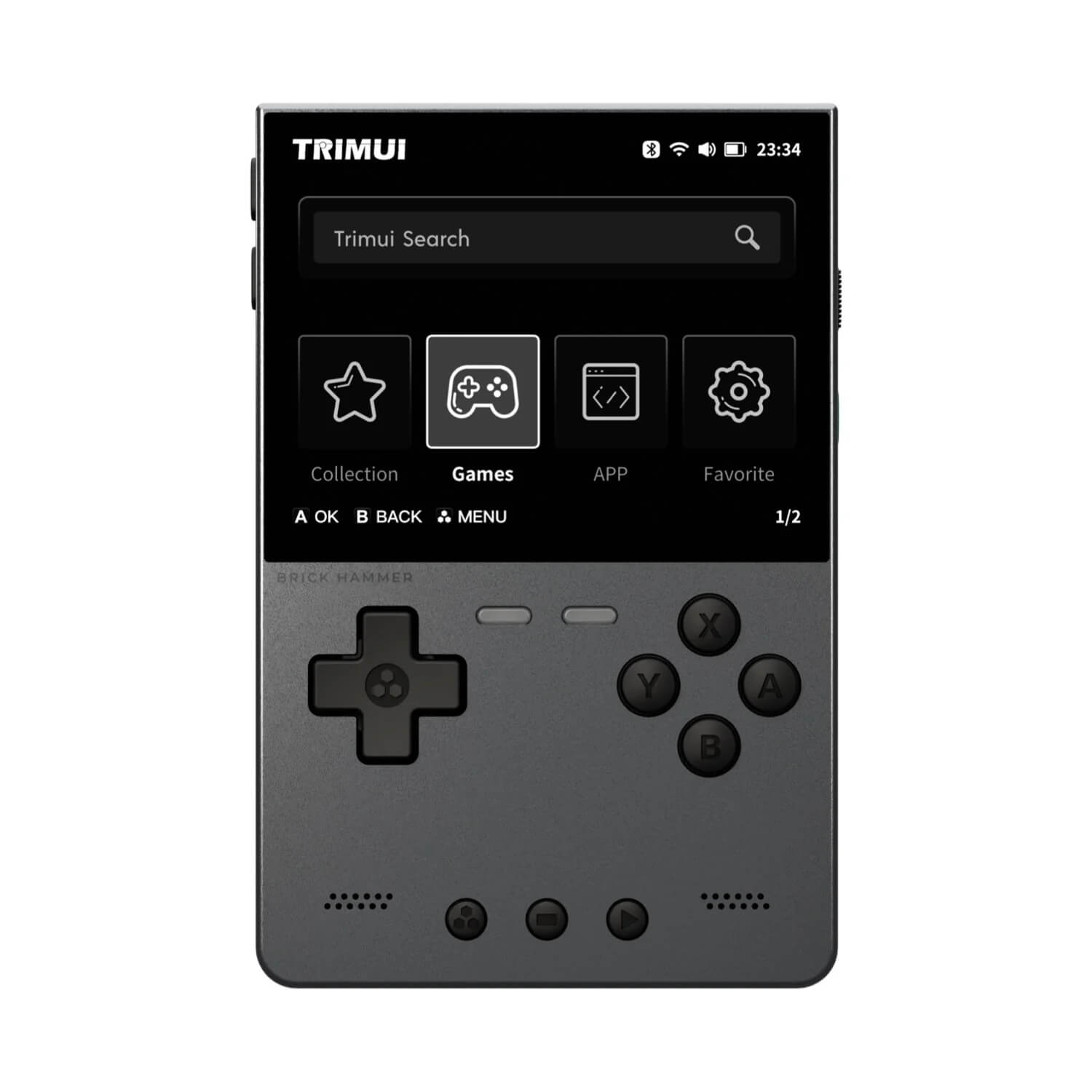
The TRIMUI Brick Hammer is the standard Brick poured into a CNC-machined aluminium shell. Internally almost nothing changed: it runs the same Allwinner A133P, the same 3.2-inch 4:3 panel, the same 3000mAh cell. What you pay the roughly $40-50 premium for is the metal, a colder and denser object that TRIMUI hopes justifies pushing a $75 handheld toward $100. It keeps the vertical, tall-brick silhouette of the original, small enough to disappear into a jacket pocket, and pairs 1GB of RAM with 8GB of eMMC plus a microSD slot rated to 1TB. Whether the upgrade makes sense depends entirely on how much you care about chassis material, because the Hammer emulates exactly what the plastic Brick emulated, not one frame faster.
Emulation performance, generation by generation
The A133P is a quad-core Cortex-A53 at 1.8GHz paired with an Imagination PowerVR GE8300. This is the same silicon Anbernic uses in the RG35XX Plus, and it sets a hard, well-understood ceiling. Everything through the 16-bit and early 32-bit era is comfortable: NES, Game Boy / Color / Advance, Master System, Genesis, PC Engine, SNES and Neo Geo all run at full speed with headroom, including heavy SNES chips like SuperFX. PlayStation 1 is the headline. PCSX-ReArmed clears the vast majority of the library at full speed, with only the most demanding discs occasionally wanting frameskip. That is where the good news stops. Nintendo 64 on Mupen64Plus-Next is a per-game gamble; Mario 64 and simpler titles hold up while anything ambitious stutters. Dreamcast on Flycast and PSP on PPSSPP are bootable but land in the “playable if you tolerate compromise” bucket, and the Brick’s lack of analog sticks makes both awkward regardless of frame rate. GameCube, Wii, PS2 and Saturn are off the table. Treat this as a machine built to make the 8-bit, 16-bit and PS1-era catalogue look great, not a Dreamcast box.
Screen, build and controls
The screen is the reason to look at a Brick at all. It is a 3.2-inch fully-laminated IPS panel at 1024×768, a true 4:3 aspect ratio at a pixel density most sub-$150 handhelds cannot touch. Retro sprites are razor-sharp and integer scaling is clean for systems whose native resolution divides neatly. There is no high-refresh trickery; it is a standard 60Hz panel, which is exactly right for the content. The Hammer wraps that panel in machined aluminium, and the build is the whole pitch: 196 grams versus 157 for the plastic Brick, cold in the hand, with firmer, more positive switches than the original’s slightly mushy buttons. Controls are a d-pad, ABXY, and two shoulder rows, with no analog sticks and no Hall-effect anything, which is honest for the form factor but rules out comfortable N64, PSP or twin-stick play. TRIMUI includes swappable shoulder-button caps in the box, plus a vibration motor and RGB lighting on the back and triggers. Connectivity is basic but sufficient: USB-C that handles charging, data and USB host, 2.4GHz Wi-Fi b/g/n, Bluetooth 2.1+EDR/4.2 for pads and headphones, a 3.5mm jack, front-firing stereo speakers and a mono microphone. The button ordering around Start, Select and Menu is fiddly, a small ergonomic miss on an otherwise tidy layout.
Software and setup
Out of the box the Hammer runs TRIMUI’s stock Linux launcher, which is functional but plain and best treated as a starting point. The Brick platform’s strength is its custom-firmware scene, and it is well served. MinUI and its more feature-rich fork NextUI are the favourites for anyone who wants a minimalist boot-straight-to-games experience, and NextUI in particular has become the default enthusiast recommendation. muOS and Knulli both run here too if you prefer a fuller front-end with box art, scraping and per-system settings, and CrossMix-OS exists for tinkerers who want everything bundled. Installation is the usual SD-card image flash, no soldering and no unlock dance, and because the internals are identical to the plastic Brick, every guide and image written for that model applies unchanged. That shared software base is a genuine advantage; you inherit a mature ecosystem rather than waiting for one to form.
Price, value and who it is for
At roughly $95-110 depending on retailer, and near $130 for bundles that add a 128GB card, the Hammer asks a meaningful premium over the $75 plastic Brick for zero performance gain. That makes it easy to recommend and easy to talk yourself out of. If the metal body genuinely matters to you, this is the nicest-feeling handheld in its price and size bracket, and the screen remains outstanding. If you mostly care about what runs, the standard Brick delivers the identical PS1-and-down experience for less, and the money saved is better spent on a device with analog sticks if you have N64 or PSP ambitions. Buy the Hammer as a pocketable, beautifully built retro player for the 8-bit through PS1 generations. Do not buy it expecting the aluminium to raise the emulation ceiling, because it does not.
📐 Size & Pocketability
⚖️ Weight vs Other Handhelds
🔋 Real-World Battery Estimator
⭐ Emulation Performance
📊 View How This Score is Calculated
The Hardware Power Score is an absolute metric. Perfect emulation of difficult, modern consoles awards significantly more points than standard retro consoles.
- 15× Multiplier: Modern PC
- 12× Multiplier: Switch, PS3, Xbox 360
- 10× Multiplier: Wii U
- 8× Multiplier: PS2, GameCube, Wii, Xbox
- 5× Multiplier: Saturn, Dreamcast, PSP
- 3× Multiplier: N64, PS1
- 1× Multiplier: SNES, GBA
Generation 6
Generation 5
Handhelds & Retro
⚡ Performance Benchmarks
Where TRIMUI Brick Hammer Imagination PowerVR GE8300 lands against the handhelds everyone knows. Every bar shares one scale, so longer genuinely means faster — add up to two rivals to compare.
CPU = Geekbench 6 multi-core · GPU = 3DMark Wild Life. Median real-world scores; every bar shares one scale — add up to two rivals to compare.
📋 Full Specifications
📺 Display
⚙️ Platform
💾 Memory
🕹️ Controls
📏 Body
🔋 Battery
⚖️ Verdict
✅ The Good
- Machined aluminium chassis feels far more premium than plastic rivals, with firmer buttons than the standard Brick
- Exceptional 3.2-inch 1024×768 laminated IPS panel, a 4:3 pixel density most budget handhelds cannot match
- Rock-solid emulation up to and including PS1, with full-speed 8-bit, 16-bit and GBA play
- Mature custom-firmware support (NextUI/MinUI, muOS, Knulli) inherited directly from the standard Brick
❌ The Bad
- Roughly $40-50 more than the plastic Brick for identical internals and no extra performance
- No analog sticks plus the modest A133P GPU, so N64, PSP and Dreamcast are compromised to unplayable
- Heavier at 196g with awkward Start/Select/Menu placement, and the same 3000mAh gives only ~4-6 hours
📰 Latest News & Guides
The Ultimate Guide to ARMSX3: Android’s New PS3 Emulator, Competitor Comparisons, and Setup Tutorial
18/08/2026Pokémon Gold, Silver, and Crystal (Gen 2) Recomp Lands on Android
17/08/2026How to Play the Pokémon Red, Blue, or Yellow Recomp on Your Android, Windows, and Linux Devices
16/08/2026🔍 Similar Handhelds
Other handhelds that emulate up to Dreamcast.