
🛒 Where to Buy
⚠️ Golden Rule of Retro Handhelds: Throw away the cheap MicroSD card that comes in the box — it will fail. And never use a high-wattage PD “Fast Charger” on these devices; it can damage the battery. Use a standard 5V/1.5A brick.
Device Overview: Sony PSP Go
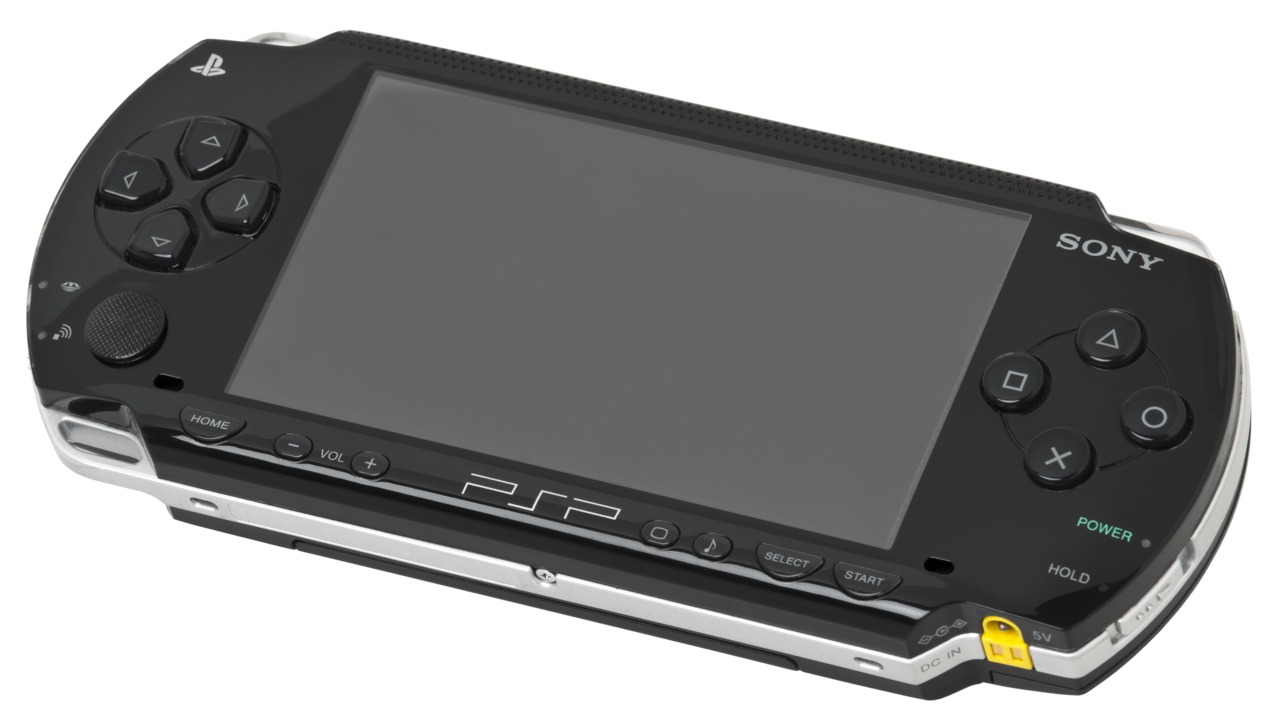
The Sony PSP Go (model PSP-N1000) is the strangest branch of the PlayStation Portable family: a 2009 redesign that ripped out the UMD drive and bet the whole platform on digital downloads. It launched on October 1, 2009 in North America and Europe at $249 / €249 — the exact money Sony was asking for the disc-based PSP-3000 sitting next to it on the shelf. That pricing, plus the fact that a Go owner could not play the UMD games they already owned, doomed it commercially; a promised program to let buyers transfer their disc libraries to digital was quietly cancelled. It was the last new PSP form factor Sony shipped before the Vita landed in 2011–12. As hardware, though, it is the most pocketable PSP ever built and a genuine curiosity worth understanding before you buy one.
The hardware and its library
Under the slider sits the same silicon as every other PSP: a dual-core MIPS R4000 CPU clocking up to 333 MHz, a Sony GPU at 166 MHz, and 64 MB of RAM (double the launch PSP-1000’s 32 MB). Nothing here is faster than a 3000 — it runs the identical library at the identical speed. What changed is delivery. There is no disc drive; instead you get 16 GB of internal flash plus a Memory Stick Micro (M2) slot, and every game arrives through the PlayStation Store over 802.11b Wi-Fi. The native catalog is the full PSP download library — Grand Theft Auto: Chinatown Wars, the God of War ports, Daxter, Patapon, Persona 3 Portable — alongside PS1 Classics like Final Fantasy VII and Metal Gear Solid that the PSP runs through Sony’s own POPS layer. Bluetooth 2.0 is the Go-exclusive trick: pair a DualShock 3, feed the video-out port to a TV, and play it like a tiny console.
Homebrew, custom firmware and emulation
The PSP is one of the most thoroughly cracked handhelds ever made, and the Go is no exception. The end state today is firmware 6.61 running PRO-C2 or LME 2.3 custom firmware, made persistent with Davee’s Infinity so the hack survives a full power-off instead of dying on each reboot. Because the Go has no UMD drive, the old “Pandora battery” recovery route is irrelevant — you mod it entirely in software. Once CFW is installed, the flash and M2 card become a homebrew playground. PS1 emulation is effectively native and flawless. The 8- and 16-bit era runs well: NES, Game Boy/GBC, Master System, Genesis and TurboGrafx all hit full speed, and gpSP pushes most Game Boy Advance games at or near full frame rate. SNES is the honest weak spot — Snes9x TYL and CATSFC lean on frame-skip or overclocking, so Super FX and SA-1 titles stutter. Anything past the 32-bit line (N64, Saturn, DS) is out of reach for a 333 MHz MIPS core, so don’t buy a Go expecting those.
Screen, build and revisions
The display is a 3.8-inch 480×272 TFT LCD — smaller than the 4.3-inch panel on other PSPs but the same pixel count, so it reads slightly sharper per inch and noticeably brighter than the original 1000. It slides up to expose the controls, and that is where the compromises show. The single analog nub was shrunk and pushed low and left, so it feels cramped for larger hands, and there are still only two shoulder buttons with no triggers and no second stick — 2009 PSP ergonomics, not modern Hall-effect sticks. The unit weighs 158 g and is 43% smaller than a PSP-1000, small enough for a jacket pocket. The battery is a sealed, non-removable 930 mAh cell good for roughly five hours of play, so a tired Go needs a soldering-level swap. There were no functional revisions: one model, the PSP-N1000, sold in Piano Black, Pearl White and a later Crimson Red.
Collecting, price and who it is for
Sony discontinued the Go in 2011 after about two years, and the PSP Store stopped selling to it in 2016, so the digital-only pitch has aged badly — you can still re-download anything already attached to your account, but the storefront convenience it was designed around is gone. That failure is precisely why it is collectible now. Loose units trade around $100–180, boxed and complete examples run $200 or more, and the Crimson Red and special editions command a premium. Sony never sold the standalone battery or storage upgrades that older PSPs enjoyed, so what you buy is what you get. It is not the PSP to buy if you simply want to play the library on the cheap — a modded PSP-3000 or PSP-1000 does everything the Go does, plays UMDs too, and costs less. Buy a Go for the smallest, oddest PlayStation Portable, the DualShock 3 pairing, or as a piece of Sony’s most interesting hardware misfire. As a daily player it is fine; as a shelf piece it is the one people ask about.
📐 Size & Pocketability
⚖️ Weight vs Other Handhelds
🔋 Real-World Battery Estimator
⭐ Emulation Performance
📊 View How This Score is Calculated
The Hardware Power Score is an absolute metric. Perfect emulation of difficult, modern consoles awards significantly more points than standard retro consoles.
- 15× Multiplier: Modern PC
- 12× Multiplier: Switch, PS3, Xbox 360
- 10× Multiplier: Wii U
- 8× Multiplier: PS2, GameCube, Wii, Xbox
- 5× Multiplier: Saturn, Dreamcast, PSP
- 3× Multiplier: N64, PS1
- 1× Multiplier: SNES, GBA
Gen 8 & PC
Generation 5
Handhelds & Retro
📋 Full Specifications
📺 Display
⚙️ Platform
💾 Memory
🕹️ Controls
📏 Body
🔋 Battery
⚖️ Verdict
✅ The Good
- Smallest and lightest PSP ever made at 158 g, genuinely pocketable with the sliding screen closed
- Same 480×272 image on a brighter, sharper 3.8-inch panel, plus 16 GB of built-in storage before you add a card
- Bluetooth pairs a DualShock 3 for TV play via the video-out port, a trick unique to the Go
- Fully hackable: permanent 6.61 PRO/LME custom firmware via Infinity unlocks flawless PS1 and solid 8/16-bit homebrew emulation
❌ The Bad
- No UMD drive, so it plays zero physical PSP games and the PS Store that fed it stopped selling in 2016
- Cramped low-set analog nub, only two shoulder buttons, and a sealed 930 mAh battery you cannot swap
- Launched at the same $249 as the more capable PSP-3000 and costs more used today, making it poor value for pure gaming
📰 Latest News & Guides
The Ultimate Guide to ARMSX3: Android’s New PS3 Emulator, Competitor Comparisons, and Setup Tutorial
18/08/2026Pokémon Gold, Silver, and Crystal (Gen 2) Recomp Lands on Android
17/08/2026How to Play the Pokémon Red, Blue, or Yellow Recomp on Your Android, Windows, and Linux Devices
16/08/2026🔍 Similar Handhelds
Other handhelds that emulate up to PSP.