
🛒 Where to Buy
⚠️ Golden Rule of Retro Handhelds: Throw away the cheap MicroSD card that comes in the box — it will fail. And never use a high-wattage PD “Fast Charger” on these devices; it can damage the battery. Use a standard 5V/1.5A brick.
Device Overview: SJGAM M19
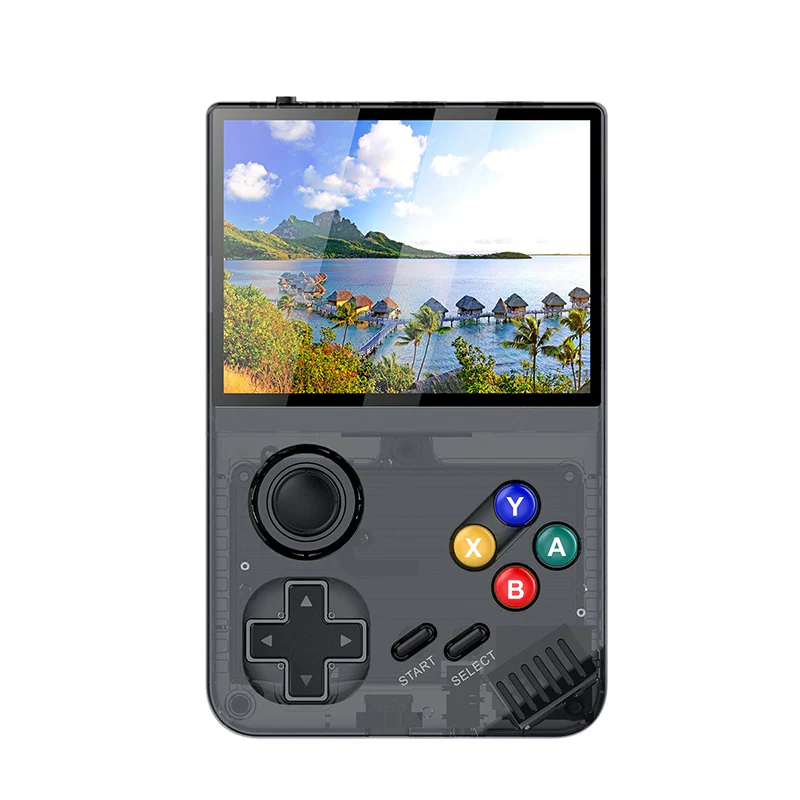
The SJGAM M19 is a sub-$55 emulation handheld built around the Rockchip RK3566, the same low-power ARM board that sits inside the R36S, the Powkiddy RGB30 and a dozen other budget clones. That lineage tells you almost everything: this is not a new silicon design but a familiar chip in a fresh plastic shell, aimed at buyers who want PS1 and 16-bit gaming for the price of two new Switch cartridges. SJGAM is an OEM better known for the plug-and-play “thousands of games built in” boxes you find in discount stores, and the M19 carries some of that DNA — it ships loaded and locked, meant to switch on rather than tinker with.
Emulation performance, generation by generation
The RK3566 pairs four Cortex-A55 cores at 1.8 GHz with a Mali-G52 2EE GPU and just 1 GB of LPDDR4 memory. That combination has been mapped exhaustively by the community, so there are no surprises here. Everything through the 16-bit era — NES, SNES, Genesis, Master System, PC Engine — runs at full speed with headroom to spare on RetroArch cores. Game Boy Advance and the original PlayStation are comfortable, with PS1 holding 60 fps across most libraries as long as you avoid heavy CD-streaming outliers. Nintendo 64, Dreamcast and PSP are the realistic ceiling, and the word “selective” matters: Mario 64 and Ocarina of Time run, but demanding N64 titles stutter, Dreamcast is a per-game gamble, and PSP is fine for 2D and light 3D while choking on anything ambitious. Nintendo DS is technically possible but the 1 GB of RAM and the single screen make it awkward, and Saturn emulation is poor — exactly as it is on every RK3566 device. Arcade sits on a spectrum: CPS1, CPS2, Neo Geo and most pre-3D MAME sets run cleanly, while later polygon-heavy boards do not. Anyone expecting GameCube, Wii or Switch is looking at the wrong class of hardware, and no firmware trick changes that.
Screen, build and controls
The 3.5-inch IPS panel runs at a native 640×480 in a 4:3 shape — 228 pixels per inch, 60 Hz. That 4:3 ratio is the right call for retro content: SNES and PS1 fill the glass without pillarboxing, and the resolution divides cleanly enough to keep older systems looking sharp. The body is plastic, roughly 160 grams, laid out vertically with a single recessed analog stick stacked above the d-pad. That lone stick is the honest limitation — there is no second one, which hurts N64 and PSP titles that assume it, and reviewers have singled out the flat, awkwardly placed shoulder buttons. The stick uses conventional potentiometers rather than Hall-effect sensors, so drift over time is a fair worry. There is no touchscreen and no gyro. Audio comes from a front-facing speaker with a 3.5 mm headphone jack alongside, and a mini-HDMI port handles TV output. The 3000 mAh battery is modest for the class and delivers a few hours rather than an all-day session, charging over the same USB-C port used for data.
Software and setup
Out of the box the M19 runs an EmuELEC-based Linux image on a bundled microSD card, pre-populated with emulators and, in true grey-market fashion, a pile of ROMs. The stock firmware is the weak point: locked down, cosmetically skinned and not built for tinkering. The good news is the chip. Because the RK3566 is so widely used, mature custom firmware exists — ROCKNIX (the successor to JELOS), ArkOS and Batocera all run on this SoC and transform the machine with proper scraping, per-core configuration and cleaner front ends. The caveat is honesty: those projects target specific known devices, and an obscure clone like the M19 may need a compatible community image or manual tweaking rather than an official one-click build. Note too that muOS, Knulli and OnionOS are not options here — those are built for Allwinner-based handhelds, not Rockchip. And with no Wi-Fi or Bluetooth on board, every ROM transfer and firmware flash happens by pulling the card and using a PC.
Price, value and who it is for
Pricing floats between roughly $51 and $75 depending on the bundled microSD card and the seller, and some storefront listings openly inflate the sheet — you will see “4 GB RAM” or a “4.3-inch screen” that the hardware does not have, so trust the RK3566 / 1 GB / 3.5-inch reality over the marketing copy. At its true price the M19 is a capable PS1-and-below machine with a decent 4:3 screen, dragged down by real compromises: one stick, no wireless, cramped shoulders and a locked stock OS. If you specifically want this vertical form factor and intend to flash better firmware, it is defensible. But the R36S and Powkiddy RGB30 use the same chip with a more established support scene, and for most buyers those are the safer picks. The M19 is for the bargain hunter who knows exactly what an RK3566 can and cannot do, and buys accordingly.
📐 Size & Pocketability
⚖️ Weight vs Other Handhelds
🔋 Real-World Battery Estimator
⭐ Emulation Performance
📊 View How This Score is Calculated
The Hardware Power Score is an absolute metric. Perfect emulation of difficult, modern consoles awards significantly more points than standard retro consoles.
- 15× Multiplier: Modern PC
- 12× Multiplier: Switch, PS3, Xbox 360
- 10× Multiplier: Wii U
- 8× Multiplier: PS2, GameCube, Wii, Xbox
- 5× Multiplier: Saturn, Dreamcast, PSP
- 3× Multiplier: N64, PS1
- 1× Multiplier: SNES, GBA
Generation 6
Generation 5
Handhelds & Retro
⚡ Performance Benchmarks
Where SJGAM M19 ARM Mali-G52 MP2 (2EE) lands against the handhelds everyone knows. Every bar shares one scale, so longer genuinely means faster — add up to two rivals to compare.
CPU = Geekbench 6 multi-core · GPU = 3DMark Wild Life. Median real-world scores; every bar shares one scale — add up to two rivals to compare.
📋 Full Specifications
📺 Display
⚙️ Platform
💾 Memory
🕹️ Controls
📏 Body
🔋 Battery
⚖️ Verdict
✅ The Good
- Built on the well-documented Rockchip RK3566, so the emulation ceiling is predictable: full-speed 8/16-bit and PS1, with N64, Dreamcast and PSP selectively playable
- Sharp 3.5-inch 4:3 IPS screen (640×480, 228 ppi) that fills the display with retro content instead of pillarboxing it
- Very low entry price, often around $51–55, undercutting name-brand rivals in the same class
- Mature custom firmware exists for the SoC (ROCKNIX, ArkOS, Batocera), so the locked stock OS can be replaced
❌ The Bad
- No Wi-Fi or Bluetooth whatsoever, so every ROM and firmware transfer means physically pulling the microSD card
- Single analog stick with potentiometers rather than Hall-effect sensors (drift-prone), plus flat, awkwardly placed shoulder buttons that reviewers dislike
- Obscure OEM with a locked-down stock image, no official custom-firmware build for this exact model, and storefront listings that misstate the specs — support leans on community effort
📰 Latest News & Guides
The Ultimate Guide to ARMSX3: Android’s New PS3 Emulator, Competitor Comparisons, and Setup Tutorial
18/08/2026Pokémon Gold, Silver, and Crystal (Gen 2) Recomp Lands on Android
17/08/2026How to Play the Pokémon Red, Blue, or Yellow Recomp on Your Android, Windows, and Linux Devices
16/08/2026🔍 Similar Handhelds
Other handhelds that emulate up to PSP.