
🛒 Where to Buy
⚠️ Golden Rule of Retro Handhelds: Throw away the cheap MicroSD card that comes in the box — it will fail. And never use a high-wattage PD “Fast Charger” on these devices; it can damage the battery. Use a standard 5V/1.5A brick.
Device Overview: AYN Loki Max
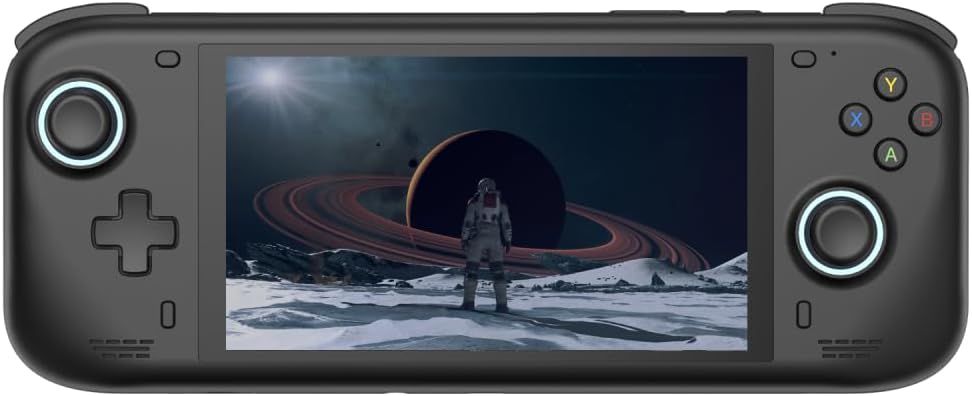
The AYN Loki Max sits in an awkward but interesting spot in the handheld world: it’s sold alongside retro emulation machines, but under the hood it’s a full Windows gaming PC. The headline part is an AMD Ryzen 7 6800U — eight Zen 3+ cores running up to 4.7GHz, paired with a 12-core Radeon 680M GPU — backed by 16GB of LPDDR5 memory and a 512GB NVMe SSD. That’s the same class of silicon that powered the first wave of Steam Deck rivals, and it completely changes what you should expect from this device. It isn’t a single-board ARM handheld that tops out at PS2; it’s a small x86 PC that happens to have controller grips bolted to the sides. If you’ve owned an Anbernic or a Retroid and you’re stepping up to the Loki Max, the mental model is different from the ground up — you’re buying a computer, not an appliance.
Emulation performance, generation by generation
Everything up to and including the sixth console generation is effortless. Game Boy, GBA, SNES, Genesis, PS1, N64, Dreamcast and PSP all run at full speed with room to spare, and you can crank internal resolution multipliers, texture filtering and shaders without the frame rate flinching. PS2, GameCube and Wii are equally comfortable on PCSX2 and Dolphin — this is the generation where the 680M’s extra GPU headroom really shows, letting you run those libraries at 2x–3x native resolution for a genuinely cleaned-up look on the 1080p panel.
The reason you buy a 6800U handheld, though, is the seventh and eighth generations. Switch emulation runs the bulk of the popular library well, with the familiar caveat that the most demanding first-party titles need per-game tuning. PS3 via RPCS3 is realistic across a wide swath of games, though it remains the most temperamental target and rewards patience. Wii U on Cemu is a strong showing, and Xbox 360 via Xenia is the rough edge — it works on a growing list of titles but is the least predictable of the bunch. The honest summary: this is a device that gets you into the hard consoles, not one that runs every single title on them flawlessly. That’s true of every handheld at this power level, and the Loki Max is one of the more capable ones for the money.
Screen, build and controls
The 6-inch 1080p IPS touchscreen is a real strength. A native 1080p panel means Switch and PC games look sharp rather than upscaled and soft, and it gives you the pixel budget to actually benefit from those higher emulation resolutions. The trade-off is size and weight: at 573 grams and roughly 9.7 x 3.7 x 1.5 inches, the Loki Max is a two-handed, sit-down device. It’s a couch, commute and travel-bag machine, not something you slide into a jacket pocket like a vertical retro handheld.
Controls are where AYN has historically done well, and the Loki Max continues that. The Hall-effect thumbsticks use magnetic sensing instead of physical contacts, which means they shouldn’t develop the stick drift that plagues so many handhelds a year or two into ownership — a meaningful detail on a device you intend to keep. Analog triggers, a solid d-pad and full-size face buttons round out a layout that holds up over long sessions.
Living with Windows
This is the part that separates a Windows handheld from a plug-and-play retro device, and it cuts both ways. On the plus side, you’re not locked into emulation: the Loki Max runs your Steam, Epic and GOG libraries, cloud-gaming apps, and anything else a Windows PC can run. Pair it with a front-end like Playnite, or an emulation manager like EmuDeck, and you can build a console-like launcher that hides the desktop entirely. USB4 and Wi-Fi 6E mean it docks cleanly to a TV or monitor and accepts fast external storage, so it doubles as a small living-room machine.
The cost is the Windows tax. Out of the box you’ll spend time on driver updates, controller mapping, per-emulator configuration and the occasional Windows Update interruption — chores a $99 Anbernic simply never asks of you. If you enjoy tinkering, it’s part of the appeal. If you want to switch a handheld on and immediately play, the learning curve is real and worth knowing about before you spend.
Price, value and who it’s for
At around $775, the Loki Max is priced like the enthusiast tool it is — that’s laptop money, and it lands in the same conversation as the Steam Deck OLED and various ROG Ally configurations. Its Value score reflects that you’re paying for the performance ceiling, not for bargain-hunting. The case for it is simple: if you want a single device that covers Game Boy all the way up to “can it run this modern PC game,” and you’re comfortable living in Windows to get there, the Loki Max delivers exactly that breadth. The case against it is just as simple: if your library is mostly PS1, PSP and Dreamcast played on the couch, you’re paying for headroom you’ll never touch — a cheaper, lighter, plug-and-play handheld will make you happier and lighter in the pocket. Buy it for the ceiling, not the floor, and it’s one of the most versatile machines in its class.
📐 Size & Pocketability
⚖️ Weight vs Other Handhelds
🔋 Real-World Battery Estimator
⭐ Emulation Performance
📊 View How This Score is Calculated
The Hardware Power Score is an absolute metric. Perfect emulation of difficult, modern consoles awards significantly more points than standard retro consoles.
- 15× Multiplier: Modern PC
- 12× Multiplier: Switch, PS3, Xbox 360
- 10× Multiplier: Wii U
- 8× Multiplier: PS2, GameCube, Wii, Xbox
- 5× Multiplier: Saturn, Dreamcast, PSP
- 3× Multiplier: N64, PS1
- 1× Multiplier: SNES, GBA
Gen 8 & PC
Generation 7
Generation 6
Generation 5
Handhelds & Retro
⚡ Performance Benchmarks
Where AYN Loki Max AMD Radeon 680M lands against the handhelds everyone knows. Every bar shares one scale, so longer genuinely means faster — add up to two rivals to compare.
CPU = Geekbench 6 multi-core · GPU = 3DMark Wild Life. Median real-world scores; every bar shares one scale — add up to two rivals to compare.
📋 Full Specifications
📺 Display
⚙️ Platform
💾 Memory
🕹️ Controls
📏 Body
🔋 Battery
⚖️ Verdict
✅ The Good
- Ryzen 7 6800U + Radeon 680M is genuinely a small PC — PS3, Wii U and Switch are realistic, not just retro consoles.
- True 6" 1080p screen, so Switch and PC games render sharp instead of upscaled-blurry.
- Hall-effect sticks mean no drift creeping in a year or two down the line.
- USB4, Wi-Fi 6E and video-out — it docks to a TV and takes fast external storage.
❌ The Bad
- At 573g and Windows-level power draw it's a couch-and-bag handheld, not a pocket one.
- $775 is laptop money; the Value score reflects that you're paying for the ceiling.
- Windows is its own chore — driver tweaks, updates and setup a plug-and-play retro handheld skips.
📰 Latest News & Guides
The Ultimate Guide to ARMSX3: Android’s New PS3 Emulator, Competitor Comparisons, and Setup Tutorial
18/08/2026Pokémon Gold, Silver, and Crystal (Gen 2) Recomp Lands on Android
17/08/2026How to Play the Pokémon Red, Blue, or Yellow Recomp on Your Android, Windows, and Linux Devices
16/08/2026🔍 Similar Handhelds
Other handhelds that emulate up to Modern.