
🛒 Where to Buy
⚠️ Golden Rule of Retro Handhelds: Throw away the cheap MicroSD card that comes in the box — it will fail. And never use a high-wattage PD “Fast Charger” on these devices; it can damage the battery. Use a standard 5V/1.5A brick.
Device Overview: Nintendo Switch OLED
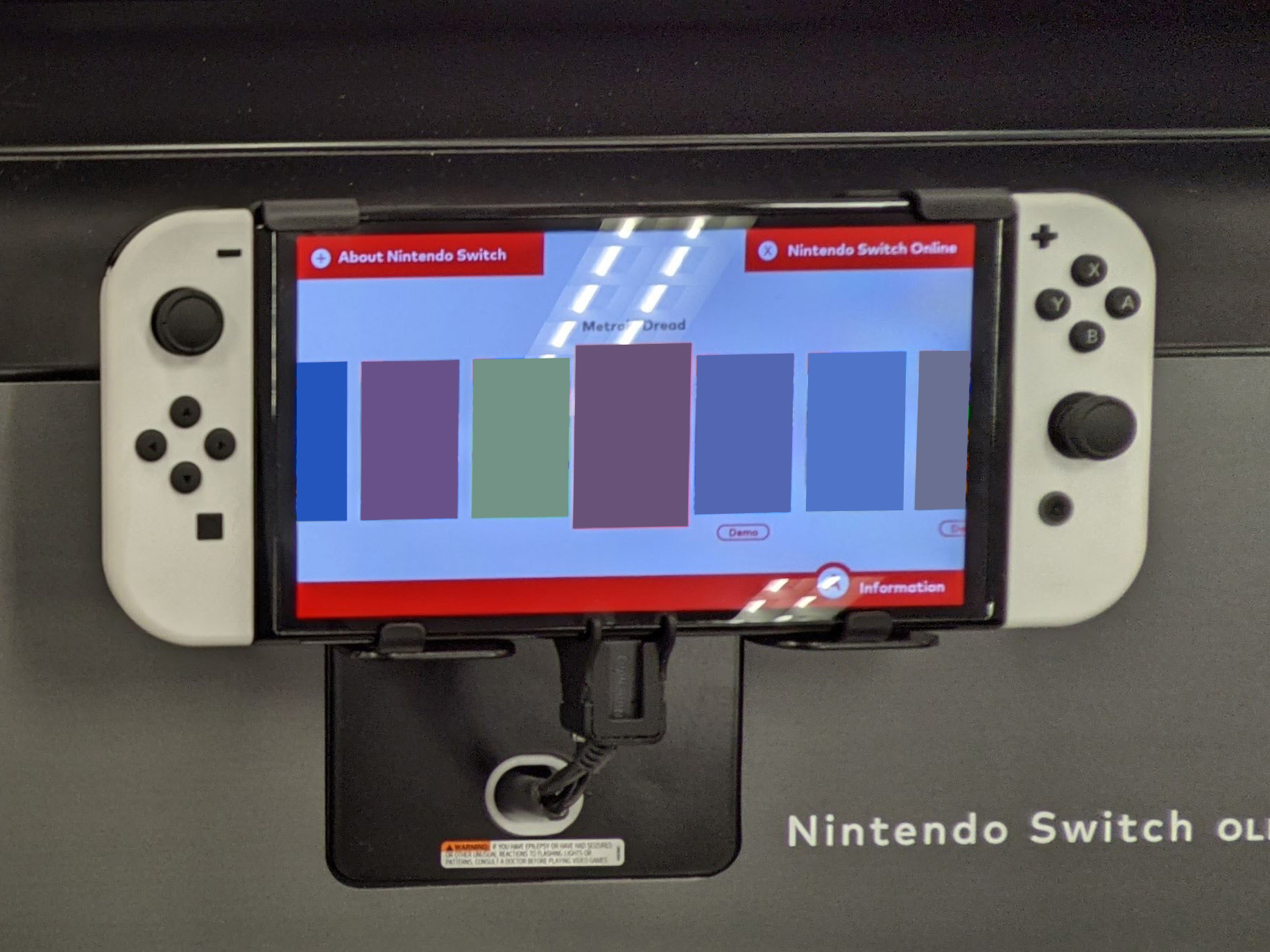
The Nintendo Switch OLED (model HEG-001) is not a new console. It is the original 2017 Switch with a better screen bolted on, released on October 8, 2021 at $349.99, a mid-generation refresh rather than the “Switch Pro” the rumour mill kept promising. It runs the exact same games at the exact same performance as the launch unit and the Switch Lite. What you pay the extra $50 over the standard model for is the panel, the kickstand and a handful of quality-of-life fixes. A full generation later, with the Switch 2 on shelves, that trade still holds up better than it has any right to.
The hardware and its library
Inside is the same Nvidia Tegra X1 that has powered every Switch, here in the “Mariko” (T210b01) revision built on a 16 nm process. Four ARM Cortex-A57 cores are available to games, paired with a 256-core Maxwell GPU and 4 GB of LPDDR4. Nintendo did not raise a single clock for the OLED, so a game that stutters on the original, such as Tears of the Kingdom in Kakariko or Pokemon Scarlet and Violet almost anywhere, stutters identically here. Handheld resolution tops out at 1280×720; docked, the console outputs up to 1080p, never 4K. Internal storage doubled to 64 GB over the launch model, still trivially filled and still expandable by microSD.
The library is the whole point. This is the machine for Breath of the Wild and Tears of the Kingdom, Super Mario Odyssey, Metroid Dread, Mario Kart 8 Deluxe, Splatoon 3, Animal Crossing: New Horizons and Super Smash Bros. Ultimate. There are no OLED-exclusive titles; every Switch plays the same cartridges. The OLED simply happens to be the nicest way to play them in handheld mode.
Homebrew, custom firmware and emulation
Here the OLED is the harder Switch to hack, and that is worth understanding before you buy one to tinker with. The Mariko bootROM is patched: the old Fusee Gelee coldboot exploit that let 2017 launch units run Atmosphere from a jig and a paperclip does not work on any OLED. Software-only entry is off the table. To run custom firmware you need a hardware modchip, an HWFLY or PicoFly board voltage-glitched onto the motherboard, which means fine-pitch soldering or paying someone to do it. Once installed, the stack is the same as any modded Switch: Hekate as the bootloader, Atmosphere as the custom firmware.
With CFW you get homebrew, emulators and the usual RetroArch cores. As a retro machine the Tegra X1 is comfortable through the fifth generation and a little beyond: NES, SNES, Genesis, GBA, PS1 and Nintendo DS run at full speed, and most N64 and PSP is playable with the right cores and per-game tweaks. Push into Saturn, Dreamcast, GameCube or PS2 and you are in compromise territory; Dolphin exists as homebrew but chugs on demanding titles. Treat it as a strong 8/16/32-bit emulator, not a Steam Deck. Note too that going online with a modded, ban-flagged console risks a Nintendo ban, so most people keep a hacked unit offline.
Screen, build and revisions
The screen is the reason to own this model. The 7-inch OLED panel is larger than the original’s 6.2-inch LCD while fitting the same chassis, thanks to slimmer bezels, and it delivers the perfect blacks, punchy colour and per-pixel contrast that LCD Switches simply cannot. Refresh stays at 60 Hz with no VRR or HDR, and the panel only matters in handheld mode; dock the console and you are back on your TV. Nintendo also fixed the two things everyone hated: the kickstand is now a full-width, friction-hinged flap that actually holds any angle, and the OLED dock adds a wired LAN port for stable online play. A magnesium-alloy frame and retuned speakers round it out.
Weight crept up modestly, to roughly 320 g for the console alone and about 420 g with the Joy-Con attached. The Joy-Con themselves are unchanged, which means the same potentiometer sticks and the same drift risk; there is no Hall-effect upgrade here. Revisions are cosmetic: the standard white-dock model, a neon red and blue set, and limited editions tied to Splatoon 3, Tears of the Kingdom, Mario and Pokemon that command a premium on the used market.
Collecting, price and who it is for
With the Switch 2 out and first-party support winding down toward 2027, the OLED has quietly become the sweet-spot used buy. Prices settled around $180 to $260 through mid-2026 depending on condition and colour, with Swappa’s floor sitting near $181 in July, after the Switch 2 launch knocked roughly $30 to $50 off. The OLED has held value better than the original model, depreciating more slowly thanks to the screen and the ongoing software tail. Buy one if you want the definitive handheld way to play the Switch back catalogue and do not need Switch 2 titles. Check the sticks for drift, inspect the OLED for burn-in on games with static HUDs, and skip it only if you play exclusively docked, where a cheaper standard model gives you the identical picture for less.
📐 Size & Pocketability
⚖️ Weight vs Other Handhelds
🔋 Real-World Battery Estimator
⭐ Emulation Performance
📊 View How This Score is Calculated
The Hardware Power Score is an absolute metric. Perfect emulation of difficult, modern consoles awards significantly more points than standard retro consoles.
- 15× Multiplier: Modern PC
- 12× Multiplier: Switch, PS3, Xbox 360
- 10× Multiplier: Wii U
- 8× Multiplier: PS2, GameCube, Wii, Xbox
- 5× Multiplier: Saturn, Dreamcast, PSP
- 3× Multiplier: N64, PS1
- 1× Multiplier: SNES, GBA
Gen 8 & PC
Generation 7
Generation 6
Generation 5
Handhelds & Retro
⚡ Performance Benchmarks
Where Nintendo Switch OLED NVIDIA Maxwell (GM20B, 256 CUDA cores) lands against the handhelds everyone knows. Every bar shares one scale, so longer genuinely means faster — add up to two rivals to compare.
CPU = Geekbench 6 multi-core · GPU = 3DMark Wild Life. Median real-world scores; every bar shares one scale — add up to two rivals to compare.
📋 Full Specifications
📺 Display
⚙️ Platform
💾 Memory
🕹️ Controls
📏 Body
🔋 Battery
⚖️ Verdict
✅ The Good
- Best handheld screen for the Switch library: a 7-inch OLED with true blacks and vivid colour, a clear step up over every LCD model
- Doubled 64 GB storage plus a genuinely sturdy full-width kickstand and a dock with a wired LAN port
- Plays the entire Switch cartridge library identically to every other model, with first-party support running into 2027
- Holds resale value well; a used unit around $180 to $260 is strong value now that the Switch 2 has arrived
❌ The Bad
- Zero performance uplift over the 2017 launch unit: same Tegra X1, same 720p handheld cap, same frame drops in demanding games
- Joy-Con still use drift-prone potentiometer sticks rather than Hall-effect, and were carried over unchanged
- Hardest Switch to mod: the patched Mariko bootROM blocks software CFW, so homebrew requires a soldered-in HWFLY or PicoFly modchip
📰 Latest News & Guides
The Ultimate Guide to ARMSX3: Android’s New PS3 Emulator, Competitor Comparisons, and Setup Tutorial
18/08/2026Pokémon Gold, Silver, and Crystal (Gen 2) Recomp Lands on Android
17/08/2026How to Play the Pokémon Red, Blue, or Yellow Recomp on Your Android, Windows, and Linux Devices
16/08/2026🔍 Similar Handhelds
Other handhelds that emulate up to Switch.