
🛒 Where to Buy
⚠️ Golden Rule of Retro Handhelds: Throw away the cheap MicroSD card that comes in the box — it will fail. And never use a high-wattage PD “Fast Charger” on these devices; it can damage the battery. Use a standard 5V/1.5A brick.
Device Overview: Nintendo Switch Lite
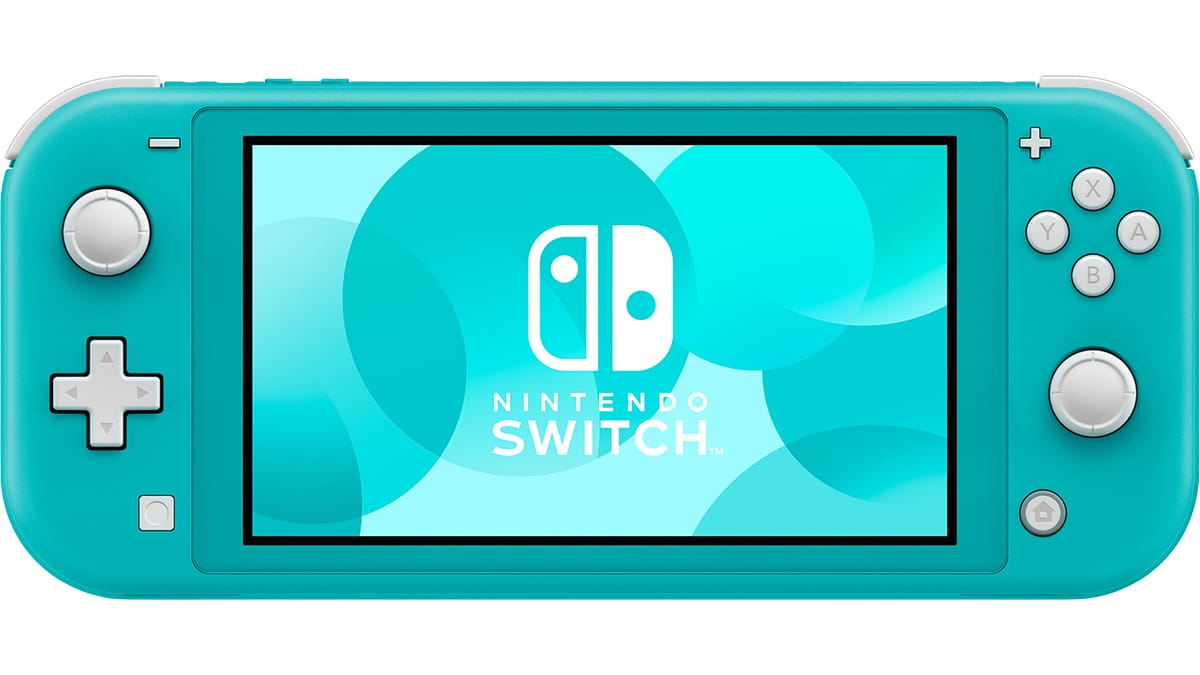
The Switch Lite is Nintendo’s acknowledgement that a large share of Switch owners never once plugged the thing into a television. Launched on 20 September 2019 at $199.99, it takes the hybrid Switch and deletes the hybrid half: there is no dock, no video output, no detachable Joy-Cons and no kickstand. What remains is a fixed, unibody handheld that runs nearly the entire Switch catalogue in your hands and nowhere else. That one design decision is the whole product, and whether it suits you depends entirely on whether you actually wanted a home console in the first place.
The hardware and its library
Inside sits the same Nvidia Tegra X1 that powers every Switch, here in the “Mariko” revision built on a 16nm process for better efficiency and heat. The CPU is a quad-core ARM Cortex-A57; the GPU is a 256-core Maxwell part; 4GB of LPDDR4 backs it up, with 32GB of eMMC storage (about 26GB usable) that you will want to expand with a microSD card up to 2TB. Because the Lite can never dock, it always runs at handheld clock speeds, so games that boosted their resolution on a TV simply render at their portable settings, which is how you would have played them here anyway. It keeps a capacitive touchscreen but loses the original Joy-Cons’ HD rumble and IR motion camera. The library is the real draw: this is a full Switch, so Breath of the Wild, Tears of the Kingdom, Super Mario Odyssey, Metroid Dread, Smash Bros. Ultimate and Animal Crossing: New Horizons all run. Demanding late ports like Tears of the Kingdom still show the same frame-rate dips you would get in handheld mode on any Switch. The asterisk is any title that needs detached Joy-Cons or TV play, such as 1-2-Switch or Ring Fit Adventure, which force you to buy Joy-Cons separately and defeat the point.
Homebrew, custom firmware and emulation
Here the Lite is genuinely harder to hack than a launch Switch, and buyers should know it. The Mariko chip patched the Fusee Gelee bootROM exploit that made early 2017-2018 units trivial to run Atmosphere on with nothing but a paperclip and a payload. On a Lite there is no software-only entry: custom firmware requires a hardware modchip, an SX Core, HWFLY or Picofly board soldered onto tiny points inside the console. That is a real, fiddly job, not a beginner afternoon, and it carries a permanent online-ban risk from Nintendo. Once glitched, Atmosphere behaves exactly as it does on any Switch, and the homebrew scene opens up. RetroArch runs well: NES, SNES, Genesis and GBA are effortless, PS1, PSP and Nintendo DS are dependable, and N64 is mostly there. GameCube and Wii through Dolphin are possible but selective, and plenty of games chug, so treat sixth-generation emulation as a bonus rather than a promise.
Screen, build and revisions
The 5.5-inch LCD keeps the same 1280×720 resolution as the original’s larger 6.2-inch panel, which makes it sharper at 267 ppi, though it is still LCD, so blacks look grey next to a Switch OLED. Two ergonomic wins stand out. First, the Lite finally has a proper d-pad in place of the original left Joy-Con’s four separate buttons, a real upgrade for fighting games and platformers. Second, at 275g it is noticeably lighter and steadier than the 398g original over long sessions, and its 3570mAh battery is rated for three to seven hours. The compromises are real too: Nintendo dropped the ambient-light sensor, so there is no auto-brightness, and the built-in analogue sticks use the same design that made “Joy-Con drift” infamous, except you cannot just swap a Joy-Con, so a drifting stick means opening the unit or mailing it in. There is effectively one hardware revision; the yellow, grey, turquoise, coral and later blue units, plus Pokemon and Animal Crossing special editions, are cosmetic only, all Mariko inside. No OLED Lite was ever made.
Collecting, price and who it is for
With the Switch 2 out since 2025, the Lite is now an end-of-generation machine, and, importantly, it does not play Switch 2 titles. That makes it a legacy buy rather than a future-proof one. On the used market in 2026 it typically runs roughly $120-160 depending on colour and condition, with sealed Pokemon Zacian and Zamazenta or Animal Crossing editions asking a collector premium. Buy one if you play exclusively in handheld, want the cheapest key to the enormous Switch back-catalogue, or need a second, kid-proof console for a household that already owns a full Switch. Skip it if you want to play on a TV, care about the newest Nintendo releases, or expect an easy modding project. Judged for what it is, a dedicated, pocketable way to play one of the best libraries in gaming, it does exactly one job and does it cleanly.
📐 Size & Pocketability
⚖️ Weight vs Other Handhelds
🔋 Real-World Battery Estimator
⭐ Emulation Performance
📊 View How This Score is Calculated
The Hardware Power Score is an absolute metric. Perfect emulation of difficult, modern consoles awards significantly more points than standard retro consoles.
- 15× Multiplier: Modern PC
- 12× Multiplier: Switch, PS3, Xbox 360
- 10× Multiplier: Wii U
- 8× Multiplier: PS2, GameCube, Wii, Xbox
- 5× Multiplier: Saturn, Dreamcast, PSP
- 3× Multiplier: N64, PS1
- 1× Multiplier: SNES, GBA
Gen 8 & PC
Generation 7
Generation 6
Generation 5
Handhelds & Retro
⚡ Performance Benchmarks
Where Nintendo Switch Lite NVIDIA Maxwell (GM20B, 256 CUDA cores) lands against the handhelds everyone knows. Every bar shares one scale, so longer genuinely means faster — add up to two rivals to compare.
CPU = Geekbench 6 multi-core · GPU = 3DMark Wild Life. Median real-world scores; every bar shares one scale — add up to two rivals to compare.
📋 Full Specifications
📺 Display
⚙️ Platform
💾 Memory
🕹️ Controls
📏 Body
🔋 Battery
⚖️ Verdict
✅ The Good
- Proper d-pad and a lighter 275g unibody make it more comfortable for long handheld play than the original
- Runs almost the entire Switch library, from Tears of the Kingdom to Smash Bros. Ultimate, for a $199.99 launch price
- Sharper 267 ppi screen than the original despite the same 720p resolution, thanks to the smaller 5.5-inch panel
- Cheapest entry point to the Switch back-catalogue and an easy second console for a household or for kids
❌ The Bad
- Handheld-only: no TV output, no kickstand, and no detachable Joy-Cons, so some games need extra hardware to play
- Non-removable analogue sticks share the drift-prone Joy-Con design, and fixing a drift means opening the console
- Much harder to mod than a launch Switch: the Mariko chip needs a soldered hardware modchip and it cannot play Switch 2 titles
📰 Latest News & Guides
The Ultimate Guide to ARMSX3: Android’s New PS3 Emulator, Competitor Comparisons, and Setup Tutorial
18/08/2026Pokémon Gold, Silver, and Crystal (Gen 2) Recomp Lands on Android
17/08/2026How to Play the Pokémon Red, Blue, or Yellow Recomp on Your Android, Windows, and Linux Devices
16/08/2026🔍 Similar Handhelds
Other handhelds that emulate up to Switch.