
🛒 Where to Buy
⚠️ Golden Rule of Retro Handhelds: Throw away the cheap MicroSD card that comes in the box — it will fail. And never use a high-wattage PD “Fast Charger” on these devices; it can damage the battery. Use a standard 5V/1.5A brick.
Device Overview: Retroid Pocket
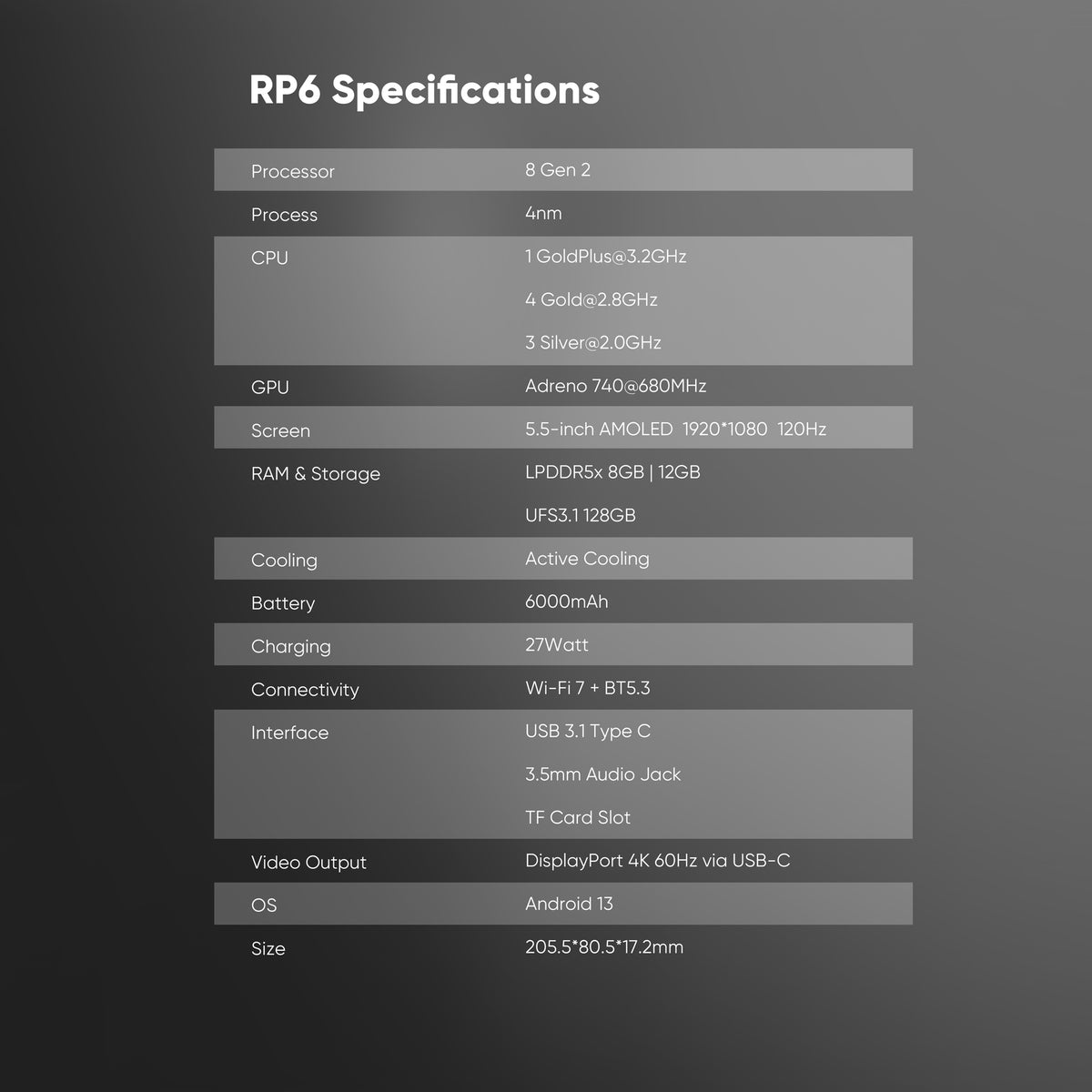
The Retroid Pocket is not one gadget but a family of Android emulation handhelds built by the Shenzhen outfit GoRetroid, and any honest catalog entry has to say that up front. The line started with the original Retroid Pocket around 2019 and the breakout Retroid Pocket 2 in September 2020, a US$84.99 horizontal box with a MediaTek MT6580, 1GB of RAM and a 4:3 640×480 screen. Six years later the same badge sits on the Retroid Pocket 6, a $229 machine with a Snapdragon 8 Gen 2, 8GB of LPDDR5x and a 120Hz 1080p AMOLED. What ties every Retroid Pocket together is a formula: Android on cheap-but-well-chosen silicon, physical controls that shame most phone clip-ons, and pricing that undercuts almost everyone. So when someone says “Retroid Pocket,” ask which one — the gap between the cheapest and the dearest is roughly the gap between a Nintendo DS and a PlayStation 2.
Emulation performance, generation by generation
These are ARM chips running Android, not x86 Windows PCs, so forget native PC gaming and think in terms of what each SoC can translate. The entry tier — the Unisoc Tiger T310 in the Retroid Pocket 2+ or the T618 in the Retroid Pocket 3 — comfortably runs everything up to and including PSP, Dreamcast, Saturn and most N64 through RetroArch cores and standalone apps like DuckStation and Flycast, but chokes on GameCube and PS2. The mid tier changed that: the MediaTek Dimensity 1100 in the Retroid Pocket 4 Pro and the Snapdragon 865 in the Retroid Pocket 5, Mini and Flip 2 handle the bulk of the GameCube and Wii library in Dolphin, plus a solid slice of PS2 in NetherSX2, though demanding PS2 titles still need per-game tuning. The Snapdragon 8 Gen 2 in the Retroid Pocket 6 is the current ceiling: near-universal GameCube and Wii, most PS2, comfortable 3DS in Citra-derived forks, and the first credible run at Switch through Ryujinx and Yuzu-fork builds — credible, not flawless. No Retroid Pocket is a Steam Deck, and none of them run Windows.
Screen, build and controls
Screens are where the line quietly grew up. Early models used mediocre IPS panels; the recent ones are genuinely good AMOLEDs — the Retroid Pocket 5, Flip 2 and 6 share a 5.5-inch 1920×1080 panel, the Mini squeezes a sharp 3.7-inch 1280×960 AMOLED into a tiny shell, and the vertical Retroid Pocket Classic uses a 3.92-inch 1240×1080 AMOLED for portrait-native NES, Game Boy and arcade play. Build is plastic but well-assembled, with weights ranging from truly pocketable minis to the chunkier 5.5-inch models. Connectivity is generous for the price: recent units carry a headphone jack, a microSD slot, and modern Wi-Fi and Bluetooth, and the Retroid Pocket 6 pairs a 6000mAh battery with 27W wired charging and Wi-Fi 7. Controls are the real selling point: recent Retroid Pocket units ship with Hall-effect analog sticks that resist the drift plaguing cheaper rivals, a proper cross d-pad, and clicky face buttons. Check per model, though — the Hall sticks and analog triggers arrived with the Retroid Pocket 4 generation, while earlier units like the Retroid Pocket 3 and 2S used conventional potentiometer sticks.
Software and setup
Every modern Retroid Pocket ships with stock Android — usually a slightly dated version such as Android 13 — plus GoRetroid’s own launcher and a bundle of emulators you are expected to point at your own legally-dumped ROMs. That stock experience works but is not tidy; the community reality is that most owners install a front end like Daijisho or ES-DE, or de-bloat the OS entirely. Because these are Android devices, the Linux custom-firmware scene that dominates cheaper handhelds — muOS, Knulli, ROCKNIX, ArkOS, Batocera — largely does not apply here, since those target Rockchip and Allwinner Linux boxes rather than Snapdragon Android units. What Retroid owners do instead is tune within Android: RetroArch cores, standalone emulators, per-title settings, and on some models community Android builds such as GammaOS. Setup is more hands-on than a locked console but far less painful than assembling a PC.
Price, value and who it is for
Value is the whole thesis. The Retroid Pocket line consistently delivers more emulation-per-dollar than the Anbernic, Ayn or AYANEO equivalents: roughly $150 buys a capable PS1, PSP and Dreamcast machine, around $199 to $229 buys GameCube-and-PS2 competence, and the Retroid Pocket 6 pushes into early Switch territory for $229 (recently nudged to $244). The trade-offs are just as consistent: middling stock software, an occasional QC lottery, shipping from China with the customs and warranty friction that implies, and a naming scheme that makes cross-shopping genuinely confusing. Buy a Retroid Pocket if you want the most capable Android emulation handheld for the money and you do not mind a little setup. Skip it if you want native modern PC games — get a Steam Deck — or a plug-and-play Linux retro box, where Anbernic still makes more sense. Just decide which Retroid Pocket first.
📐 Size & Pocketability
⚖️ Weight vs Other Handhelds
🔋 Real-World Battery Estimator
⭐ Emulation Performance
📊 View How This Score is Calculated
The Hardware Power Score is an absolute metric. Perfect emulation of difficult, modern consoles awards significantly more points than standard retro consoles.
- 15× Multiplier: Modern PC
- 12× Multiplier: Switch, PS3, Xbox 360
- 10× Multiplier: Wii U
- 8× Multiplier: PS2, GameCube, Wii, Xbox
- 5× Multiplier: Saturn, Dreamcast, PSP
- 3× Multiplier: N64, PS1
- 1× Multiplier: SNES, GBA
Generation 6
Generation 5
Handhelds & Retro
📋 Full Specifications
📺 Display
⚙️ Platform
💾 Memory
🕹️ Controls
📏 Body
🔋 Battery
⚖️ Verdict
✅ The Good
- Best emulation-per-dollar across the range, from ~$85 PS1-class units up to a $229 Snapdragon 8 Gen 2 flagship
- Hall-effect analog sticks on recent models resist the drift that plagues cheaper handhelds
- Recent AMOLED panels are genuinely good, including a 120Hz 1080p screen on the Retroid Pocket 6
- Full Android means RetroArch, standalone emulators, streaming apps and the Play Store, not a locked menu
❌ The Bad
- Confusing, sprawling lineup — one "Retroid Pocket" name spans a dozen models with wildly different capability
- Stock software is dated and cluttered; getting the best out of it means installing front ends or tweaking yourself
- Ships from China with the shipping-time, customs and warranty friction that implies, and QC can be a lottery
📰 Latest News & Guides
The Ultimate Guide to ARMSX3: Android’s New PS3 Emulator, Competitor Comparisons, and Setup Tutorial
18/08/2026Pokémon Gold, Silver, and Crystal (Gen 2) Recomp Lands on Android
17/08/2026How to Play the Pokémon Red, Blue, or Yellow Recomp on Your Android, Windows, and Linux Devices
16/08/2026🔍 Similar Handhelds
Other handhelds that emulate up to DS.