
🛒 Where to Buy
⚠️ Golden Rule of Retro Handhelds: Throw away the cheap MicroSD card that comes in the box — it will fail. And never use a high-wattage PD “Fast Charger” on these devices; it can damage the battery. Use a standard 5V/1.5A brick.
Device Overview: Miyoo Flip
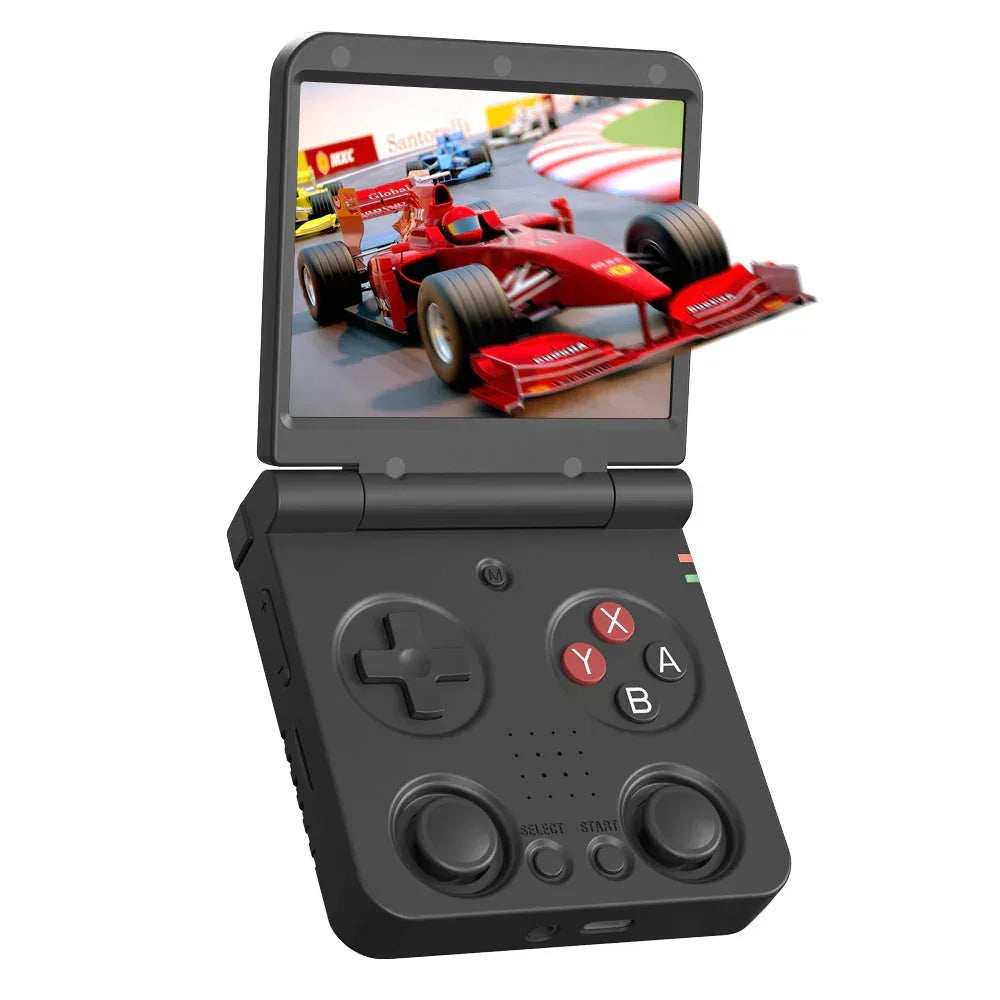
The Miyoo Flip is Miyoo’s attempt to rebuild the Game Boy Advance SP for the emulation era, and the resemblance is deliberate right down to the hinge. It is a clamshell that folds shut to protect a 3.5-inch screen, which immediately separates it from the exposed-slab designs that crowd the sub-$100 shelf. Inside sits a Rockchip RK3566, the same quad-core Cortex-A55 chip Anbernic and Powkiddy have leaned on for years, paired with a single gigabyte of RAM. That combination tells you exactly where this device lives: it is a capable 8-bit-through-PS1 machine wrapped in the most pocketable body Miyoo has shipped, not a horsepower play. The V2 revision, which is what most buyers now receive, exists mainly to fix the wobbly hinge that dogged early units.
Emulation performance, generation by generation
The RK3566 is a known quantity, and the Flip behaves exactly as that chip does everywhere else. Everything from the NES and Master System up through the SNES, Genesis, PC Engine and the full Game Boy line runs at full speed with headroom to spare, and PlayStation 1 is effectively solved: the overwhelming majority of the library holds 60fps through DuckStation or PCSX ReARMed. Above that line the picture gets honest. Nintendo 64 is playable rather than dependable, with Mupen64Plus running Mario 64 and the friendlier titles fine while it stumbles on the demanding ones, and there is no per-game guarantee. Dreamcast through Flycast is similar, plenty of games are enjoyable and some drop frames. PSP via PPSSPP handles lighter 2D and mid-tier 3D fare but chokes on the heavy hitters, and the 640×480 panel forces upscaling compromises. Saturn is mostly a struggle beyond simple 2D titles. Nintendo DS runs on DraStic or melonDS, though squeezing two screens onto a 4:3 panel is always fiddly. GameCube, Wii, PS2, 3DS and Switch are simply not on the menu; this is an ARM handheld drawing a couple of watts, and no firmware changes that.
Screen, build and controls
The 3.5-inch IPS panel runs at 640×480 in a native 4:3 ratio, which is the right shape for retro content and gives clean scaling for older systems. It is sharp and colourful, and the one real complaint is modest peak brightness that makes bright outdoor play difficult. The clamshell body weighs around 165 grams and genuinely disappears into a pocket, and the folding design means you are not carrying an exposed screen loose in a bag. The controls are more complete than the SP inspiration suggests: a well-regarded d-pad, four face buttons, four shoulder buttons, and two analog sticks set into the lower half of the shell. Those sticks are the compromise. They sit deeply inset so the lid can close, which makes them awkward to reach and tiring across longer 3D sessions, and they are conventional potentiometer sticks rather than Hall-effect, so drift is a long-term possibility. For the 2D libraries this device is built around, none of that matters; for N64 and PSP it is a standing reminder of what you are working with. Connectivity covers dual-band Wi-Fi, Bluetooth 5.2, a 3.5mm headphone jack, stereo speakers, dual microSD slots and video output for a TV.
Software and setup
Out of the box the Flip runs Miyoo’s own Linux front-end, which is serviceable and can be switched into an EmulationStation layout, but the device’s real strength is that the community adopted it. MinUI is the standout choice here; its stripped-back, no-nonsense menus suit the pick-up-and-play spirit of a clamshell perfectly, and it is the firmware most owners end up living on. Beyond that, muOS and ROCKNIX both target the RK3566, GarlicOS 2 has a build, and Knulli support has been arriving, at times only as an alpha. Setup follows the usual Miyoo pattern of imaging a microSD card, and the dual-slot design lets you keep the stock card intact while you experiment on a second. This is not a plug-in-and-forget appliance; getting the best out of it means a little card-swapping and reading, which is par for the course at this price.
Price, value and who it is for
The Flip lands at roughly $85 to $90 depending on retailer and whether a card is bundled. That is a small premium over open slab handhelds using the same chip, and you are paying it for the form factor rather than the silicon: the clamshell, the hinge and the pocketability are the product. If your library stops at PS1, and especially if you value something you can snap shut and drop into a jacket, the Flip is one of the most likable small handhelds you can buy. If you want reliable N64, PSP or anything heavier, or you refuse to live with cramped non-Hall inset sticks, a slab device with a stronger chip is the smarter purchase. Bought for what it actually is, a modern GBA SP that plays almost everything up to the original PlayStation, it is easy to recommend.
📐 Size & Pocketability
⚖️ Weight vs Other Handhelds
🔋 Real-World Battery Estimator
⭐ Emulation Performance
📊 View How This Score is Calculated
The Hardware Power Score is an absolute metric. Perfect emulation of difficult, modern consoles awards significantly more points than standard retro consoles.
- 15× Multiplier: Modern PC
- 12× Multiplier: Switch, PS3, Xbox 360
- 10× Multiplier: Wii U
- 8× Multiplier: PS2, GameCube, Wii, Xbox
- 5× Multiplier: Saturn, Dreamcast, PSP
- 3× Multiplier: N64, PS1
- 1× Multiplier: SNES, GBA
Generation 6
Generation 5
Handhelds & Retro
⚡ Performance Benchmarks
Where Miyoo Flip ARM Mali-G52 MP2 (2EE) lands against the handhelds everyone knows. Every bar shares one scale, so longer genuinely means faster — add up to two rivals to compare.
CPU = Geekbench 6 multi-core · GPU = 3DMark Wild Life. Median real-world scores; every bar shares one scale — add up to two rivals to compare.
📋 Full Specifications
📺 Display
⚙️ Platform
💾 Memory
🕹️ Controls
📏 Body
🔋 Battery
⚖️ Verdict
✅ The Good
- Genuinely pocketable clamshell that folds shut to protect the screen, a rarity below $100
- Full-speed emulation of everything from 8-bit systems through PlayStation 1 on a sharp 4:3 640×480 IPS panel
- Strong community firmware support (MinUI, muOS, ROCKNIX, GarlicOS 2) plus dual microSD slots for safe experimenting
- V2 revision fixes the flimsy early hinge, and the d-pad and four shoulder buttons feel good
❌ The Bad
- Inset analog sticks are cramped and tiring, and being potentiometer rather than Hall-effect they risk drift over time
- RK3566 and 1GB RAM cap it at PS1; N64, Dreamcast and PSP are inconsistent, and GameCube/PS2 and up are off the table
- Low peak brightness makes outdoor play difficult
📰 Latest News & Guides
The Ultimate Guide to ARMSX3: Android’s New PS3 Emulator, Competitor Comparisons, and Setup Tutorial
18/08/2026Pokémon Gold, Silver, and Crystal (Gen 2) Recomp Lands on Android
17/08/2026How to Play the Pokémon Red, Blue, or Yellow Recomp on Your Android, Windows, and Linux Devices
16/08/2026🔍 Similar Handhelds
Other handhelds that emulate up to PSP.