
🛒 Where to Buy
⚠️ Golden Rule of Retro Handhelds: Throw away the cheap MicroSD card that comes in the box — it will fail. And never use a high-wattage PD “Fast Charger” on these devices; it can damage the battery. Use a standard 5V/1.5A brick.
Device Overview: Zotac Zone 2
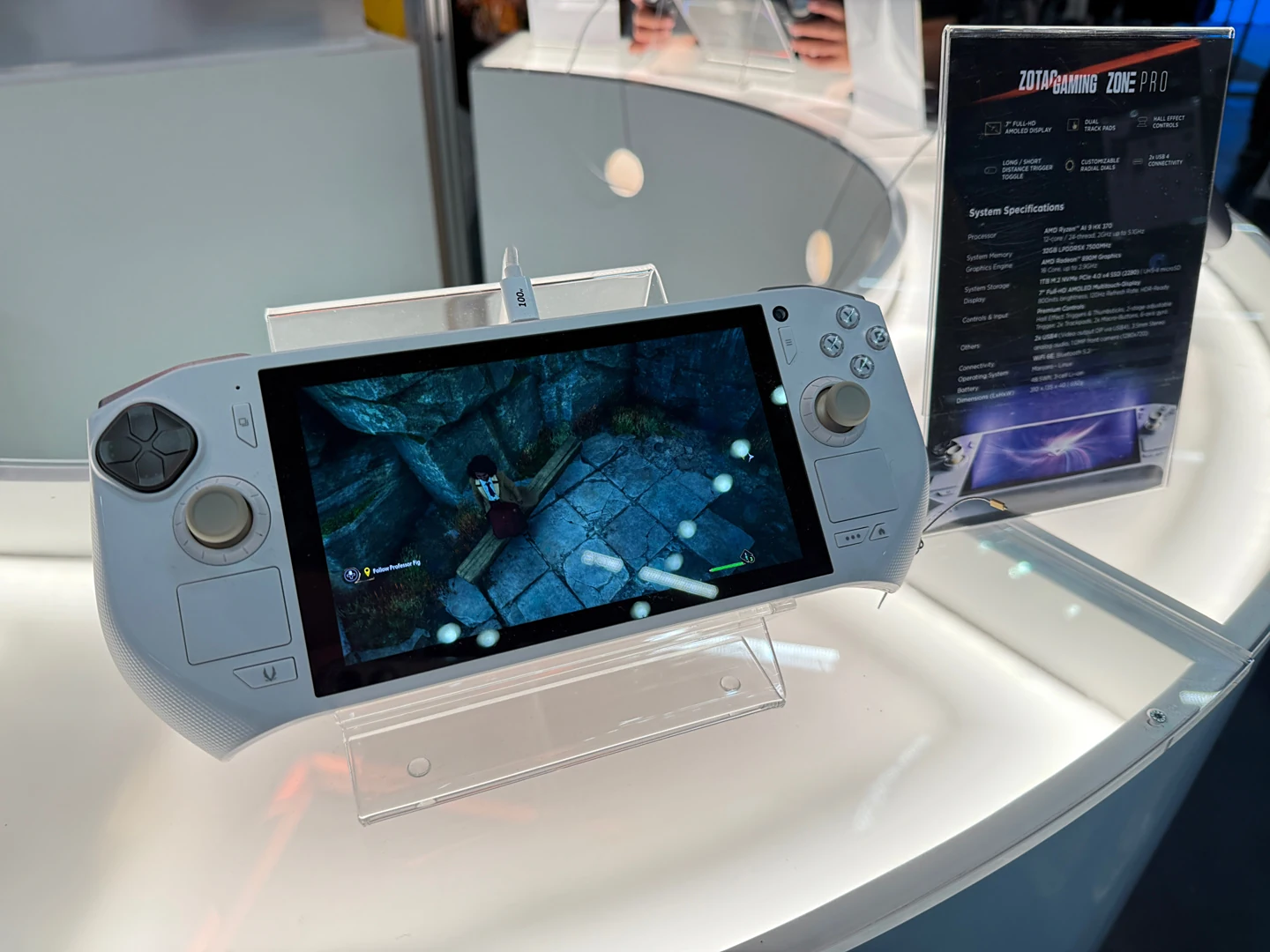
First, a housekeeping note that matters more than usual here: the device everyone called the “Zone 2” is the same machine Zotac now officially badges the Zone Pro. It was shown as a working prototype at CES, Computex and Gamescom 2025, targeted an October 2025 launch, and then slipped that window. As of writing it is not yet on shelves at a confirmed retail price, so treat the price section below as a rumor with a paper trail, not a receipt. Everything else here is drawn from Zotac’s own hands-on units and the spec sheet they’ve shown repeatedly, which has stayed consistent across three trade shows.
The hardware is genuinely high-end. Inside is AMD’s Ryzen AI 9 HX 370 (Strix Point): twelve Zen 5 cores in a 4+8 split, the 16-CU Radeon 890M on RDNA 3.5, paired with 32GB of LPDDR5X-7500 and a user-replaceable 1TB M.2 2280 PCIe 4.0 SSD. That puts it a clear tier above the Steam Deck OLED’s Van Gogh chip and a step beyond the ROG Ally X’s Z1 Extreme, landing in the same conversation as the Legion Go’s top configuration. The 890M is the fastest integrated GPU in any shipping handheld class, but temper the excitement: at the 15-30W you actually run portably, it behaves like a fast 1080p-ish iGPU, not a discrete card. The headroom shows up most when you feed it the AMOLED panel’s native res sparingly and lean on FSR.
Emulation performance, generation by generation
This is where the HX 370 earns its keep. Everything through the sixth generation is a non-event: PS1, N64, Dreamcast, PSP, GameCube and Wii all run at full speed with upscaling to spare, and you can leave Dolphin’s internal resolution cranked without thinking about it. PS2 via PCSX2 is effortless across the library. The seventh generation is where you start making the usual case-by-case decisions, but the silicon is up to it: most of the Switch catalog runs well on Ryujinx-derived forks, Wii U through Cemu is strong, and PS3 via RPCS3 is realistic for a large slice of games provided you accept that the heaviest titles will need per-game patches and a watchful eye on the 48.5Wh battery, which this chip drains quickly under emulation load. The honest rough edge is the same one every x86 handheld hits: Xbox 360 via Xenia. Xenia is Windows-only and still inconsistent, so it’s both the hardest target and the one that clashes most with this device’s default OS (more on that below). Treat 360 as a hobby project, not a feature.
Screen, build and controls
The panel is the headline and it holds up: a 7-inch 1920×1080 AMOLED at 120Hz, roughly 800 nits, with touch. It’s a real upgrade over the Steam Deck OLED’s 800p screen, sharper and faster, and AMOLED black levels make a visible difference in dark games. The trade-off is weight and battery. At 692g it’s heavy in the hand, in Legion Go territory rather than Steam Deck, and the 48.5Wh cell is small for a chip this hungry, so expect short sessions at high wattage.
The control scheme is the most ambitious part of the design. You get drift-resistant Hall-effect sticks, dual micro-trackpads flanking the screen Steam Deck-style, dual-stage Hall-effect triggers, a pair of physical radial dials ringing the sticks with ratcheting feedback (mapped to brightness and RGB by default), M1/M2 rear macro buttons, a six-axis gyro and a built-in kickstand. The trackpads plus gyro make mouse-driven games and desktop navigation genuinely workable, which matters given what the software is.
Software and setup
Here is the plot twist that separates the Zone Pro from every “Windows handheld” assumption: it does not ship with Windows. Zotac dropped Windows 11 and ships a custom immutable Manjaro Linux build with KDE Plasma 6, co-developed with the Manjaro team and built around Steam, complete with a Big Picture link on the desktop. This is a deliberate move toward the Steam Deck’s SteamOS model, and it’s the right one for a couch device: you avoid the Windows handheld tax entirely, no fighting the desktop, no taskbar roulette, no driver babysitting. Because it’s still an ordinary x86 PC, you can wipe it and install Windows 11 yourself if you must, and the two USB4 ports make a dock-and-desktop workflow trivial. But understand the consequence: Linux is excellent for Steam and for the emulators that have native builds (EmulationStation, RetroArch, Dolphin, PCSX2, RPCS3 all run), while anti-cheat-gated multiplayer games and Windows-only tools like Xenia become the friction points. Playnite is a Windows front-end, so on the stock OS you’ll be living in Steam plus an EmuDeck-style Linux setup rather than the Playnite-centric flow you’d build on a Windows unit.
Price, value and who it’s for
No confirmed USD price exists yet. The original Zone launched at $799, and chatter around the Pro has clustered near the $1,000 mark, which would undercut a maxed Legion Go but sit well above a Steam Deck OLED. If it lands there, this is for the buyer who specifically wants the 890M’s ceiling, the 120Hz 1080p AMOLED, and a Linux-first experience without building it themselves. It is not for someone who needs Windows-only games, wants long unplugged battery life, or wants a light handheld. Until Zotac confirms price and ships it, treat the Zone 2 / Zone Pro as a strong, distinctive design that still has to clear the last hurdle every handheld faces: actually arriving.
📐 Size & Pocketability
🔋 Real-World Battery Estimator
⭐ Emulation Performance
📊 View How This Score is Calculated
The Hardware Power Score is an absolute metric. Perfect emulation of difficult, modern consoles awards significantly more points than standard retro consoles.
- 15× Multiplier: Modern PC
- 12× Multiplier: Switch, PS3, Xbox 360
- 10× Multiplier: Wii U
- 8× Multiplier: PS2, GameCube, Wii, Xbox
- 5× Multiplier: Saturn, Dreamcast, PSP
- 3× Multiplier: N64, PS1
- 1× Multiplier: SNES, GBA
Gen 8 & PC
Generation 7
Generation 6
Generation 5
Handhelds & Retro
⚡ Performance Benchmarks
Where Zotac Zone 2 AMD Radeon 890M lands against the handhelds everyone knows. Every bar shares one scale, so longer genuinely means faster — add up to two rivals to compare.
CPU = Geekbench 6 multi-core · GPU = 3DMark Wild Life. Median real-world scores; every bar shares one scale — add up to two rivals to compare.
📋 Full Specifications
📺 Display
⚙️ Platform
💾 Memory
🕹️ Controls
📏 Body
🔋 Battery
⚖️ Verdict
✅ The Good
- Ryzen AI 9 HX 370 with Radeon 890M is the top performance tier in its class, flattening everything through PS2/GC/Wii and making PS3/Switch realistic
- Sharp 7-inch 1080p 120Hz AMOLED touch panel, a clear step up from the Steam Deck OLED's 800p screen
- Ships with a Steam-centric immutable Manjaro Linux + KDE Plasma 6 build, sidestepping the Windows handheld tax out of the box
- Rich, repairable control set: Hall sticks and dual-stage Hall triggers, dual trackpads, ratcheting radial dials, M1/M2 rear macros, gyro, kickstand, plus a user-replaceable 1TB SSD and two USB4 ports
❌ The Bad
- Heavy at 692g with a small 48.5Wh battery, so high-wattage and emulation sessions drain fast
- Linux-first OS means Windows-only targets (Xenia for Xbox 360, some anti-cheat multiplayer titles) need a Windows reinstall or are off the table
- Still not actually released at a confirmed price; renamed to Zone Pro and already missed its October 2025 target window
📰 Latest News & Guides
The Ultimate Guide to ARMSX3: Android’s New PS3 Emulator, Competitor Comparisons, and Setup Tutorial
18/08/2026Pokémon Gold, Silver, and Crystal (Gen 2) Recomp Lands on Android
17/08/2026How to Play the Pokémon Red, Blue, or Yellow Recomp on Your Android, Windows, and Linux Devices
16/08/2026🔍 Similar Handhelds
Other handhelds that emulate up to Modern.