
🛒 Where to Buy
⚠️ Golden Rule of Retro Handhelds: Throw away the cheap MicroSD card that comes in the box — it will fail. And never use a high-wattage PD “Fast Charger” on these devices; it can damage the battery. Use a standard 5V/1.5A brick.
Device Overview: Data Frog SF2000
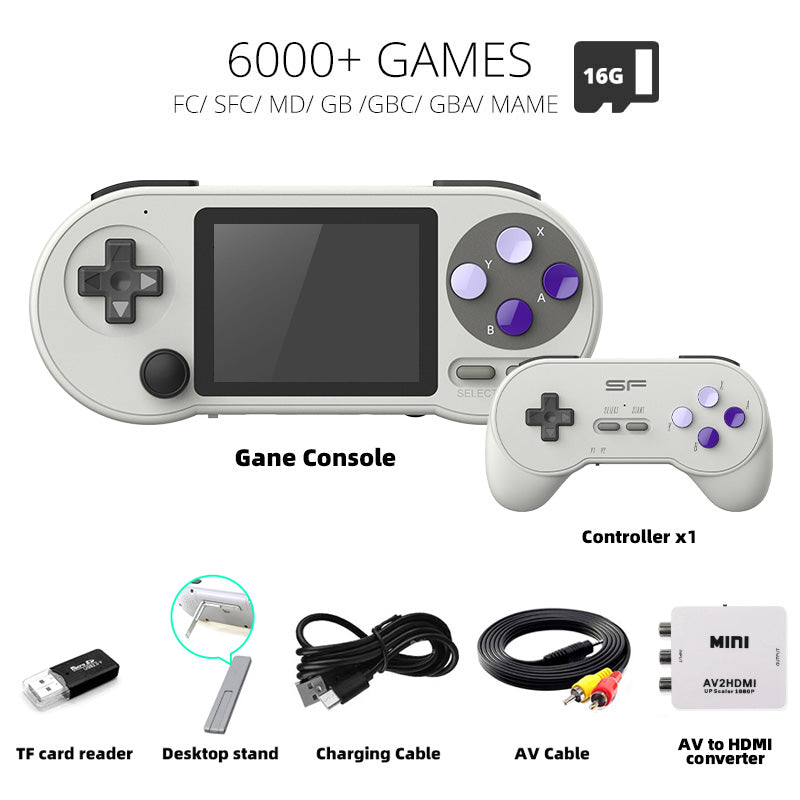
The SF2000 is the handheld you grab at the checkout impulse-buy rack, not the one you research for a month. It is a roughly $20-to-$25 plastic slab shaped like an SNES controller with a screen bolted on top, sold under a dozen rebadged names on AliExpress and Amazon (LACOS, ZYGLO, Panw, and Data Frog’s own store). It ships with a microSD card stuffed with around 6,000 games and a promise that you plug it in and play. That promise is mostly true, which is the surprising part. The dishonest part is everything written on the box.
Positioned against the handhelds people actually obsess over, the SF2000 is not in the same conversation as a Miyoo Mini. The Miyoo costs two to three times as much, runs OnionOS, has a sharper 640×480 panel, and treats you like a hobbyist. Budget Powkiddy units land somewhere between. The SF2000’s pitch is purely price and convenience: it is the cheapest thing that boots into a usable game menu out of the bag, and it is a genuinely good gift for a kid or a nostalgic relative who will never touch a settings screen.
Emulation performance, generation by generation
Here is the honest ceiling, and it is low. The SoC is a HiChip/HCSEMI B210: a single-core MIPS24KEc running at 918 MHz with a Mali-400 GPU and 128 MB of DDR2. Note “single-core.” The box and most listings scream “SL4350 dual-core 1GHz” and “1280×720” – both fiction. Treat every spec printed on the packaging as marketing, not measurement.
Within that budget, 8-bit and early 16-bit is where it lives. NES, Game Boy, Game Boy Color, Sega Master System, and Genesis/Mega Drive run well and are the reason to own this thing. Arcade (a curated CPS/MAME-ish set) is largely fine for the lighter boards. SNES is where it gets shaky – simpler titles are playable, but anything leaning on the SuperFX or Mode 7 effects, or just demanding cartridges, drops frames or chugs. GBA is the same story: it runs, but it is hit-or-miss, with heavier games stuttering. Anything past that – PS1, N64, Dreamcast, PSP, Saturn, DS – is simply not here, and no wishing changes that. This is an 8/16-bit and arcade machine, full stop.
The preloaded library is the usual grey-area dump: thousands of “games” padded with duplicates, hacks, and bootleg garbage, plus a fair number of titles that crash or run badly. The real working list is a fraction of the headline number. There is also an accuracy tax – the screen stretches everything to fill the panel, ignoring original aspect ratios, so circles are eggs unless you intervene.
Screen, build and controls
The display is a roughly 3-inch IPS panel at a true 320×240, 4:3. It is small and low-resolution, but IPS means viewing angles and color are better than the price suggests, and for chunky pixel-art sprites it is perfectly legible. The panel is actually a 240×320 screen rotated 90 degrees, which is why output is stretched rather than pixel-perfect.
The build is exactly what $20 buys: light, hollow, creaky plastic with a single tinny speaker and no headphone jack. The face buttons are an SNES homage and the d-pad is a clone of the SNES cross – serviceable, but quality control is a coin flip. Some units have a d-pad that fumbles diagonals, and stuck buttons are a known complaint. The upside: enthusiasts have shown you can drop a genuine SNES d-pad and membrane straight in.
The modding scene
This is the SF2000’s secret second life, and it is wildly out of proportion to a $20 toy. A dedicated community – centered on Von Millhausen’s reference site and tools like FrogTool and Tadpole – has reverse-engineered the firmware to a remarkable degree. With Tadpole you can wipe the junk ROM lists, add your own clean ROM sets, replace box art, install UI themes, back up saves, and patch a nasty stock bootloader bug.
That bootloader bug matters: a quirk in the bios folder’s FAT layout black-screens the device when the entry count hits certain multiples of four, and naive modding triggers it. The first thing any modder does is apply the bugfix. Beyond housekeeping, an experimental “multicore” firmware hijacks the existing emulators to add systems the device never shipped with – Atari 2600, PC-Engine, MAME2000, Sega 32X, even Doom and Cave Story – with mixed results (it notably does not add GBA). There is no true open custom firmware yet; the BIOS stays closed. But the risk-versus-effort math is forgiving: the device is microSD-based, so a bad flash usually means re-imaging a card, not a dead unit, and recovery steps are well documented.
Price, value and who it’s for
At around $20-25, the SF2000 is priced like a novelty and mostly delivers like one – with an asterisk. Buy it if you want a cheap, cheerful, plug-and-play box for NES/Genesis/Game Boy nostalgia, a gift for someone who will never mod anything, or a guilt-free tinker toy whose modding scene is half the fun. Skip it if you care about SNES and GBA running reliably, want decent audio or a headphone jack, or expect anything beyond 16-bit. For that, save up for a Miyoo Mini. The SF2000 is honest about exactly one thing: it is the floor, and the floor is more interesting than it has any right to be.
📐 Size & Pocketability
🔋 Real-World Battery Estimator
⭐ Emulation Performance
📊 View How This Score is Calculated
The Hardware Power Score is an absolute metric. Perfect emulation of difficult, modern consoles awards significantly more points than standard retro consoles.
- 15× Multiplier: Modern PC
- 12× Multiplier: Switch, PS3, Xbox 360
- 10× Multiplier: Wii U
- 8× Multiplier: PS2, GameCube, Wii, Xbox
- 5× Multiplier: Saturn, Dreamcast, PSP
- 3× Multiplier: N64, PS1
- 1× Multiplier: SNES, GBA
Handhelds & Retro
📋 Full Specifications
📺 Display
⚙️ Platform
💾 Memory
🕹️ Controls
📏 Body
🔋 Battery
⚖️ Verdict
✅ The Good
- Dirt-cheap (~$20-25) and genuinely plug-and-play out of the box, ideal as a gift or impulse buy
- Runs NES, Game Boy/GBC, Master System, Genesis and lighter arcade titles well; an IPS panel at this price is a real perk
- Deep, well-documented modding scene (FrogTool/Tadpole) lets you clean up ROM lists, add your own sets, swap box art and theme the UI
- User-replaceable 18650 battery and a swappable SNES-style d-pad/membrane make it easy to repair and upgrade
❌ The Bad
- Box specs are fiction – it's a single-core MIPS B210, not the advertised "dual-core 1GHz / 1280×720"; SNES and GBA are hit-or-miss and nothing past 16-bit runs
- Cheap hollow build with inconsistent quality control – mushy or diagonal-dropping d-pads and stuck buttons are common, plus a single tinny speaker and no headphone jack
- Stock firmware ships a junk-padded ~6,000-game list and a real bootloader bug that black-screens the device, so safe modding requires applying the bugfix first
📰 Latest News & Guides
The Ultimate Guide to ARMSX3: Android’s New PS3 Emulator, Competitor Comparisons, and Setup Tutorial
18/08/2026Pokémon Gold, Silver, and Crystal (Gen 2) Recomp Lands on Android
17/08/2026How to Play the Pokémon Red, Blue, or Yellow Recomp on Your Android, Windows, and Linux Devices
16/08/2026🔍 Similar Handhelds
Other handhelds that emulate up to GBA.