
🛒 Where to Buy
⚠️ Golden Rule of Retro Handhelds: Throw away the cheap MicroSD card that comes in the box — it will fail. And never use a high-wattage PD “Fast Charger” on these devices; it can damage the battery. Use a standard 5V/1.5A brick.
Device Overview: Anbernic RG-353M
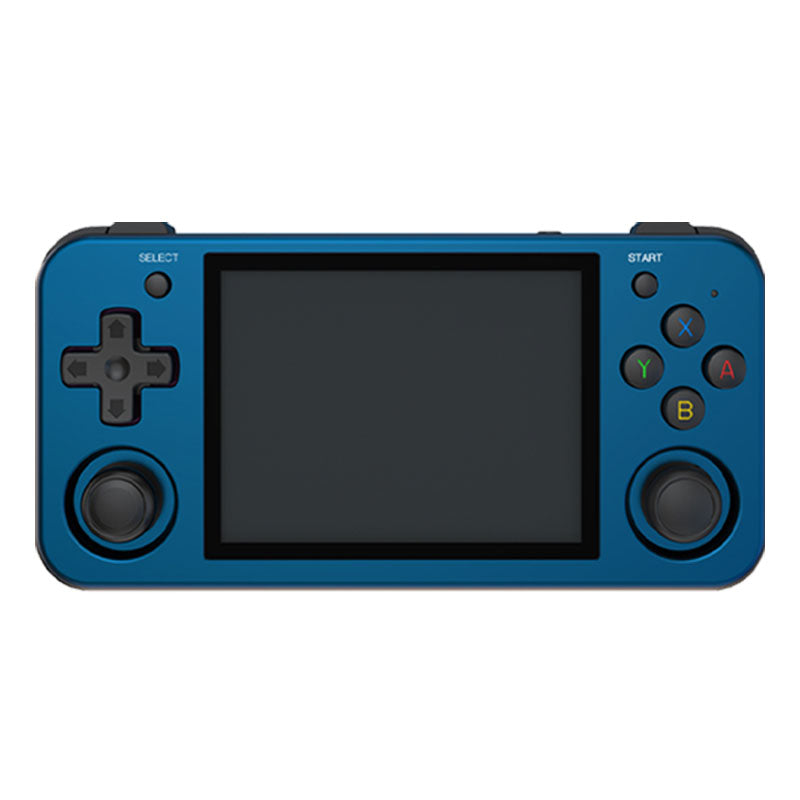
The Anbernic RG-353M is the metal-bodied top of the RG353 family, and it exists to answer one question: how nice can a Rockchip RK3566 handheld feel before the chip inside becomes the limit? Its CNC-machined aluminium shell, dual Hall-effect analogue sticks and a sharp 3.5-inch 4:3 screen put it a clear tier above the plastic RG353P and RG353V in the hand. The silicon, however, is identical across all three, so the RG-353M is a device you buy for build quality and ergonomics rather than raw horsepower. At roughly $137 at launch it was one of the pricier sub-4-inch emulation handhelds Anbernic had shipped, and it earned that price with materials, not benchmarks.
Emulation performance, generation by generation
The RK3566 is a quad-core Cortex-A55 clocked to 1.8GHz with a Mali-G52 GPU and 2GB of LPDDR4. That is a low-power ARM SoC, not a pocket PC, and its ceiling reflects that. Everything through the 16-bit era runs without thinking: NES, SNES, Mega Drive, PC Engine, Game Boy, Game Boy Color and Game Boy Advance all hold full speed with room for shaders. PlayStation 1 is fully playable across the library. Nintendo DS runs well on DraStic, and the second screen maps neatly onto the touch panel. This is the RG-353M’s comfort zone, and it nails it.
Above that, results get honest. Nintendo 64 is a mixed bag on RK3566: Mario Kart 64 and Super Mario 64 are fine, while Conker, Perfect Dark and other late first-party titles drop frames or need per-game tweaks. Dreamcast via Flycast is mostly playable at the screen’s native 640×480, with occasional dips in busier scenes. PSP on PPSSPP handles 2D and lighter 3D games such as Lumines and the Ys titles comfortably, but demanding polygon-pushers like God of War: Chains of Olympus need frameskip and lowered settings. Sega Saturn is the usual wall; 2D-heavy titles play under Beetle Saturn but the system taxes this chip hard. GameCube, PS2, Wii and Switch are out of reach, full stop.
Screen, build and controls
The 3.5-inch IPS panel runs 640×480 at a 4:3 aspect ratio, which is the single best reason to pick this device. That resolution and shape map cleanly onto fourth- and fifth-generation systems, so SNES, PS1 and GBA fill the screen with no awkward letterboxing or scaling artefacts. Colours are strong, viewing angles are wide, and the panel is multi-touch for the Android side and DS input. The aluminium chassis is the headline: it feels dense and cold, genuinely premium, at 232 grams. Anbernic left the side rails plastic so the Wi-Fi and Bluetooth antennas are not choked by the metal, a sensible compromise. The dual analogue sticks use Hall-effect magnetic sensors, so they should not develop the drift that plagues potentiometer sticks. The shoulder buttons are stacked L1/L2 and R1/R2 pairs rather than true analogue triggers, which is the one ergonomic weak spot; they work, but they are shallow. Connectivity is generous for the class: dual-band 2.4/5GHz Wi-Fi, Bluetooth 4.2, a mini-HDMI output for TV play, USB-C, and dual microSD slots so you can keep a system card and a games card separate.
Software and setup
Out of the box the RG-353M is a dual-boot device with Android 11 on the internal 32GB eMMC 5.1 and a Linux emulation build on a bundled card. Android is technically capable and lets you run Dreamcast or PSP standalone apps or stream, but driving it through a 3.5-inch touch screen is fiddly, and most owners live on the Linux side. The stock Linux front end is serviceable, but the real reason to own an RK3566 handheld is the custom-firmware scene. ArkOS is the reliable, no-drama choice; JELOS and its successor ROCKNIX offer a slicker EmulationStation experience with good out-of-the-box scraping; and Batocera is there if you want its ecosystem. You flash these to a second card, so stock Android stays untouched. Note that muOS, Knulli and OnionOS target other chips (the Allwinner H700 and the Miyoo Mini), so they are not options here, and EmuDeck is a PC tool with no bearing on this device.
Price, value and who it is for
The RG-353M launched around $137 and has hovered near that ever since, which puts it in an awkward spot: it costs more than the plastic RG353P and RG353V that run the exact same games at the exact same speed. You are paying purely for the aluminium shell, the Hall sticks and the hand-feel. If those matter to you, it is one of the nicest small horizontal handhelds ever made and a lovely PS1-and-below machine with a perfectly matched 4:3 screen. If you only care about what runs, the cheaper 353 variants or a newer H700 device deliver the same or better value. Buy the RG-353M if you want a metal, pocketable retro player and accept that its ceiling sits around Dreamcast and lighter PSP; skip it if you were hoping for GameCube, Saturn or anything more modern.
📐 Size & Pocketability
⚖️ Weight vs Other Handhelds
🔋 Real-World Battery Estimator
⭐ Emulation Performance
📊 View How This Score is Calculated
The Hardware Power Score is an absolute metric. Perfect emulation of difficult, modern consoles awards significantly more points than standard retro consoles.
- 15× Multiplier: Modern PC
- 12× Multiplier: Switch, PS3, Xbox 360
- 10× Multiplier: Wii U
- 8× Multiplier: PS2, GameCube, Wii, Xbox
- 5× Multiplier: Saturn, Dreamcast, PSP
- 3× Multiplier: N64, PS1
- 1× Multiplier: SNES, GBA
Generation 6
Generation 5
Handhelds & Retro
⚡ Performance Benchmarks
Where Anbernic RG-353M ARM Mali-G52 MP2 (2EE) lands against the handhelds everyone knows. Every bar shares one scale, so longer genuinely means faster — add up to two rivals to compare.
CPU = Geekbench 6 multi-core · GPU = 3DMark Wild Life. Median real-world scores; every bar shares one scale — add up to two rivals to compare.
📋 Full Specifications
📺 Display
⚙️ Platform
💾 Memory
🕹️ Controls
📏 Body
🔋 Battery
⚖️ Verdict
✅ The Good
- CNC-machined aluminium shell at 232g feels genuinely premium and is arguably the best-built RK3566 handheld released.
- The 3.5-inch 640×480 IPS panel is a perfect 4:3 fit for SNES, PS1 and GBA, with no ugly scaling or letterboxing.
- Dual Hall-effect analogue sticks resist the drift that kills cheaper potentiometer sticks over time.
- Deep custom-firmware support (ArkOS, JELOS/ROCKNIX, Batocera) on top of stock dual-boot Android 11 and Linux.
❌ The Bad
- The RK3566 caps out around Dreamcast and lighter PSP; N64 and Saturn are patchy and GameCube/PS2 are impossible.
- Priced noticeably higher than the plastic RG353P/RG353V that run identical games at identical speed.
- Stacked shoulder buttons instead of true analogue triggers, and Android is awkward on the small touch screen.
📰 Latest News & Guides
The Ultimate Guide to ARMSX3: Android’s New PS3 Emulator, Competitor Comparisons, and Setup Tutorial
18/08/2026Pokémon Gold, Silver, and Crystal (Gen 2) Recomp Lands on Android
17/08/2026How to Play the Pokémon Red, Blue, or Yellow Recomp on Your Android, Windows, and Linux Devices
16/08/2026🔍 Similar Handhelds
Other handhelds that emulate up to PSP.