
🛒 Where to Buy
⚠️ Golden Rule of Retro Handhelds: Throw away the cheap MicroSD card that comes in the box — it will fail. And never use a high-wattage PD “Fast Charger” on these devices; it can damage the battery. Use a standard 5V/1.5A brick.
Device Overview: Sony PSP-2000
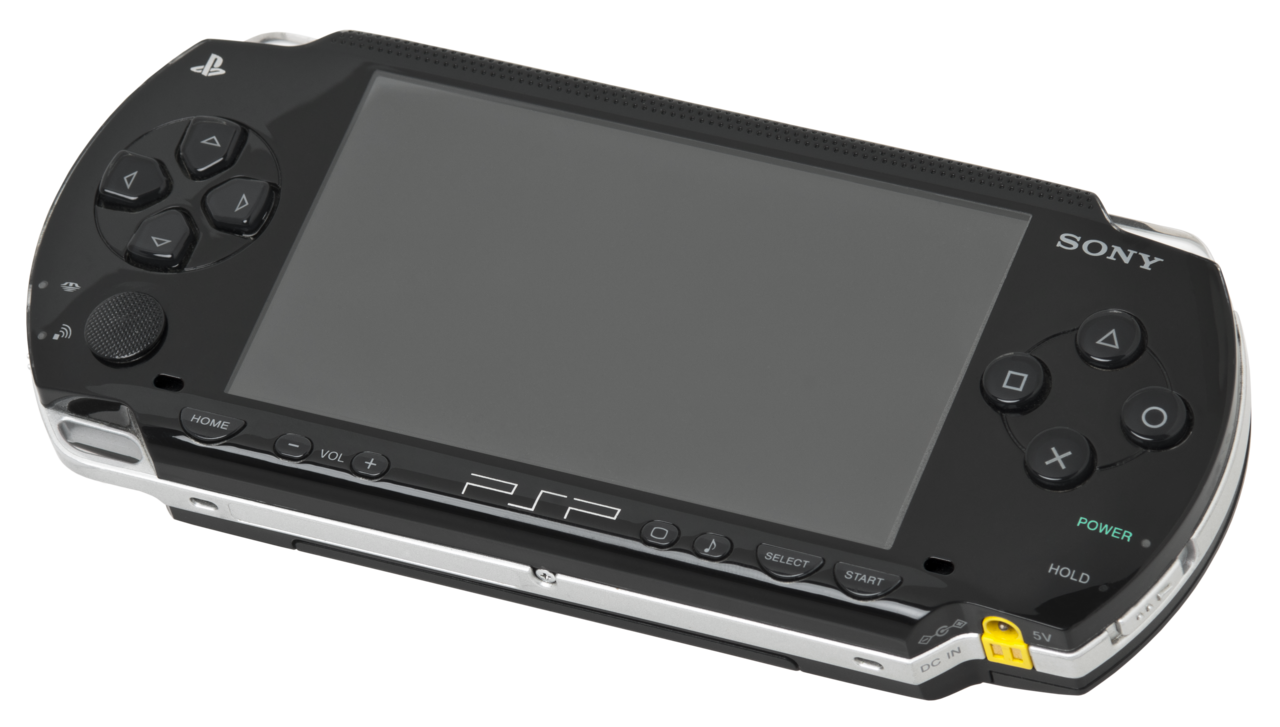
The Sony PSP-2000, sold as the “Slim & Lite,” is the 2007 middle child of the PlayStation Portable line and, for most people who still buy one, the one to get. Sony took the 2004 original, shaved roughly a third off its thickness, dropped it from 280 g to 189 g, and quietly doubled the internal RAM. It kept the UMD optical drive, the 4.3-inch widescreen and the single sliding analog nub, so nothing about how it plays changed — but everything about carrying it did. At $169.99 on launch it slotted in below the aging original and became the volume seller of the family.
The hardware and its library
Under the shell sit two MIPS R4000-derived cores — a main CPU and a “Media Engine” for audio and video decode — clocked up to 333 MHz, though plenty of games ran at 222 MHz to protect battery life. The graphics core carries 2 MB of embedded DRAM and pushed effects that genuinely embarrassed the Nintendo DS: real-time lighting, full 3D worlds and FMV that looked like a PlayStation 2 game had been poured into your pocket. The one meaningful internal change over the PSP-1000 is memory: 64 MB against the original’s 32 MB. That extra RAM is why the 2000 loads faster, runs the web browser without choking and handles PS1 Classics more gracefully. Storage is Memory Stick PRO Duo; retail games ship on UMD, a proprietary mini-optical disc that whirs, seeks and drinks battery.
The library is the reason to own one. Monster Hunter Freedom Unite alone carried the platform in Japan; Metal Gear Solid: Peace Walker, both God of War entries, Crisis Core: Final Fantasy VII, Persona 3 Portable, the Grand Theft Auto Stories games, Daxter, Patapon, LocoRoco and Lumines are console-grade work, not phone filler. Roughly 1,300 UMD titles exist, and a large slice of them still hold up.
Homebrew, custom firmware and emulation
The PSP is one of the most thoroughly cracked handhelds ever made, and the 2000 sits at the center of that story. Early motherboards were opened with a Pandora Battery and a Magic Memory Stick that forced the console into service mode; Sony later shipped the TA-88v3 board to patch that route. It no longer matters much, because modern permanent custom firmware — 6.61 Infinity by Total_Noob — installs from software and survives reboots on every PSP-2000 regardless of board. On top of it you run PRO CFW or the current ARK-4, which launch homebrew and ISOs straight off the Memory Stick and retire the UMD drive entirely. (Adrenaline, often mentioned in the same breath, is a Vita-only project that boots a PSP environment on newer hardware; on the PSP itself the scene is PRO, ARK and Infinity.)
Be realistic about the ceiling: this is PlayStation-1-class silicon, not a pocket PC. It comfortably runs NES, Master System, Game Gear, PC Engine, Genesis (PicoDrive), SNES (Snes9x TYL and catsfc) and Game Boy Advance (gpSP) at or near full speed, and PS1 games play beautifully through POPS or homebrew loaders. Nintendo 64 via Daedalus X64 is a partial, game-by-game affair with compromises. Nintendo DS, Saturn, Dreamcast, PS2 and GameCube are out of reach — do not buy a PSP expecting them.
Screen, build and revisions
The 4.3-inch TFT runs 480×272 and is brighter than the launch panel, though fast motion can show a faint ghosting that some owners find distracting. Controls are of their era: a D-pad, four face buttons, two shoulder triggers and a single analog nub — no second stick, no clickable sticks and nothing resembling Hall-effect sensors, which simply did not exist in 2007 handhelds. The 2000 added a video-out port (composite as standard, component for games) that the original lacked, and dropped the original’s infrared port. The trade for the slim body was a smaller 1200 mAh battery, so expect roughly four to six hours of play. Within the family the ladder runs PSP-1000 (Fat, 2004), PSP-2000 (Slim, 2007), PSP-3000 (Brite, 2008, a richer screen but with a visible interlacing artifact and harder to hack), PSP Go (2009, no UMD, 16 GB built in) and the stripped PSP-E1000 Street (2011, no Wi-Fi). The 2000 is the enthusiast pick: slim, fully hackable and with TV-out.
Collecting, price and who it is for
Expect roughly $60 to $120 used depending on condition and whether it is boxed. Inspect for dead pixels, nub drift, a working UMD door and — importantly — battery health, since most original cells are long dead and a fresh replacement transforms the thing. Buy a PSP-2000 if you want the native PSP catalog on real hardware, a tidy emulation box that tops out around PS1 and GBA, and TV-out, all for pocket money. Skip it if you need dual-screen DS games, modern ergonomics or a second analog stick. For what it is — a 2007 handheld that a decade of hackers refused to let die — it remains a genuinely satisfying thing to own.
📐 Size & Pocketability
⚖️ Weight vs Other Handhelds
🔋 Real-World Battery Estimator
⭐ Emulation Performance
📊 View How This Score is Calculated
The Hardware Power Score is an absolute metric. Perfect emulation of difficult, modern consoles awards significantly more points than standard retro consoles.
- 15× Multiplier: Modern PC
- 12× Multiplier: Switch, PS3, Xbox 360
- 10× Multiplier: Wii U
- 8× Multiplier: PS2, GameCube, Wii, Xbox
- 5× Multiplier: Saturn, Dreamcast, PSP
- 3× Multiplier: N64, PS1
- 1× Multiplier: SNES, GBA
Gen 8 & PC
Generation 5
Handhelds & Retro
📋 Full Specifications
📺 Display
⚙️ Platform
💾 Memory
🕹️ Controls
📏 Body
🔋 Battery
⚖️ Verdict
✅ The Good
- Doubled 64 MB of RAM over the PSP-1000 means faster loads, a usable web browser and smoother PS1 Classics playback
- One of the deepest handheld libraries ever, from Monster Hunter and Peace Walker to God of War and Crisis Core across roughly 1,300 UMD titles
- Permanent custom firmware (6.61 Infinity, PRO, ARK-4) installs from software and runs homebrew and ISOs off a Memory Stick, retiring the UMD drive
- Slim 189 g body plus added TV-out make it the most practical PSP for both handheld and couch play
❌ The Bad
- A single analog nub with no second stick and no Hall-effect controls makes modern twin-stick games and emulators awkward
- Emulation realistically tops out at PS1 and GBA; N64 is spotty and DS, Saturn, Dreamcast and up are off the table
- The smaller 1200 mAh battery and long-dead original cells mean most units need a replacement battery for decent runtime
📰 Latest News & Guides
The Ultimate Guide to ARMSX3: Android’s New PS3 Emulator, Competitor Comparisons, and Setup Tutorial
18/08/2026Pokémon Gold, Silver, and Crystal (Gen 2) Recomp Lands on Android
17/08/2026How to Play the Pokémon Red, Blue, or Yellow Recomp on Your Android, Windows, and Linux Devices
16/08/2026🔍 Similar Handhelds
Other handhelds that emulate up to PSP.