
🛒 Where to Buy
⚠️ Golden Rule of Retro Handhelds: Throw away the cheap MicroSD card that comes in the box — it will fail. And never use a high-wattage PD “Fast Charger” on these devices; it can damage the battery. Use a standard 5V/1.5A brick.
Device Overview: Sony PSP-3000
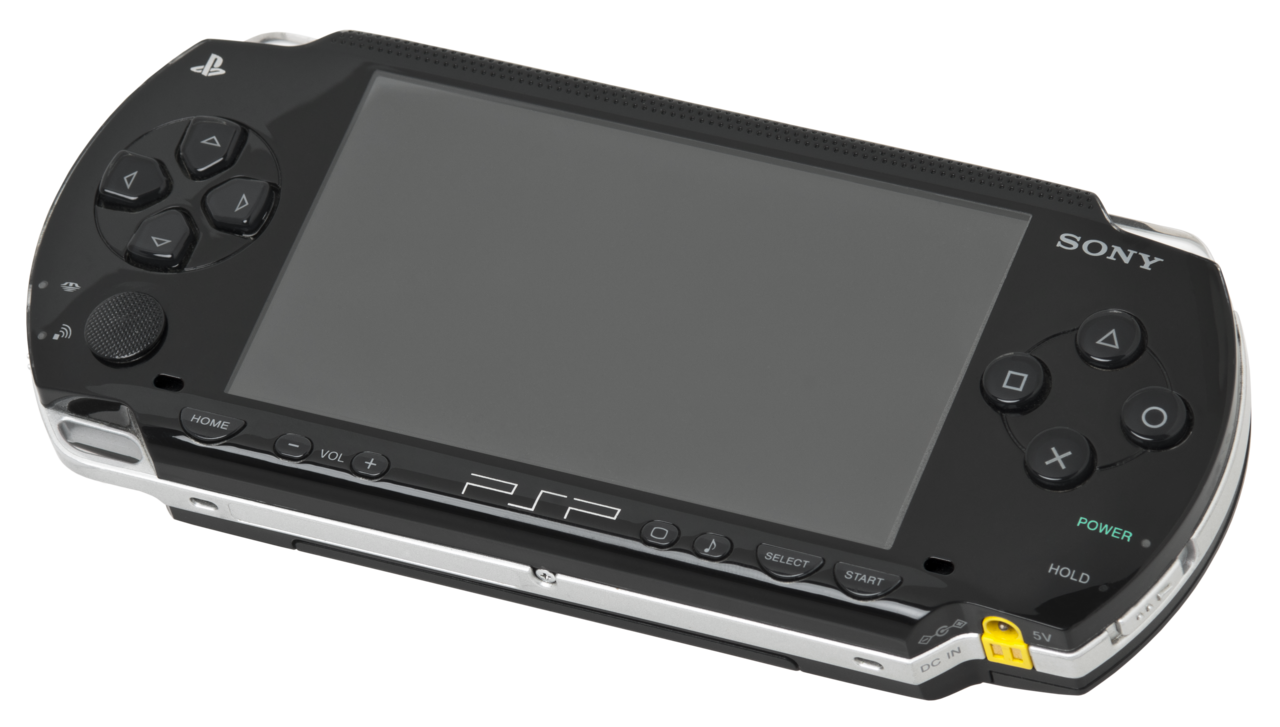
The PSP-3000 is the third and final major revision of Sony’s first handheld, launched in October 2008 at $169 for the Core Pack and bundled into a $199 Ratchet & Clank Entertainment Pack. By this point the PSP was a mature machine: the same UMD drive, the same single analog nub and the same 480×272 widescreen as the PSP-2000, now with a retooled LCD and a built-in microphone. Sony was not trying to out-sell the DS. It was selling the only pocket device of its era that ran near-PS2-scale 3D, played movies off tiny optical discs and doubled as a music and video player. Judged today, the 3000 is the model most people should buy for an authentic PSP experience, with one asterisk hanging over its screen.
The hardware and its library
Inside sits Sony’s CXD2962GG, a system-on-chip built around two MIPS R4000-derived cores, a main CPU and a “Media Engine,” that scale from 1 to 333 MHz, paired with 64 MB of main RAM, double the 32 MB of the launch PSP-1000. That was a generous budget for 2008 handhelds and it shows in the catalog. God of War: Chains of Olympus and Ghost of Sparta push real character models and lighting; Grand Theft Auto: Liberty City Stories and Vice City Stories are full open-world ports; Daxter, Jeanne d’Arc, Crisis Core: Final Fantasy VII, Lumines, Patapon and the Monster Hunter Freedom titles are the reason people still collect the platform. Games ship on UMD, an optical format unique to PSP, and saves plus downloads live on a Memory Stick Pro Duo, a proprietary card that is now the single most annoying part to source cheaply.
Homebrew, custom firmware and emulation
The 3000 was Sony’s answer to the hacked 1000 and 2000. Its motherboard patched the bootrom exploit that the Pandora Battery relied on, so for a while it wore the “unhackable” label. It never really was. Userland cracks, first the ChickHEN TIFF exploit and then a chain of game-save exploits, opened the door, and the scene now consolidates on ARK-4, the actively maintained custom firmware running on a 6.61 base. The genuinely new development is cIPL: recent tooling installs a custom bootloader on the 3000 for truly permanent CFW with brick protection, replacing the older, now-deprecated Infinity persistence hack. Once on CFW you get ISO loading from the card, plugins and the emulator stack, but be realistic about that stack. This is a 333 MHz MIPS chip, not a Windows box. NES, Game Boy/Color, Master System, Game Gear, Genesis and PC Engine run at full speed; SNES through Snes9x TYL/Euphoria is mostly playable but stutters in Super FX and audio-heavy games; GBA via gpSP is full speed with some frameskip. PlayStation 1 is the standout because it is barely emulation at all: POPS runs signed EBOOTs converted from your own discs almost natively. N64 through DaedalusX64 is a curiosity that handles a short whitelist of titles and gives up on the rest.
Screen, build and revisions
The 3000’s headline feature is its LCD. Sony fitted a panel with roughly five times the contrast of the 2000, a wider color gamut, an anti-reflective coating for outdoor use and half the pixel response time, on paper the best screen any PSP shipped with. In practice it carries a defect the community argued over for years: a visible “interlacing” or scanline pattern, worst on scrolling text and high-contrast edges. It is a byproduct of the panel’s subpixel layout, not true interlacing, and Sony confirmed it was normal with no fix planned. Some units and some eyes never notice it; others find it maddening, which is exactly why a share of enthusiasts still prefer the 2000’s screen. Physically the 3000 reuses the slim 2000 shell, about 189 g with the 1200 mAh battery and 169 x 71 x 19 mm, with a slightly recessed d-pad, a relocated logo and the new mic. Controls are one analog nub, a d-pad, four face buttons and non-analog L/R triggers; there is no second stick and, being 2008 hardware, nothing resembling Hall-effect sensors. Battery life lands around four to six hours depending on brightness and Wi-Fi.
Collecting, price and who it is for
Used prices sit roughly in the $70 to $140 band depending on condition, color and whether a charger and card are included; boxed limited-edition colors run higher. Watch for a dead analog nub, a swollen battery and yellowed piano-black shells. Buy a 3000 if you want the definitive stock PSP with the brightest screen and can tolerate the scanline quirk, or if you specifically intend to run ARK-4 and treat it as a pocket PS1 and 8/16-bit machine. If the screen artifact bothers you, the PSP-2000 is the alternative, while the PSP Go trades the UMD drive for internal flash and a smaller display. For most buyers in 2026, a CFW’d PSP-3000 with a large Memory Stick is one of the better-value retro handhelds you can own.
📐 Size & Pocketability
⚖️ Weight vs Other Handhelds
🔋 Real-World Battery Estimator
⭐ Emulation Performance
📊 View How This Score is Calculated
The Hardware Power Score is an absolute metric. Perfect emulation of difficult, modern consoles awards significantly more points than standard retro consoles.
- 15× Multiplier: Modern PC
- 12× Multiplier: Switch, PS3, Xbox 360
- 10× Multiplier: Wii U
- 8× Multiplier: PS2, GameCube, Wii, Xbox
- 5× Multiplier: Saturn, Dreamcast, PSP
- 3× Multiplier: N64, PS1
- 1× Multiplier: SNES, GBA
Gen 8 & PC
Generation 5
Handhelds & Retro
📋 Full Specifications
📺 Display
⚙️ Platform
💾 Memory
🕹️ Controls
📏 Body
🔋 Battery
⚖️ Verdict
✅ The Good
- Best PSP screen on paper: roughly 5x the contrast of the PSP-2000, a wider color gamut and an anti-reflective coating that makes it the most usable PSP outdoors
- Fully hackable today; ARK-4 with permanent cIPL turns it into an excellent native PS1 and 8/16-bit emulation handheld
- Strong first-party library (God of War, Crisis Core, GTA, Monster Hunter) running on a capable 64 MB / 333 MHz platform
- Slim 189 g body with a built-in microphone and a realistic four-to-six-hour battery life
❌ The Bad
- The notorious "interlacing"/scanline artifact on the LCD, most visible on scrolling and high-contrast content, which Sony openly declined to fix
- Single analog nub, no second stick and non-analog shoulder triggers, dated even against its own generation's dual-stick console ports
- Locked to proprietary UMD discs and Memory Stick Pro Duo cards, both increasingly expensive to source
📰 Latest News & Guides
The Ultimate Guide to ARMSX3: Android’s New PS3 Emulator, Competitor Comparisons, and Setup Tutorial
18/08/2026Pokémon Gold, Silver, and Crystal (Gen 2) Recomp Lands on Android
17/08/2026How to Play the Pokémon Red, Blue, or Yellow Recomp on Your Android, Windows, and Linux Devices
16/08/2026🔍 Similar Handhelds
Other handhelds that emulate up to PSP.