
🛒 Where to Buy
⚠️ Golden Rule of Retro Handhelds: Throw away the cheap MicroSD card that comes in the box — it will fail. And never use a high-wattage PD “Fast Charger” on these devices; it can damage the battery. Use a standard 5V/1.5A brick.
Device Overview: Dingoo A320
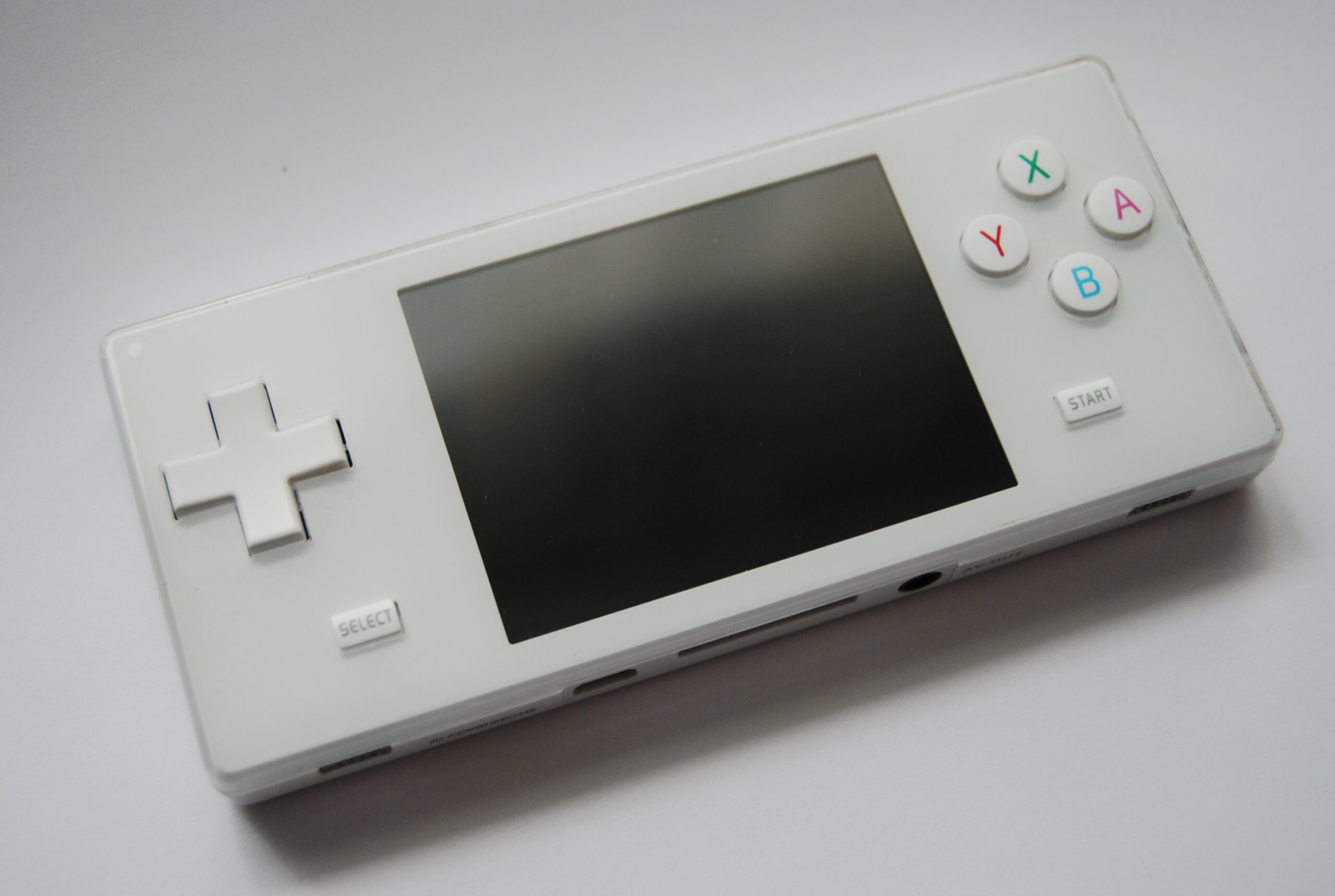
The Dingoo A320 is the handheld that turned “cheap Chinese emulator” into a hobby rather than a punchline. Launched in February 2009 at $99.99, it arrived as a squat candy-bar slab from Shenzhen’s Dingoo Digital, sold in the West mostly through import shops like Chinavasion under names such as “Micro Game Station.” What made it matter was not the bundled software but the silicon: an Ingenic JZ4732, a MIPS-architecture chip from the JZ47xx XBurst family, which a Linux hacker community pried open within months of launch. Treat the A320 as a museum piece with a pulse – an underpowered but genuinely open little machine that seeded the entire modern retro-handheld scene.
Emulation performance, generation by generation
This is a single-core MIPS device clocked around 336 MHz with 32 MB of RAM and no 3D GPU whatsoever, so calibrate expectations to 8- and 16-bit, not PlayStation. NES, Game Boy and Game Boy Color run at full speed with room to spare – gnuboy and FCEUX never break a sweat, and Master System and Game Gear via SMS Plus are equally trivial. Sega Genesis/Mega Drive is the sweet spot: PicoDrive and the native DrMD-style core hold 60 fps across almost the whole library, though the Sega CD and 32X add-ons are effectively off-limits. SNES is where the ceiling shows: PocketSNES and snes9x ports handle the bread-and-butter catalog fine, but Super FX and heavy SA-1 games like Star Fox and Yoshi’s Island stutter or need frameskip. Game Boy Advance is playable through gpSP, though demanding titles want a slight frameskip and the overclock. PC Engine via Temper and Neo Geo via GnGeo are solid, and CPS1/CPS2 arcade runs both natively and through MAME4ALL ports. PlayStation is the honest wall – psx4all exists under Dingux but is a slideshow on most 3D games; N64, Dreamcast and PSP were never on the table. Anything past 1994-era polygons is simply not what this chip does.
Screen, build and controls
The 2.8-inch TFT panel runs a native 320×240 at roughly 143 ppi – an integer-friendly canvas for 16-bit consoles that mostly output 256×224 or 320×240, so pixels land crisply with little scaling ugliness. Colours are decent for a 2009 budget LCD; viewing angles and brightness are not. The shell weighs a pocketable 110 g and measures 125 x 55.5 x 14 mm, its glossy plastic body scratching and smudging on sight. Controls are the weak spot: a passable d-pad, four face buttons, and L1/R1 shoulders that feel mushy and cramped. There is no analog stick at all – no nub, certainly nothing Hall-effect – which is a second reason, on top of raw horsepower, that PS1 and N64 were dead ends. A 1700 mAh Li-ion cell delivers roughly seven hours, respectable for the class and the era.
Software and setup
Out of the box the A320 boots Dingoo’s proprietary firmware, a menu built on the uC/OS-II real-time kernel with bundled emulators plus music, video, an e-book reader, a voice recorder and even an FM tuner – a genuine portable media player, not just a games box, complete with composite TV-out over the included AV cable. Storage is 2 GB or 4 GB of internal NAND depending on the SKU, expandable through the miniSD slot, and files copy over as a plain USB mass-storage drive. The stock OS is clumsy and its emulators are opaque forks, so the reason enthusiasts still talk about this device is Dingux: a community Linux distribution released in mid-2009 that dual-boots from a miniSD card (note: miniSD, not microSD – you may need an adapter). Dingux, and later the more polished OpenDingux, unlocked the real open-source emulator ports, SDL games, ScummVM and homebrew, and let you overclock the CPU toward 400 MHz. Setup is dated by 2026 standards – you are flashing bootloaders and copying folders, not browsing an app store – but the payoff is a fully hackable handheld.
Price, value and who it is for
At $99 in 2009 the A320 undercut a PSP while doing something Sony’s machine could not: run whatever you fed it, legally grey ROMs and all. In 2026 that math is gone. Dingoo Digital is defunct, so these only exist on the used market, typically $40 to $90 for a tested unit – and for that money a modern $60 Anbernic or Miyoo Mini running muOS or OnionOS annihilates it on screen quality, controls, storage and emulation ceiling. So who is it for now? Collectors and retro-handheld historians who want the device that proved an open Linux handheld could sell, tinkerers who enjoy the Dingux flashing ritual, and anyone chasing 8- and 16-bit nostalgia on the exact hardware that started the wave. As a daily driver it is obsolete; as an artifact, it is one of the most important budget handhelds ever made.
📐 Size & Pocketability
⚖️ Weight vs Other Handhelds
🔋 Real-World Battery Estimator
⭐ Emulation Performance
📊 View How This Score is Calculated
The Hardware Power Score is an absolute metric. Perfect emulation of difficult, modern consoles awards significantly more points than standard retro consoles.
- 15× Multiplier: Modern PC
- 12× Multiplier: Switch, PS3, Xbox 360
- 10× Multiplier: Wii U
- 8× Multiplier: PS2, GameCube, Wii, Xbox
- 5× Multiplier: Saturn, Dreamcast, PSP
- 3× Multiplier: N64, PS1
- 1× Multiplier: SNES, GBA
Generation 5
Handhelds & Retro
📋 Full Specifications
📺 Display
⚙️ Platform
💾 Memory
🕹️ Controls
📏 Body
🔋 Battery
⚖️ Verdict
✅ The Good
- Fully open to Dingux and OpenDingux Linux, giving it real open-source emulator ports (gpSP, PicoDrive, PocketSNES) and a genuinely hackable platform.
- Native 320×240 on a 2.8-inch panel is a clean integer match for 16-bit systems, so NES, SNES and Genesis pixels look crisp with minimal scaling.
- Strong 8- and 16-bit performance: full-speed Genesis, NES and Game Boy plus most SNES, with roughly seven hours from the 1700 mAh battery.
- More than a games box – bundled music, video, FM radio, voice recorder and composite TV-out in a pocketable 110 g shell.
❌ The Bad
- Weak single-core MIPS JZ4732 with just 32 MB RAM and no 3D GPU: PS1 is a slideshow and N64, PSP and Dreamcast are impossible.
- Cramped, mushy controls with no analog stick of any kind, wrapped in a glossy plastic shell that scratches easily.
- Discontinued 2009 dead-brand hardware with no support, used-market-only availability, and modern $60 handhelds that outclass it on nearly every axis.
📰 Latest News & Guides
The Ultimate Guide to ARMSX3: Android’s New PS3 Emulator, Competitor Comparisons, and Setup Tutorial
18/08/2026Pokémon Gold, Silver, and Crystal (Gen 2) Recomp Lands on Android
17/08/2026How to Play the Pokémon Red, Blue, or Yellow Recomp on Your Android, Windows, and Linux Devices
16/08/2026🔍 Similar Handhelds
Other handhelds that emulate up to GBA.