
🛒 Where to Buy
⚠️ Golden Rule of Retro Handhelds: Throw away the cheap MicroSD card that comes in the box — it will fail. And never use a high-wattage PD “Fast Charger” on these devices; it can damage the battery. Use a standard 5V/1.5A brick.
Device Overview: Sony PlayStation Vita
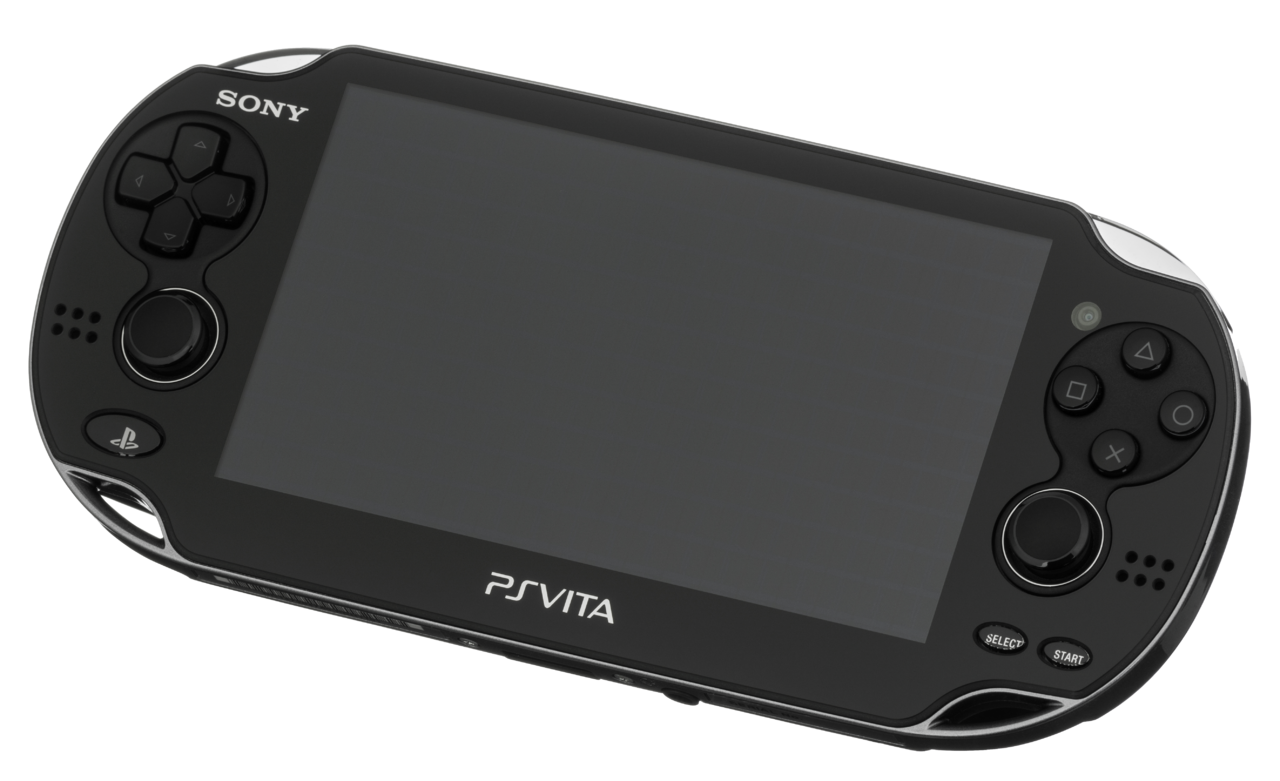
The Sony PlayStation Vita is the most powerful dedicated handheld Sony ever shipped, and the last one it ever will. It reached Japan on December 17, 2011 and the West in February 2012, priced at $249.99 for the Wi-Fi unit and $299.99 for the 3G-equipped version. On paper it was a small miracle for its era: console-grade 3D on a five-inch screen you hold in two hands. In practice it was a machine Sony half-abandoned within three years, undone by a proprietary memory-card format, a thin Western third-party lineup, and a smartphone market that swallowed the casual-portable audience whole. What it left behind is a cult device with a strange, excellent library and, thanks to a fully cracked-open homebrew scene, one of the better retro machines you can carry.
The hardware and its library
Under the hood sits a quad-core ARM Cortex-A9 MPCore CPU paired with a quad-core PowerVR SGX543MP4+ GPU, 512MB of system RAM and a separate 128MB of VRAM. In 2011 that was flagship-tablet silicon, and it showed: Uncharted: Golden Abyss, Killzone Mercenary and WipEout 2048 looked like nothing else in your pocket. The Vita was also Sony’s first handheld with two real analog sticks, which is the single most important detail for anyone playing modern-style games or emulating consoles that assume twin sticks. The native catalog is where the Vita earns its devotion, not through the blockbusters Sony wanted but through Persona 4 Golden (still the definitive version), Gravity Rush, Tearaway, the Danganronpa games, and an enormous late-life flood of Japanese RPGs and indies. It also doubles as a first-class player for the PSP and PS1 back catalog bought through PlayStation Network. The system runs Sony’s LiveArea interface, a bubble-and-panel launcher that is slick to look at but sluggish to navigate, and it stores everything on a single proprietary card slot rather than SD.
Homebrew, custom firmware and emulation
The Vita’s second life is entirely down to hacker TheFloW and the wider community. HENkaku, delivered through the h-encore/h-encore2 exploit and the taiHEN plugin framework, jailbreaks any Vita on firmware up to 3.74. Pair it with Enso and the hack becomes permanent, surviving every reboot with no PC required. This is the cleanest console jailbreak of its generation, and the toolchain around it is mature: VitaShell for file management, PKGj for grabbing content, and Autoplugin to wire up taiHEN modules without editing config files by hand.
Two things matter for retro players. First, Adrenaline: it boots the Vita’s built-in, Sony-written PSP emulator into a full PSP 6.61 custom firmware, so PSP and PS1 titles run at effectively native speed with save states, fast-forward and shaders. That is not flaky software emulation, it is the real PSP hardware emulation Sony already shipped, unlocked. Second, RetroArch runs natively on the Vita and comfortably handles NES, SNES, Genesis, TurboGrafx-16, Game Boy/GBC/GBA and Neo Geo. Push past that and the ceiling appears fast: PS1 is better left to Adrenaline, N64 and Sega Saturn are compatibility gambles, and DS, Dreamcast, GameCube or PSP-through-RetroArch are out of reach. One frequent confusion is worth clearing up, too: Vita3K is an emulator OF the Vita that runs on PC and Android, not something that runs on the device itself.
Screen, build and revisions
There are two hardware generations. The original PCH-1000 has a 5-inch 960×544 OLED panel that still looks gorgeous, with deep blacks and punchy color, and a dense, slightly premium feel at 260g. The later PCH-2000 (“Slim,” 2013 to 2014) swapped OLED for an LCD, which most people count as a real downgrade in contrast, but made the body 20% thinner and 15% lighter (219g), added roughly two hours of battery life, and baked in 1GB of internal storage. Both share the 2210mAh battery, the front capacitive touchscreen, the rear touchpad, six-axis motion and front/rear cameras. Battery life is modest either way, around 3 to 5 hours on the OLED model and 4 to 6 on the LCD. There was also the PlayStation TV (Vita TV), a small non-portable box that outputs Vita and PSP games to a television.
Collecting, price and who it is for
Sony ended production in 2019 and shut down most first-party support, so everything here is used-market. Expect roughly $120 to $180 for a working PCH-1000 or PCH-2000 in decent shape, more for boxed or limited-edition shells, and brace for the Vita’s original sin: the proprietary memory cards are slow, capped at 64GB officially, and were absurdly overpriced when new. The saving grace is the SD2Vita adapter, which lets a cheap microSD card pose as Vita storage once the system is hacked, so budget for one. Choose the OLED PCH-1000 if the screen is your priority, or the LCD PCH-2000 if you want lighter weight and longer battery. Who is it for? Someone who wants that specific, weird library and a superb, effortless PSP/PS1 machine in the same shell. If you only care about 8- and 16-bit emulation, cheaper handhelds do it with less fuss; the Vita earns its keep for the things only a Vita can do.
📐 Size & Pocketability
⚖️ Weight vs Other Handhelds
🔋 Real-World Battery Estimator
⭐ Emulation Performance
📊 View How This Score is Calculated
The Hardware Power Score is an absolute metric. Perfect emulation of difficult, modern consoles awards significantly more points than standard retro consoles.
- 15× Multiplier: Modern PC
- 12× Multiplier: Switch, PS3, Xbox 360
- 10× Multiplier: Wii U
- 8× Multiplier: PS2, GameCube, Wii, Xbox
- 5× Multiplier: Saturn, Dreamcast, PSP
- 3× Multiplier: N64, PS1
- 1× Multiplier: SNES, GBA
Gen 8 & PC
Generation 6
Generation 5
Handhelds & Retro
📋 Full Specifications
📺 Display
⚙️ Platform
💾 Memory
🕹️ Controls
📏 Body
🔋 Battery
⚖️ Verdict
✅ The Good
- Console-grade quad-core hardware with true dual analog sticks and a 960×544 five-inch screen that still outclasses most handhelds of its era
- Fully and permanently jailbreakable via HENkaku/Enso up to firmware 3.74, with no soldering and no PC needed after setup
- Near-native PSP and PS1 playback through Adrenaline, plus solid 8/16-bit RetroArch emulation, all in one pocket device
- A genuinely distinctive native library headlined by Persona 4 Golden, Gravity Rush and a deep late-life JRPG and indie catalog
❌ The Bad
- Proprietary memory cards are slow, expensive and officially capped at 64GB, making an SD2Vita adapter effectively mandatory
- Modest 3 to 6 hour battery life and a hard emulation ceiling: N64, Saturn, Dreamcast, DS and GameCube are unreliable or impossible
- Discontinued since 2019 with no first-party support, and the LCD PCH-2000 is a visible downgrade from the original OLED panel
📰 Latest News & Guides
The Ultimate Guide to ARMSX3: Android’s New PS3 Emulator, Competitor Comparisons, and Setup Tutorial
18/08/2026Pokémon Gold, Silver, and Crystal (Gen 2) Recomp Lands on Android
17/08/2026How to Play the Pokémon Red, Blue, or Yellow Recomp on Your Android, Windows, and Linux Devices
16/08/2026🔍 Similar Handhelds
Other handhelds that emulate up to PSP.