
🛒 Where to Buy
⚠️ Golden Rule of Retro Handhelds: Throw away the cheap MicroSD card that comes in the box — it will fail. And never use a high-wattage PD “Fast Charger” on these devices; it can damage the battery. Use a standard 5V/1.5A brick.
Device Overview: Sony PSP Street
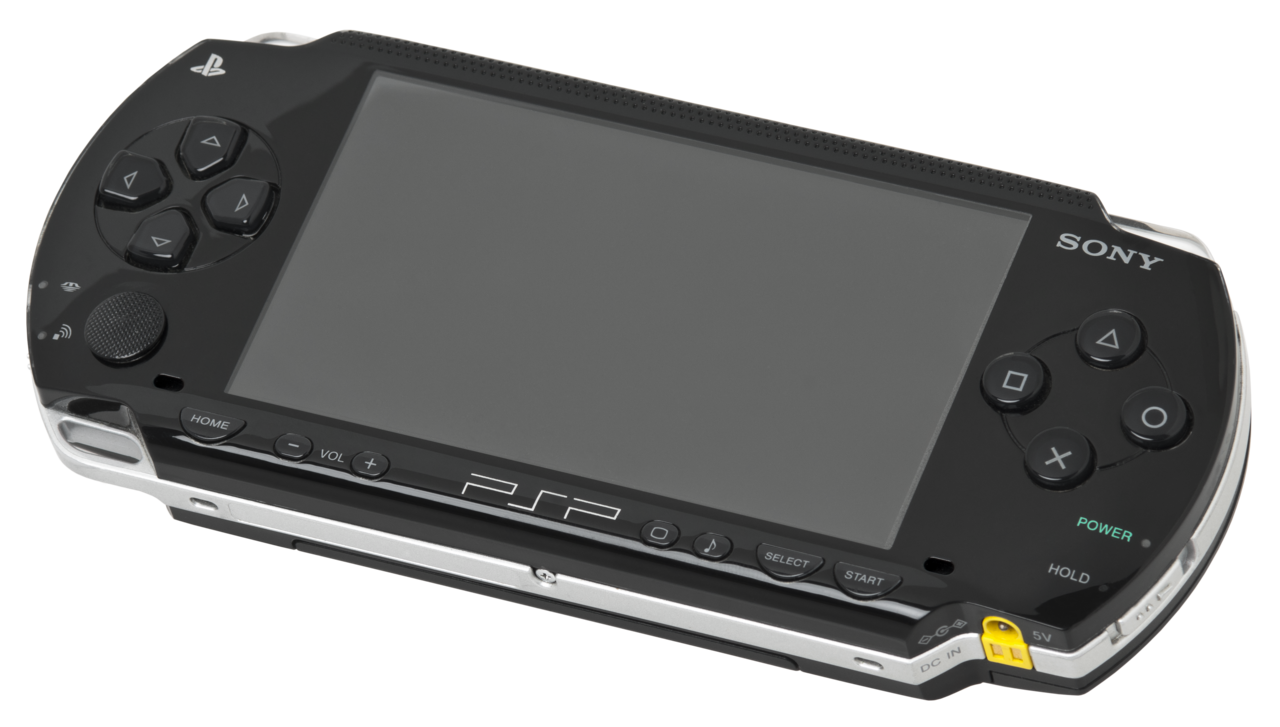
The Sony PSP Street (model PSP-E1000) is the runt of the PlayStation Portable litter, and it arrived at a strange moment. Sony announced it at Gamescom in August 2011 and shipped it across PAL territories on 26 October 2011 at a recommended EUR 99.99 (about GBP 99.99) – roughly two months before the PS Vita reached Japan. It was never sold in North America or Japan. The pitch was simple: take the PSP-3000 board, strip out anything that added cost, and put a working PSP on shelves for under a hundred euros. What you lose in that trade is the whole point of understanding this machine.
The hardware and its library
Underneath, the Street is a PSP-3000 with its wings clipped. The MIPS R4000-based CPU still scales to 333 MHz, the GPU runs at 166 MHz, and there is 64 MB of system RAM – identical to every slim PSP from the 2000 onward, so game compatibility is total. It reads UMD discs and Memory Stick PRO Duo cards, with no internal flash for digital titles. The cost-cutting shows up everywhere else: there is no Wi-Fi at all, the stereo speakers become a single mono unit on the front, the microphone is gone, and the physical brightness buttons were removed and buried in a software menu. That library, though, is the reason to care. This plays God of War: Ghost of Sparta, Grand Theft Auto: Liberty City Stories, Persona 3 Portable, Metal Gear Solid: Peace Walker, Crisis Core: Final Fantasy VII, Daxter and the Patapon and LocoRoco games at full quality – one of the strongest handheld back catalogues ever assembled.
Homebrew, custom firmware and emulation
Every retail PSP is trivially hackable today, and the Street is no exception – with one caveat that comes straight from its missing Wi-Fi. The endgame is 6.61 PRO-C (or LME) custom firmware made permanent with DaveeFTW’s Infinity 2.0, which explicitly added E1000 support and survives reboots without a battery-based magic memory stick. Because there is no wireless, you cannot use any browser exploit to get there; you copy the exploit and CFW files over USB and trigger them through a game-save loader instead. It is ten minutes of following a guide rather than a genuine obstacle. Custom firmware also unlocks ISO loading straight from the Memory Stick, so the missing UMD-only limitation stops mattering, along with plugins and a wider homebrew scene. Once you are on CFW, the PSP plays PS1 games natively through POPS, and homebrew emulators cover the 8- and 16-bit era comfortably: NES, SNES (Snes9x Euphoria, CATSFC), Mega Drive and Master System (PicoDrive), PC Engine, Game Boy and Game Boy Color all run full speed. Game Boy Advance via gpSP is close to full speed once you tune the sound and frameskip. Above that the ceiling is hard – Nintendo 64 through DaedalusX64 is a partial, stuttery experience on most titles, and there is simply no Saturn, Dreamcast or PS2 here. Treat it as a superb PS1-and-earlier machine that also happens to hold the PSP’s own library.
Screen, build and revisions
The panel is the same 4.3-inch, 480×272 TFT (roughly 128 ppi) as the rest of the range, and it is perfectly sharp for the resolution the PSP actually renders at. The chassis is where you feel the budget. At 172 x 73 x 21.5 mm and 223 grams it is both thicker and heavier than the 189-gram PSP-3000, the plastic is creakier, and the d-pad and face buttons are rubberised rather than the harder plastic of earlier models. The matte finish is the one genuine upgrade: it hides fingerprints far better than the glossy 3000 ever did. The 925 mAh battery is smaller than the 3000’s 1200 mAh cell, so plan on roughly 3.5 to 4.5 hours from a healthy unit. Two variants exist – the launch Charcoal Black (E1000) and a Ceramic White (E1004) added in July 2012.
Collecting, price and who it is for
The E1000 was the final redesign of the PSP hardware, launched into the shadow of its own successor, and that history colours the used market. Because it was PAL-only, the Street is a mild curiosity in North America and common secondhand across Europe. Expect roughly GBP 30-60 (about USD 40-80) for a loose, working unit, with boxed launch editions asking more. One collector-friendly detail: PSP game UMDs are not region-locked, so an imported machine happily plays discs from any territory. The honest read is that the E1000 makes sense for exactly one buyer – someone who wants the cheapest possible route to a custom-firmware PSP for offline single-player and emulation, and who genuinely does not need Wi-Fi. If you want ad-hoc multiplayer for Monster Hunter, whatever remains of the PlayStation Store, or the nicer speakers and slimmer body, spend a little more on a used PSP-3000. Buy the Street for what it is: a no-frills, hackable game player parked at the very bottom of the price ladder.
📐 Size & Pocketability
⚖️ Weight vs Other Handhelds
🔋 Real-World Battery Estimator
⭐ Emulation Performance
📊 View How This Score is Calculated
The Hardware Power Score is an absolute metric. Perfect emulation of difficult, modern consoles awards significantly more points than standard retro consoles.
- 15× Multiplier: Modern PC
- 12× Multiplier: Switch, PS3, Xbox 360
- 10× Multiplier: Wii U
- 8× Multiplier: PS2, GameCube, Wii, Xbox
- 5× Multiplier: Saturn, Dreamcast, PSP
- 3× Multiplier: N64, PS1
- 1× Multiplier: SNES, GBA
Gen 8 & PC
Generation 5
Handhelds & Retro
📋 Full Specifications
📺 Display
⚙️ Platform
💾 Memory
🕹️ Controls
📏 Body
🔋 Battery
⚖️ Verdict
✅ The Good
- Full PSP-3000-class internals (333 MHz CPU, 64 MB RAM) with total game compatibility, at the lowest launch price in the line (EUR 99.99).
- Trivially hackable: 6.61 PRO-C plus Infinity 2.0 gives permanent custom firmware, unlocking native PS1 playback and solid 8/16-bit emulation.
- Matte shell resists fingerprints far better than the glossy 3000, and PSP game UMDs are region-free for importers.
- Cheap and plentiful secondhand in Europe (around GBP 30-60), a low-risk entry point into PSP homebrew.
❌ The Bad
- No Wi-Fi whatsoever – no ad-hoc multiplayer, no PlayStation Store, and CFW must be installed over USB rather than via a browser exploit.
- Downgraded from the PSP-3000: mono speaker, no microphone, no hardware brightness buttons, and a smaller 925 mAh battery (3.5-4.5 hours).
- Thicker, heavier (223 g vs 189 g) and creakier plastic than the PSP-3000 it is based on.
📰 Latest News & Guides
The Ultimate Guide to ARMSX3: Android’s New PS3 Emulator, Competitor Comparisons, and Setup Tutorial
18/08/2026Pokémon Gold, Silver, and Crystal (Gen 2) Recomp Lands on Android
17/08/2026How to Play the Pokémon Red, Blue, or Yellow Recomp on Your Android, Windows, and Linux Devices
16/08/2026🔍 Similar Handhelds
Other handhelds that emulate up to PSP.