
🛒 Where to Buy
⚠️ Golden Rule of Retro Handhelds: Throw away the cheap MicroSD card that comes in the box — it will fail. And never use a high-wattage PD “Fast Charger” on these devices; it can damage the battery. Use a standard 5V/1.5A brick.
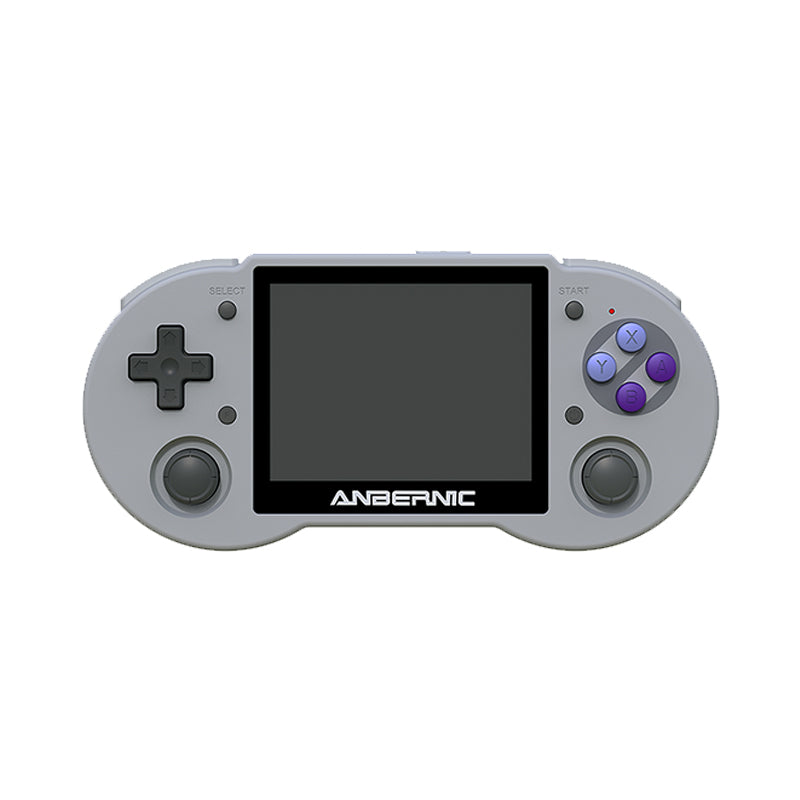
Device Overview: Anbernic RG-353P
The Anbernic RG-353P is a 2022 landscape handheld built around Rockchip’s RK3566, the quad-core Cortex-A55 chip that powers most of Anbernic’s “353” family. It is the horizontal, dual-stick member of that line: ABXY buttons up top, two analog sticks below, and a 3.5-inch 4:3 touchscreen in the middle. Its whole reason to exist is the tier between cheap PS1-only boards and anything that can touch GameCube. If you already own a Miyoo Mini for 8-bit and 16-bit, the RG-353P is the step up that adds sticks, a bigger screen, and confident PlayStation, Nintendo 64 and Dreamcast play. It is not a Windows machine and should never be judged like one; the RK3566 is a low-power ARM SoC paired with a Mali-G52 GPU and 2GB of LPDDR4, and its limits are firm.
Emulation performance, generation by generation
Everything through the 16-bit era is trivial: NES, SNES, Genesis, PC Engine, Game Boy Advance and Neo Geo all run at full speed with headroom to spare, and the 4:3 panel frames them without letterboxing. The genuine sweet spot is fifth-generation and Dreamcast. PS1 through Beetle PSX is flawless. Nintendo 64 on Mupen64Plus-Next or ParaLLEl runs most of the library at or near 60fps, with the usual awkward holdouts (Rogue Squadron, some Perfect Dark scenes). Dreamcast via Flycast is strong, holding full speed on Crazy Taxi, Soul Calibur and Sonic Adventure. Nintendo DS on DraStic runs the bulk of its catalog well, and the real touchscreen actually handles the stylus layer. Saturn is the honest maybe: through Beetle Saturn or YabaSanshiro the 2D fighters and shmups are fine, but the chip chokes on heavier 3D, so treat it as partial. PSP on PPSSPP is the ceiling. Lighter titles and 2D fighters hover near 30fps (Tekken 6 is playable), but demanding 3D games such as the PSP Grand Theft Auto entries drop into the teens in busy scenes. You can play PSP here; you cannot treat this as a PSP replacement. GameCube, PS2, Wii and 3DS are out of reach entirely, and no firmware trick changes that. Buy it for the PS1-to-Dreamcast band, not for the generation above it.
Screen, build and controls
The 3.5-inch IPS panel runs 640×480, which is a clean 4:3 shape that scales retro systems tidily, and it is OCA-laminated so the image sits right under the glass. Multi-touch is present and genuinely useful for DS and menu navigation. The shell is plastic, offered in solid and translucent finishes, and the unit itself weighs roughly 210 grams (Anbernic’s own listing quotes a much higher 422g figure that appears to include packaging). The controls are the compromise. The two analog sticks are standard potentiometer units, not Hall effect, so long-term drift is a real risk; Anbernic only moved this family to Hall sticks in later revisions. The D-pad and face buttons are fine. The shoulders are the sticking point: L1/L2 and R1/R2 are stacked rather than inline, all digital with no analog travel, and the arrangement feels cramped if you have larger hands. Ports are generous for the price: USB-C, a mini-HDMI output for TV play, a 3.5mm jack, and two microSD slots.
Software and setup
Out of the box the RG-353P dual-boots Android 11 and a stock Linux front end, and you switch between them by physically pulling the left microSD card. Android is worth keeping for standalone emulator apps, Moonlight streaming and the odd store game; the bundled Linux image works but is not where you will want to stay. This device rewards custom firmware, and because it is an RK3566 board the relevant options are ArkOS, JELOS (now continued as ROCKNIX), AmberELEC and Batocera. Note that the popular muOS and Knulli images do not apply here, as those target the Allwinner H700 devices, and OnionOS is a Miyoo Mini project; do not go looking for them. Setup means flashing one of those images to a card and doing a little scraping and mapping, which is a weekend of tinkering rather than a plug-and-play evening.
Price, value and who it is for
The RG-353P launched in the roughly $110 to $130 range depending on retailer and storage bundle, and on the used market it now regularly turns up under $100. At that price it makes sense for a specific person: someone who wants real analog sticks and comfortable PS1, N64 and Dreamcast play in a pocketable 4:3 body, and who is happy to flash ArkOS or ROCKNIX to get the best out of it. Skip it if you only ever play 8-bit and 16-bit, where a cheaper vertical handheld does the same job, and skip it if PSP or GameCube at full speed is the goal, because the RK3566 cannot deliver that. Within its actual band, it is a sensible, tinker-friendly buy that has aged into a bargain.
📐 Size & Pocketability
⚖️ Weight vs Other Handhelds
🔋 Real-World Battery Estimator
⭐ Emulation Performance
📊 View How This Score is Calculated
The Hardware Power Score is an absolute metric. Perfect emulation of difficult, modern consoles awards significantly more points than standard retro consoles.
- 15× Multiplier: Modern PC
- 12× Multiplier: Switch, PS3, Xbox 360
- 10× Multiplier: Wii U
- 8× Multiplier: PS2, GameCube, Wii, Xbox
- 5× Multiplier: Saturn, Dreamcast, PSP
- 3× Multiplier: N64, PS1
- 1× Multiplier: SNES, GBA
Generation 6
Generation 5
Handhelds & Retro
⚡ Performance Benchmarks
Where Anbernic RG-353P ARM Mali-G52 MP2 (2EE) lands against the handhelds everyone knows. Every bar shares one scale, so longer genuinely means faster — add up to two rivals to compare.
CPU = Geekbench 6 multi-core · GPU = 3DMark Wild Life. Median real-world scores; every bar shares one scale — add up to two rivals to compare.
📋 Full Specifications
📺 Display
⚙️ Platform
💾 Memory
🕹️ Controls
📏 Body
🔋 Battery
⚖️ Verdict
✅ The Good
- Confident PS1, Nintendo 64 and Dreamcast emulation from the RK3566, the band most buyers actually want
- Sharp 3.5-inch 640×480 IPS panel that is OCA-laminated and a clean 4:3 fit for retro systems
- Dual-boot Android 11 plus Linux out of the box, with strong custom firmware support (ArkOS, JELOS/ROCKNIX, Batocera, AmberELEC)
- Genuinely useful extras for the price: multi-touch screen, mini-HDMI TV output, dual microSD slots and a headphone jack
❌ The Bad
- Analog sticks are standard potentiometer units, not Hall effect, so drift is a long-term risk
- Stacked, all-digital L1/L2 and R1/R2 shoulder buttons feel cramped and lack analog triggers
- PSP is the hard ceiling and GameCube/PS2/3DS are out of reach, so it is easy to overestimate its power
📰 Latest News & Guides
The Ultimate Guide to ARMSX3: Android’s New PS3 Emulator, Competitor Comparisons, and Setup Tutorial
18/08/2026Pokémon Gold, Silver, and Crystal (Gen 2) Recomp Lands on Android
17/08/2026How to Play the Pokémon Red, Blue, or Yellow Recomp on Your Android, Windows, and Linux Devices
16/08/2026🔍 Similar Handhelds
Other handhelds that emulate up to PSP.