
🛒 Where to Buy
⚠️ Golden Rule of Retro Handhelds: Throw away the cheap MicroSD card that comes in the box — it will fail. And never use a high-wattage PD “Fast Charger” on these devices; it can damage the battery. Use a standard 5V/1.5A brick.
Device Overview: Game Kiddy GKD Mini Plus
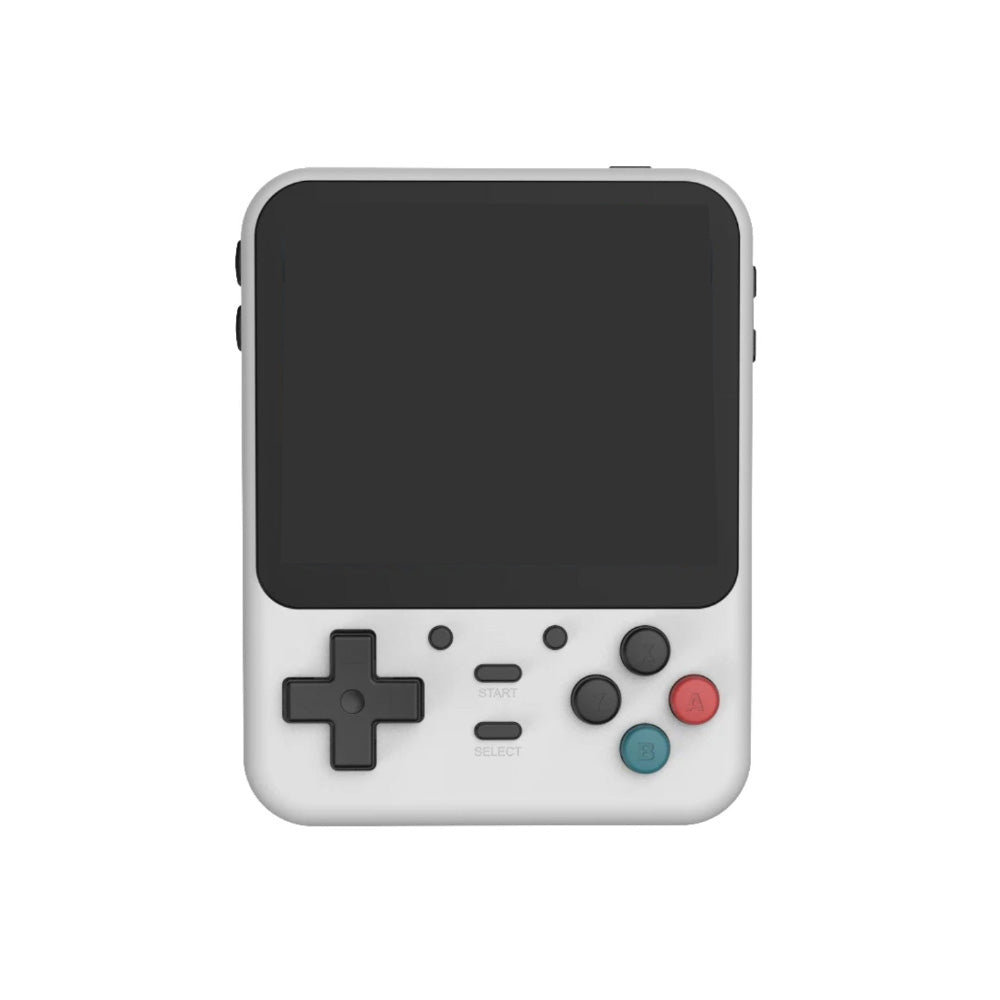
The Game Kiddy GKD Mini Plus is a vertical, Game Boy-shaped emulation handheld that landed in January 2023 as the sequel to the smaller GKD Mini. It keeps the pocket-first silhouette, a tall 86 x 111 x 19 mm slab you can palm one-handed, but drops in a sharper 3.5-inch screen, a Rockchip RK3566, and a party trick nobody else was doing at the time: a clip-on dock that bolts dual analog sticks onto the bottom over USB-C. One warning before you buy: Game Kiddy also sold a near-identical “GKD Mini Plus Classic” running a much weaker Actions chip, and listings routinely muddle the two. This profile covers the RK3566 model, the one worth owning.
Emulation performance, generation by generation
The RK3566 is a quad-core Cortex-A55 clocked at 1.8 GHz with a Mali-G52 2EE GPU and just 1 GB of LPDDR4. That is a low-power ARM SoC, not a gaming PC, so calibrate expectations to what those cores can actually push. Everything up to and including the 16-bit and early 32-bit era runs without drama: NES, Game Boy and GBA, Master System, Genesis, SNES and TurboGrafx are all full speed under RetroArch cores like mGBA and Snes9x. PlayStation 1 is the comfort zone, where PCSX ReARMed holds full speed across the vast majority of the library. Above that, the ceiling gets ragged. Nintendo 64 through Mupen64Plus and Dreamcast through Flycast are hit-and-miss: plenty of titles are playable with frame-skipping and per-game tuning, but this is not a set-and-forget N64 machine. PSP under PPSSPP is weak, limited to lighter 2D and simpler 3D games. Nintendo DS is the sore spot, since DraStic is unreliable here and the stock firmware has been reported to crash on DS titles outright. Treat the Mini Plus as a strong 8-, 16- and 32-bit machine that occasionally reaches into the fifth generation, not as a PSP or DS handheld.
Screen, build and controls
The 3.5-inch IPS panel is the headline upgrade over the original Mini. At 640 x 480 in a native 4:3 ratio (roughly 228 PPI, 60 Hz), it is a clean match for CRT-era systems, with no letterboxing on square content and crisp integer scaling on pixel art. The body is plastic and, honestly, feels a bit hollow; case seams do not always line up perfectly, though the controls themselves are good. The d-pad and face buttons sit up top in that stubby Game Boy layout, with L1/R1 and L2/R2 across the shoulders and an extra set of side buttons for tate-mode vertical shooters. There are no built-in analog sticks and no Hall-effect anything. Sticks only exist if you buy the separate GKD Mini Dock, which clips to the base and connects over USB-C. It works for PS1 titles that need analog, but it makes the device awkwardly long and it covers and muffles the stereo speakers. Rounding out the hardware: a 3000 mAh battery, dual microSD slots, Wi-Fi, Bluetooth, a headphone jack and dual vibration motors. There is no video output.
Software and setup
Out of the box it runs Game Kiddy’s own Linux build on top of EmulationStation and RetroArch, functional but the weakest part of the package, and its DS crashing is a known flaw. The good news is that the RK3566 is one of the best-supported chips in the hobby, so you are not stuck with it. ArkOS is the natural first stop: lean, stable, and built precisely for RK3326/RK3566 hardware. ROCKNIX, the successor to JELOS, is the more modern, settings-rich alternative, and community images such as PlumOS have targeted this device specifically. Installation is the usual routine: download the image that matches the RK3566, flash it to a card with Balena Etcher, drop it in the OS slot, and let the first boot expand the filesystem. Custom firmware smooths out most of the stock rough edges and unlocks proper per-core configuration, box-art scraping and reliable save states.
Price, value and who it is for
The Mini Plus launched globally around $109 to $110; today it drifts closer to $90 for the base 16 GB unit, with the dock adding roughly $13. At that price it competes head-on with the Miyoo Mini Plus, and the honest verdict is mixed. The GKD’s bigger 3.5-inch screen and more comfortable size are genuine wins for anyone with larger hands, and the optional sticks are a clever answer to a real limitation of the form factor. But the Miyoo has a far larger, more active custom-firmware community, better software polish, and a cult following the GKD never earned. Buy the GKD Mini Plus if you want a vertical, one-handed device for 8-, 16- and 32-bit libraries, value the roomier screen, and do not mind flashing your own firmware. Skip it if you were counting on strong PSP or DS emulation, or if you want the biggest homebrew ecosystem, because the Miyoo still owns that corner.
📐 Size & Pocketability
🔋 Real-World Battery Estimator
⭐ Emulation Performance
📊 View How This Score is Calculated
The Hardware Power Score is an absolute metric. Perfect emulation of difficult, modern consoles awards significantly more points than standard retro consoles.
- 15× Multiplier: Modern PC
- 12× Multiplier: Switch, PS3, Xbox 360
- 10× Multiplier: Wii U
- 8× Multiplier: PS2, GameCube, Wii, Xbox
- 5× Multiplier: Saturn, Dreamcast, PSP
- 3× Multiplier: N64, PS1
- 1× Multiplier: SNES, GBA
Generation 6
Generation 5
Handhelds & Retro
⚡ Performance Benchmarks
Where Game Kiddy GKD Mini Plus ARM Mali-G52 MP2 (2EE) lands against the handhelds everyone knows. Every bar shares one scale, so longer genuinely means faster — add up to two rivals to compare.
CPU = Geekbench 6 multi-core · GPU = 3DMark Wild Life. Median real-world scores; every bar shares one scale — add up to two rivals to compare.
📋 Full Specifications
📺 Display
⚙️ Platform
💾 Memory
🕹️ Controls
📏 Body
🔋 Battery
⚖️ Verdict
✅ The Good
- Sharp 3.5-inch 640×480 IPS panel in native 4:3, excellent for CRT-era and pixel-art systems
- RK3566 runs NES through PlayStation 1 at full speed and is one of the best-supported chips for ArkOS and ROCKNIX
- Optional USB-C dock adds real dual analog sticks, answering the vertical form factor's biggest limitation
- Comfortable one-handed size with dual microSD slots, Wi-Fi, Bluetooth, headphone jack and vibration motors
❌ The Bad
- Stock Linux firmware is rough and has been reported to crash on Nintendo DS games
- N64 and Dreamcast are inconsistent and PSP is weak; it is not a fifth-generation or PSP/DS machine
- Plastic build feels hollow with uneven seams, and a confusingly named weaker "Classic" variant muddies listings
📰 Latest News & Guides
The Ultimate Guide to ARMSX3: Android’s New PS3 Emulator, Competitor Comparisons, and Setup Tutorial
18/08/2026Pokémon Gold, Silver, and Crystal (Gen 2) Recomp Lands on Android
17/08/2026How to Play the Pokémon Red, Blue, or Yellow Recomp on Your Android, Windows, and Linux Devices
16/08/2026🔍 Similar Handhelds
Other handhelds that emulate up to PSP.