
🛒 Where to Buy
⚠️ Golden Rule of Retro Handhelds: Throw away the cheap MicroSD card that comes in the box — it will fail. And never use a high-wattage PD “Fast Charger” on these devices; it can damage the battery. Use a standard 5V/1.5A brick.
Device Overview: Abxylute Cloud
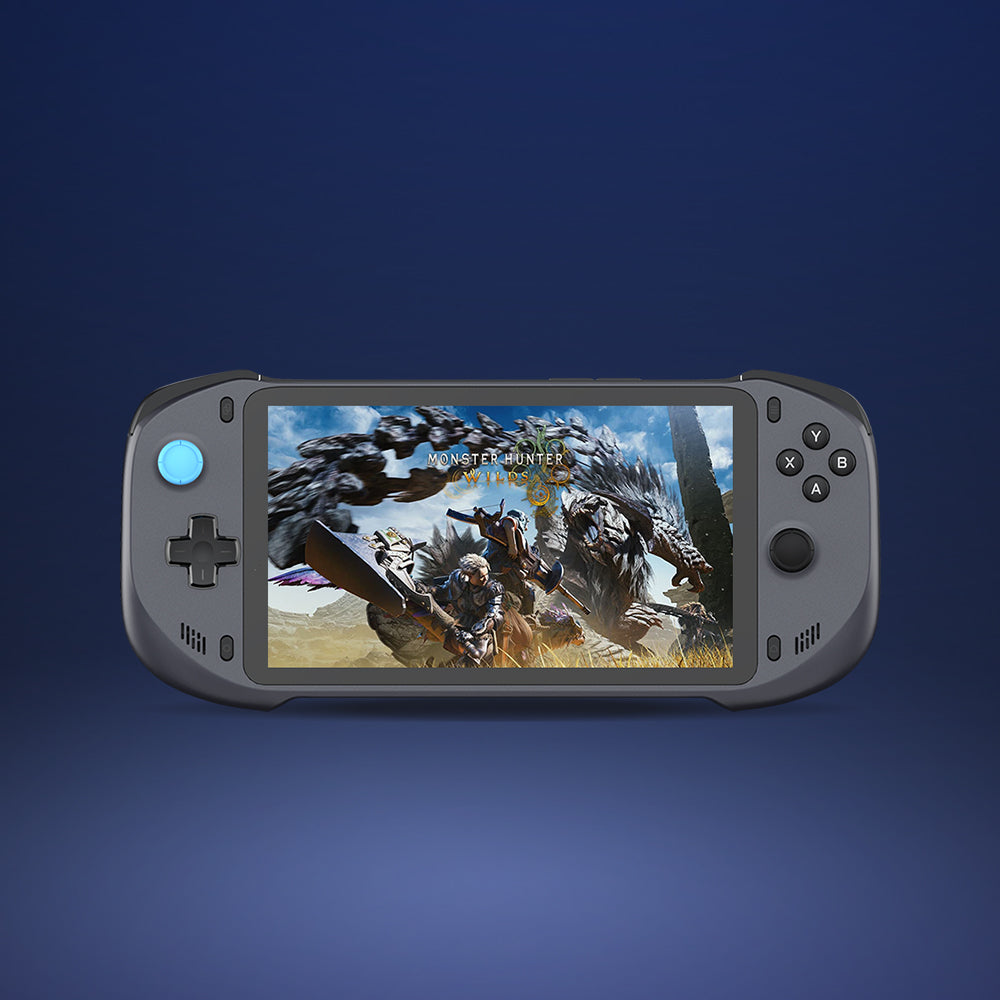
The Abxylute Cloud (sold officially as the “One Cloud Gaming Handheld,” and sometimes labeled abxylute One) is built around one idea: let the cloud do the heavy lifting. Inside is a MediaTek MT8365 — four Cortex-A53 cores and a single-cluster Mali-G52 MC1 GPU — paired with 4GB of LPDDR4 and 32GB or 64GB of storage. That is deliberately modest silicon. Abxylute did not spend the budget on a chip that runs AAA games locally; it spent it on a 7-inch 1080p screen, a light body, and hall-effect controls, then handed the actual rendering to GeForce Now, Xbox Cloud Gaming, and your own PC or console over the network.
That makes it a different proposition from a Logitech G Cloud or a Razer Edge. The G Cloud is the closest rival in spirit and price, and it ships a slightly punchier Snapdragon. The Razer Edge is a more powerful Android gaming tablet that happens to stream — and costs far more. Against a phone-plus-clip-on-controller, the Abxylute’s pitch is a bigger screen, integrated grips, and a battery sized for streaming rather than a phone you also need for everything else. It is not trying to be a Steam Deck or an emulation powerhouse, and judging it as one misses the point.
Cloud gaming and emulation performance
For streaming, it does the job. The official software supports GeForce Now, Xbox Cloud Gaming, Boosteroid, Steam Link, Moonlight, PS Remote Play, and Chiaki, which covers nearly every way you’d pipe a game onto an Android handheld. Reviewers running Baldur’s Gate 3 through GeForce Now and a Game Pass library through Xbox Cloud reported clean control and a display large enough to make those sessions genuinely playable — broadly on par with streaming on a good phone, sometimes a touch more consistent. Moonlight from a gaming PC on the same network is the strongest case here, because the bottleneck becomes your router rather than a distant data center.
Local performance is where you have to be honest. The MT8365 is an entry-level chip, and it shows. Native Android games are hit or miss: lighter titles like Dead Cells hold 60fps after dialing settings down, but Genshin Impact crawls at roughly 20fps on its lowest preset, and even menus can stutter. Emulation follows the same ceiling. Up to PS1, N64, GBA, SNES, NES, and Genesis, it runs well — in fact better than many demanding native Android games. Dreamcast and PSP are inconsistent and depend on the title. GameCube, Wii, PS2, and 3DS are out of reach; don’t buy this expecting them. If a deep local emulation library is the goal, a Snapdragon-class handheld is the right tool. The Abxylute Cloud handles the 8- and 16-bit and early-3D eras as a bonus, not as its main act.
Screen, build and controls
The screen is the standout. A 7-inch 1920×1080 panel at 60Hz with around 450 nits is sharp and colorful — noticeably crisper than an original Switch, and good enough that streamed games and PS1 sprites both look clean. At roughly 410-430g the body is light for its screen size, which matters over the long streaming sessions this device is built for. Controls are better than the price suggests: hall-effect joysticks that won’t drift, analog L2/R2 triggers, a D-pad, and a standard ABXY face layout. Ergonomics are the weak spot. The grips are shallow and the chassis edge can dig into your palm, and on some units the speakers sit exactly where your hands rest, so you trade a comfortable hold against clear audio. Headphones or Bluetooth sidestep that entirely.
Software and setup
It runs Android 12, so setup is familiar: sign into the Play Store, install GeForce Now, Xbox, Moonlight, or your remote-play app of choice, map the controls, and play. Abxylute bundles its own launcher to corral the streaming services, but underneath it’s plain Android, which means you also get a browser, media apps, and sideloaded emulators. Connectivity is Wi-Fi 5 (802.11ac) plus Bluetooth — adequate, though a Wi-Fi 6 router would have future-proofed the one thing this device leans on hardest. And that is the catch with any streaming handheld: it is only as good as your connection. On strong home Wi-Fi near the router, it’s smooth; on congested or distant networks, you’ll see the lag and compression. Test your streaming apps on a phone first — the Abxylute will perform about the same.
Price, value and who it’s for
It launched around $199 and currently sits at $179 on sale (listed at $239 regular) on Abxylute’s own store, which makes it one of the cheapest purpose-built streaming handhelds you can buy. At that price the value is clear if you fit the profile: you have GeForce Now or Game Pass Ultimate, or a gaming PC or console to stream from, and you want a comfortable, big-screen, long-battery way to play on the couch or in bed. If you instead want a device that runs games and heavy emulators offline, your money goes further on a Snapdragon handheld. The Abxylute Cloud is a focused tool — buy it for the cloud, take the retro emulation as a freebie, and skip it if local horsepower is the priority.
📐 Size & Pocketability
⚖️ Weight vs Other Handhelds
🔋 Real-World Battery Estimator
⭐ Emulation Performance
📊 View How This Score is Calculated
The Hardware Power Score is an absolute metric. Perfect emulation of difficult, modern consoles awards significantly more points than standard retro consoles.
- 15× Multiplier: Modern PC
- 12× Multiplier: Switch, PS3, Xbox 360
- 10× Multiplier: Wii U
- 8× Multiplier: PS2, GameCube, Wii, Xbox
- 5× Multiplier: Saturn, Dreamcast, PSP
- 3× Multiplier: N64, PS1
- 1× Multiplier: SNES, GBA
Gen 8 & PC
Generation 6
Generation 5
Handhelds & Retro
📋 Full Specifications
📺 Display
⚙️ Platform
💾 Memory
🕹️ Controls
📏 Body
🔋 Battery
⚖️ Verdict
✅ The Good
- Excellent 7-inch 1080p screen, sharp for both streaming and retro games
- Broad streaming support out of the box: GeForce Now, Xbox Cloud, Moonlight, Steam Link, PS Remote Play, Chiaki
- Light (~410-430g) with no-drift hall-effect sticks and analog triggers, plus ~8 hours of streaming battery
- One of the cheapest dedicated streaming handhelds, often under $200
❌ The Bad
- Entry-level MediaTek MT8365 is weak for native Android games and caps emulation at roughly PS1/N64 (no GameCube, PS2, PSP-and-up reliability)
- Shallow grips and palm-blocking speaker placement hurt long-session comfort
- Only Wi-Fi 5, and performance lives or dies on your network — useless without solid internet
📰 Latest News & Guides
The Ultimate Guide to ARMSX3: Android’s New PS3 Emulator, Competitor Comparisons, and Setup Tutorial
18/08/2026Pokémon Gold, Silver, and Crystal (Gen 2) Recomp Lands on Android
17/08/2026How to Play the Pokémon Red, Blue, or Yellow Recomp on Your Android, Windows, and Linux Devices
16/08/2026🔍 Similar Handhelds
Other handhelds that emulate up to PSP.