
🛒 Where to Buy
⚠️ Golden Rule of Retro Handhelds: Throw away the cheap MicroSD card that comes in the box — it will fail. And never use a high-wattage PD “Fast Charger” on these devices; it can damage the battery. Use a standard 5V/1.5A brick.
Device Overview: Retroid Pocket 2S
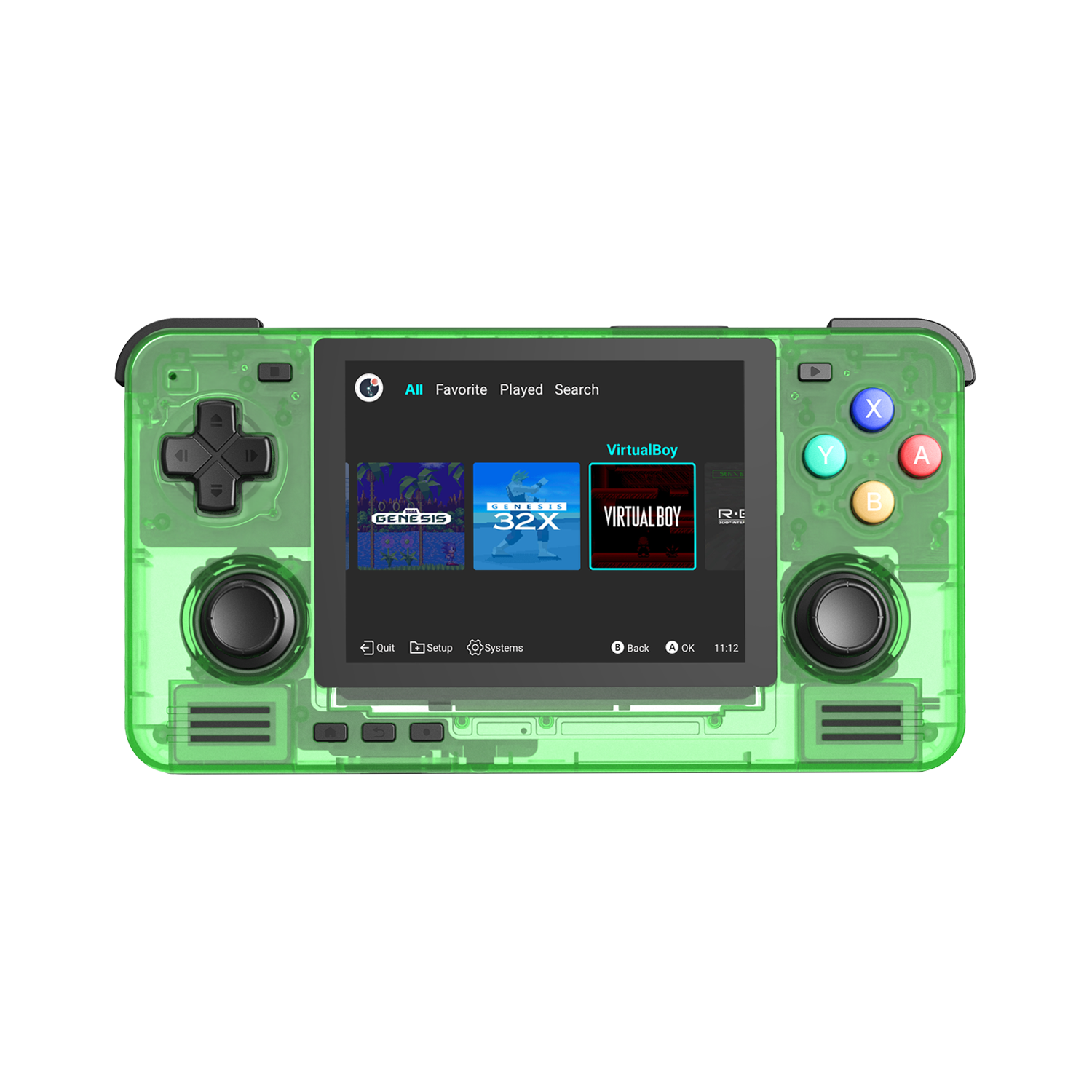
The Retroid Pocket 2S is the handheld I hand to people who say “I just want my old games in my pocket for a hundred bucks” and mean it literally. It launched in mid-2023 at $99 for the 3GB/32GB model and $119 for 4GB/128GB, with a $149 Metal Edition on top. The chip inside is a Unisoc Tiger T610 — and yes, get that right, because half the internet confuses it with the T618 in the Pocket 3+ and 4. The T610 pairs two Cortex-A75 cores at 1.8GHz with six A55 cores and a Mali-G52 MP2 GPU. It is a budget SoC, full stop, and the 2S is built honestly around that fact.
What defines the 2S is the vertical, Game Boy-style body wrapped around a 3.5-inch 640×480 4:3 IPS panel. That 4:3 shape is the whole pitch: it is the correct aspect ratio for everything from the NES through the PSP and GameCube, so you get a big, square, pixel-honest image instead of a letterboxed sliver. Against its own family it sits below the wide-screen Retroid Pocket Mini, 4, and 5, which use far stronger Snapdragon chips and target PS2 and Switch. Against Anbernic, the 2S’s trump card is Android plus Hall-effect sticks at a price where Anbernic still ships Linux and potentiometer sticks. This is the cheap, vertical, retro-shaped Retroid — nothing more, and that’s the point.
Emulation performance, generation by generation
Everything 2D is trivial. NES, SNES, Genesis, Game Boy/Color/Advance, Neo Geo, PC Engine, and arcade via MAME or FBNeo all run at full speed with headroom for shaders and rewind. PS1 through DuckStation is flawless, and you can enhance resolution comfortably. The Tiger T610’s sweet spot is the fifth and sixth generation: N64 via Mupen64Plus FZ is good for the mainstream library (Mario 64, Zelda, GoldenEye) with the usual per-game tweaks; Dreamcast via Flycast runs the bulk of the catalog well; and PSP through PPSSPP is genuinely strong — God of War, GTA, and the racers hold up, though the heaviest 3D titles want resolution dropped to native.
Now the honest ceiling. GameCube via Dolphin (MMJR or the AetherSX2-era forks) is selective, not a clean sweep — lighter 3D and 2D-leaning games are playable, but ambitious titles dip and stutter, so treat GameCube as “some games, with patience,” not a feature. Saturn via Yaba Sanshiro is hit-or-miss. Nintendo DS via DraStic works but the single screen forces awkward layout toggling. PS2 through AetherSX2 is, bluntly, not worth your time on this chip — a handful of 2D PS2 games limp along; everything else is a slideshow. Wii, 3DS, and Switch are simply off the table. If a reviewer tells you the T610 “runs GameCube flawlessly,” they tested four forgiving games. PSP and Dreamcast are the realistic, satisfying top of this device.
Screen, build and controls
The 3.5-inch 640×480 IPS panel is bright, sharp, and the right shape — at roughly 228 PPI individual pixels disappear. The bezel around it is chunky, a fair complaint, but it never bothered me in use. The shell is plastic, light at about 200g, and comfortable for long sessions with no fan and no meaningful heat. The 4000mAh battery is genuinely large for this class and gets you through an afternoon.
Controls are the upgrade that matters. The 2S moves to Hall-effect analog sticks — magnetic, drift-resistant, concave, and mounted below the face buttons. The D-pad borrows the clicky PS Vita-style design and is excellent for fighters and platformers. You get two clicky bumpers and two analog triggers, plus the face buttons sit exactly where your thumbs expect. For a $99 handheld, the input quality is the part that punches above the price.
Software and setup
This is an Android 11 device, and that is both its strength and its homework. Out of the box GoRetroid ships a custom launcher and a one-button emulator installer that genuinely gets you playing in a couple of minutes. But Android means you own the maintenance: you will be configuring RetroArch cores or standalone emulators (DuckStation, PPSSPP, Flycast, Mupen64Plus FZ, DraStic, Dolphin) per system, mapping controls, and managing BIOS files yourself. Many owners install a cleaner front-end like Daijisho or ES-DE and connect to Google Play for streaming, Moonlight, or even native Android games. If you want a console that “just works” with zero tinkering, the Android reality will frustrate you; if you enjoy dialing in each emulator, it is liberating.
Price, value and who it’s for
At $99-$119 the 2S is one of the best-value vertical handhelds you can buy. Buy it if you want a pocketable, 4:3-screen machine for everything up to PSP and Dreamcast, value Hall sticks and Android flexibility, and accept some setup. Skip it if your dream is GameCube, PS2, or Switch — for that you want the Snapdragon-based Retroid Pocket 4/5 and a bigger budget — or if you want a plug-and-play Linux device with no configuration, where an Anbernic running a preloaded card may suit you better. The 2S knows exactly what it is: an affordable, well-built retro handheld that nails everything through the sixth generation and is honest about where it stops.
📐 Size & Pocketability
⚖️ Weight vs Other Handhelds
🔋 Real-World Battery Estimator
⭐ Emulation Performance
📊 View How This Score is Calculated
The Hardware Power Score is an absolute metric. Perfect emulation of difficult, modern consoles awards significantly more points than standard retro consoles.
- 15× Multiplier: Modern PC
- 12× Multiplier: Switch, PS3, Xbox 360
- 10× Multiplier: Wii U
- 8× Multiplier: PS2, GameCube, Wii, Xbox
- 5× Multiplier: Saturn, Dreamcast, PSP
- 3× Multiplier: N64, PS1
- 1× Multiplier: SNES, GBA
Generation 7
Generation 6
Generation 5
Handhelds & Retro
⚡ Performance Benchmarks
Where Retroid Pocket 2S Arm Mali-G52 MP2 lands against the handhelds everyone knows. Every bar shares one scale, so longer genuinely means faster — add up to two rivals to compare.
CPU = Geekbench 6 multi-core · GPU = 3DMark Wild Life. Median real-world scores; every bar shares one scale — add up to two rivals to compare.
📋 Full Specifications
📺 Display
⚙️ Platform
💾 Memory
🕹️ Controls
📏 Body
🔋 Battery
⚖️ Verdict
✅ The Good
- Hall-effect drift-resistant analog sticks and an excellent clicky D-pad, rare at the $99-$119 price
- Sharp, bright 3.5-inch 640×480 4:3 IPS screen that matches retro and PSP/GameCube aspect ratios natively
- Full Android 11 with one-button GoRetroid emulator setup, Play Store, streaming and launcher flexibility
- Large 4000mAh battery in a light ~200g body with strong PS1/N64/Dreamcast/PSP performance
❌ The Bad
- Unisoc Tiger T610 caps the real ceiling at PSP/Dreamcast; GameCube is selective and PS2 is effectively unusable
- Thick screen bezels and an all-plastic shell on the standard model
- Android setup work (per-emulator config, BIOS, mapping) is required and can frustrate plug-and-play buyers
📰 Latest News & Guides
The Ultimate Guide to ARMSX3: Android’s New PS3 Emulator, Competitor Comparisons, and Setup Tutorial
18/08/2026Pokémon Gold, Silver, and Crystal (Gen 2) Recomp Lands on Android
17/08/2026How to Play the Pokémon Red, Blue, or Yellow Recomp on Your Android, Windows, and Linux Devices
16/08/2026🔍 Similar Handhelds
Other handhelds that emulate up to Saturn.