
🛒 Where to Buy
⚠️ Golden Rule of Retro Handhelds: Throw away the cheap MicroSD card that comes in the box — it will fail. And never use a high-wattage PD “Fast Charger” on these devices; it can damage the battery. Use a standard 5V/1.5A brick.
Device Overview: TJD T80
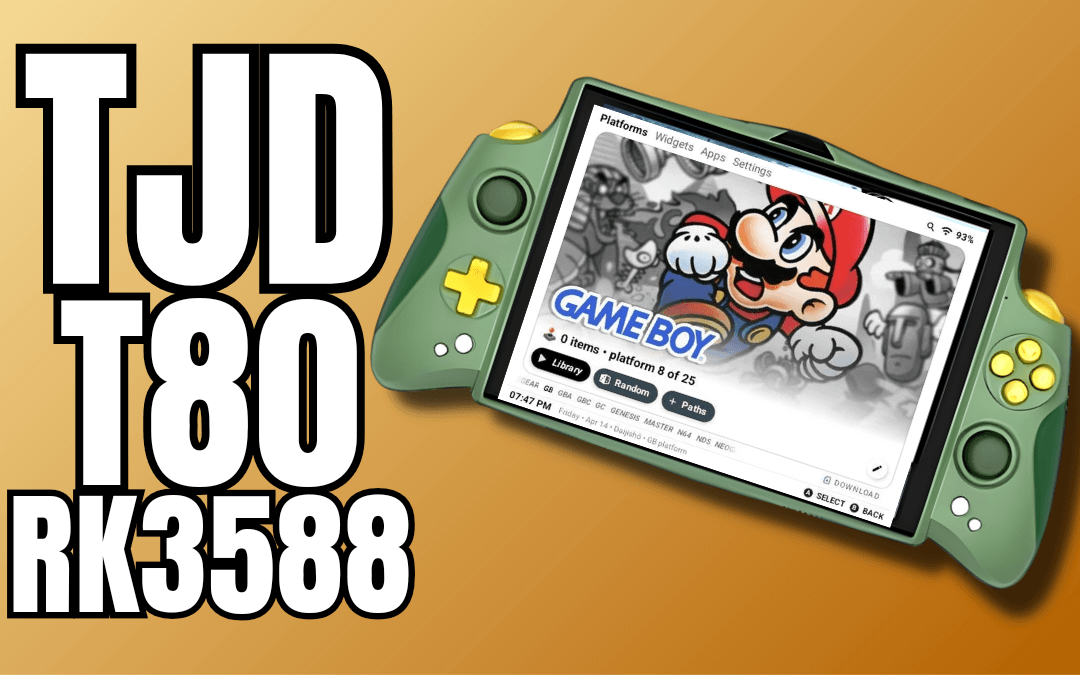
The TJD T80 is one of the odder objects in the Android handheld space: an 8-inch, 4:3 tablet with game controls bolted to either side, a 10,000mAh battery, and a 2048×1536 screen more suited to a productivity slate than a Game Boy replacement. TJD is a Shenzhen brand best known for cheap all-in-one plug-and-play retro boxes, not for credible emulation hardware, and the T80 arrived in 2024 trailing an Indiegogo campaign and a cloud of vague marketing. The single most important thing to understand before buying is that “TJD T80” is not one device. It ships with at least two completely different chipsets at very different price points, and which one you get changes what the machine can actually do.
Emulation performance, generation by generation
The base roughly $199 unit runs an Allwinner A523: eight Cortex-A55 cores and a single-core Mali-G57 GPU. That is a modest, power-efficient chip, not a performance part. On it, everything up to and including the 32-bit era is comfortable. NES, SNES, Genesis, Game Boy Advance, PlayStation 1 and Nintendo 64 run at full speed in RetroArch cores and standalone emulators like DuckStation and Mupen64Plus-Next. PSP is largely playable in PPSSPP if you keep the resolution near native. Dreamcast, Saturn and lighter arcade sets are reachable but not uniformly smooth. Nintendo 3DS in Citra or Lime3DS is borderline and title-dependent. GameCube and PS2, via Dolphin and NetherSX2, are where an A523 falls apart: expect frame rates in the teens and heavy per-game tuning at best, with the single-core Mali-G57 the obvious bottleneck. The pricier T80 configuration swaps in a Rockchip RK3588S, with four Cortex-A76 cores plus a Mali-G610, and that is a genuine step up and the same silicon inside far more respected handhelds. On it, GameCube, Wii and a good chunk of the PS2 library become properly playable, and Dreamcast and Saturn stop being a question. Ignore any listing that promises Switch or PS3: those claims are aspirational on the RK3588S and simply false on the A523.
Screen, build and controls
The panel is the headline and the reason to consider the T80 at all. It is an 8-inch IPS at 2048×1536, roughly 320 pixels per inch, 60Hz, with quoted 500-nit brightness. The 4:3 shape is deliberate and correct for retro content, since DS, GBA, PS1 and arcade titles fill it far better than a 16:9 phone screen, and the sharpness is real. The trade-off is size and mass: 272.5 x 144.5 x 58mm and about 630 grams of plastic. This is a two-handed, couch-or-desk device, not something for a jacket pocket. Controls include dual clickable analog sticks, a d-pad, four face buttons, vertical analog L1/L2/R1/R2 triggers, and extra M2/M3/M4 back buttons. Sources disagree on whether the sticks use Hall-effect sensors, and TJD has not clearly confirmed it, so treat drift-proof sticks as unverified rather than promised. Storage is 128GB or 256GB of eMMC depending on configuration, expandable over microSD. There is active cooling, dual USB-C ports, a mini-HDMI output, a headphone jack, WiFi 6E, Bluetooth 5.0, and even 5MP front and 13MP rear cameras, features that speak to the tablet DNA underneath rather than to any serious gaming need.
Software and setup
The T80 ships with Android 14, though some early material listed Android 13, and Android is the realistic ceiling for it. Setup is the usual Android emulation routine: install RetroArch, standalone emulators and a frontend like Daijisho or ES-DE, then point them at ROMs on the card. Unlike the small Rockchip RK3326 and RK3566 handhelds that anchor the Linux custom-firmware scene, neither of the T80’s chips has turnkey community firmware you should count on. The Allwinner A523 has essentially no meaningful CFW support, so you are on stock Android, full stop. The RK3588S has a real Linux ecosystem in ROCKNIX and Batocera, but those are built and validated per device, and an obscure, low-volume unit like the T80 is unlikely to get first-class attention. muOS, Knulli, ArkOS and OnionOS target entirely different, smaller hardware and do not apply here. Plan to live in Android.
Price, value and who it is for
At the roughly $199 base price you are paying largely for that big 2K screen and the enormous battery, wrapped around a chip that tops out around PSP. Spec-for-spec, cheaper and better-supported handhelds exist at that money if raw emulation is the goal. The T80 makes sense for a narrow buyer: someone who specifically wants an 8-inch 4:3 display for DS, GBA and PS1, values all-day battery, and is comfortable staying on Android. If you want GameCube and PS2, you must buy the more expensive RK3588S version and verify the chipset before paying, and even then, better-known devices on the same silicon arrive with far larger communities. TJD’s history of overpromising is the final caution: confirm exactly which chip, how much RAM and which OS a given listing ships before you commit.
📐 Size & Pocketability
⚖️ Weight vs Other Handhelds
🔋 Real-World Battery Estimator
⭐ Emulation Performance
📊 View How This Score is Calculated
The Hardware Power Score is an absolute metric. Perfect emulation of difficult, modern consoles awards significantly more points than standard retro consoles.
- 15× Multiplier: Modern PC
- 12× Multiplier: Switch, PS3, Xbox 360
- 10× Multiplier: Wii U
- 8× Multiplier: PS2, GameCube, Wii, Xbox
- 5× Multiplier: Saturn, Dreamcast, PSP
- 3× Multiplier: N64, PS1
- 1× Multiplier: SNES, GBA
Gen 8 & PC
Generation 7
Generation 6
Generation 5
Handhelds & Retro
📋 Full Specifications
📺 Display
⚙️ Platform
💾 Memory
🕹️ Controls
📏 Body
🔋 Battery
⚖️ Verdict
✅ The Good
- Genuinely sharp 8-inch 4:3 2048×1536 IPS panel, roughly 320 PPI, ideal for DS, GBA, PS1 and arcade content
- Huge 10,000mAh battery plus dual USB-C ports for long, cable-flexible play sessions
- Complete control set with dual clickable sticks, vertical analog triggers, four extra rear buttons, active cooling and mini-HDMI out
- The higher-tier RK3588S variant is a capable chip that handles GameCube, Wii and much of the PS2 library
❌ The Bad
- The base $199 Allwinner A523 model tops out around PSP; GameCube and PS2 are not realistically playable on it
- Confusing two-chipset lineup, TJD's vague marketing and unverified claims (such as Hall-effect sticks) make it easy to buy the wrong version
- Large 630g plastic body with near-total reliance on stock Android and little-to-no dependable custom-firmware support
📰 Latest News & Guides
The Ultimate Guide to ARMSX3: Android’s New PS3 Emulator, Competitor Comparisons, and Setup Tutorial
18/08/2026Pokémon Gold, Silver, and Crystal (Gen 2) Recomp Lands on Android
17/08/2026How to Play the Pokémon Red, Blue, or Yellow Recomp on Your Android, Windows, and Linux Devices
16/08/2026🔍 Similar Handhelds
Other handhelds that emulate up to PS2.