
🛒 Where to Buy
⚠️ Golden Rule of Retro Handhelds: Throw away the cheap MicroSD card that comes in the box — it will fail. And never use a high-wattage PD “Fast Charger” on these devices; it can damage the battery. Use a standard 5V/1.5A brick.
Device Overview: SJGAM M22 Pro
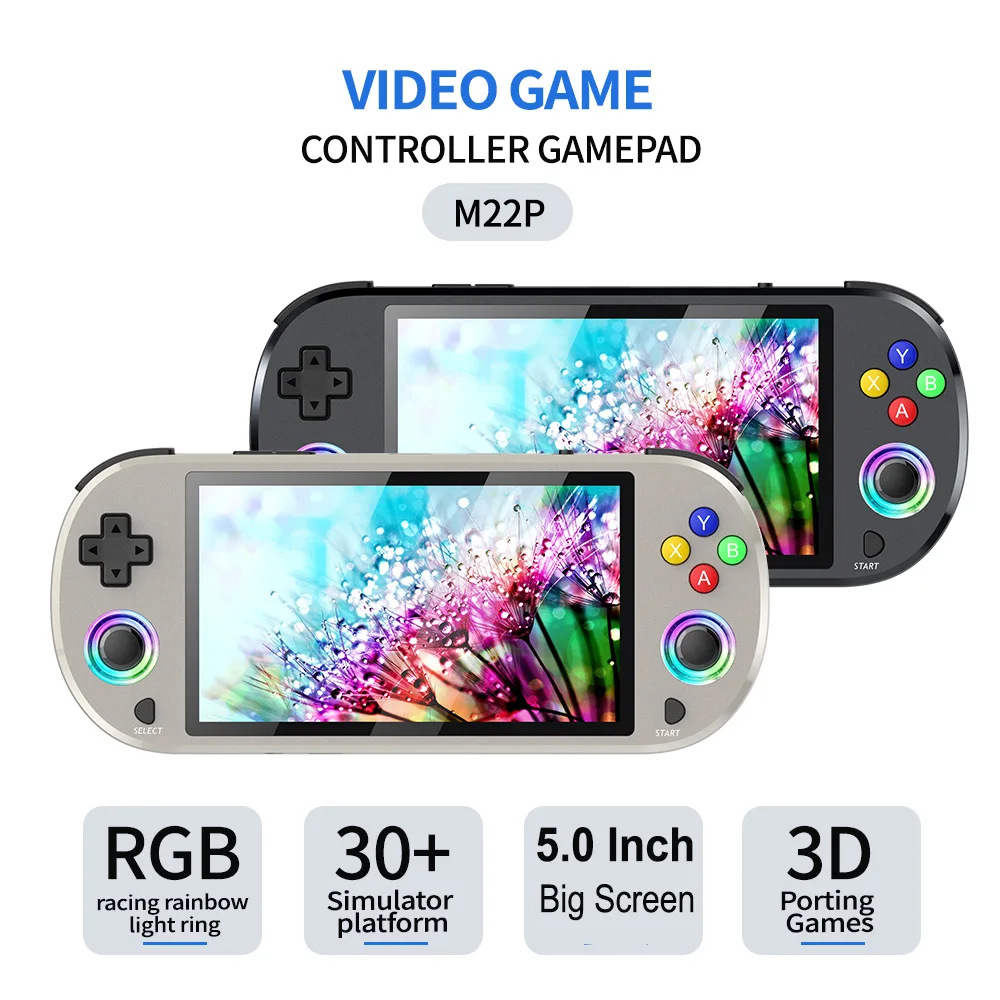
The SJGAM M22 Pro is a sub-$50 emulation handheld that arrived in November 2024 wearing a borrowed silhouette: it copies the TrimUI Smart Pro’s flat-slab, PS Vita-style body almost gesture for gesture, down to the dual symmetrical sticks and the 5-inch 16:9 screen. What it does not copy is the chip inside. Where the Smart Pro runs a quad-core Cortex-A53 Allwinner A133P, the M22 Pro ships a weaker part that SJGAM brands “N909” – four Cortex-A7 cores clocked 1.2 to 1.8 GHz with a Mali-400 MP2 GPU at 500 MHz and 1 GB of RAM. That single substitution defines the whole device. You are buying the look of a 2023-era mid-tier handheld with the silicon of a bargain-bin one.
Emulation performance, generation by generation
Set expectations to the chip, not the chassis. A quad Cortex-A7 paired with a Mali-400 is the same broad class of hardware that powered the earliest cheap Linux handhelds, and it behaves accordingly under the RetroArch and EmulationStation stack that EmuELEC provides. Everything through the 16-bit era is comfortable: NES, Master System, Genesis/Mega Drive, PC Engine, SNES and Game Boy through GBA all run at full speed, and the single-piece d-pad suits them. Arcade is a mixed bag – Final Burn Neo handles CPS1, CPS2 and most pre-3D boards, but heavier CPS3 and larger Neo Geo sets stutter. PlayStation 1 is the honest ceiling: many titles are playable, but expect frame dips in effects-heavy games rather than the locked full speed a stronger chip delivers. Everything above that line is off the table. Nintendo 64, Dreamcast, Saturn and PSP are not realistic on a Mali-400, no matter what the store listing’s inflated emulator count implies.
Screen, build and controls
The screen is the M22 Pro’s most surprising spec and its most suspect. Catalog sheets list a 5-inch, fully laminated IPS panel at 1920×1080 (a claimed 440 ppi) behind tempered glass, at 60 Hz. On paper that is sharper than handhelds three times the price. In practice a Mali-400 cannot render games at 1080p, so titles are drawn at low internal resolutions and scaled up; the high pixel count mainly sharpens the interface and hides the fuzziness that cheaper 640×480 panels show. Full lamination and solid viewing angles are genuine wins. The body is all plastic at 191x81x33 mm, with bump-out grips moulded into the back for a firmer hold than the flat Vita profile suggests. Controls are dual analog sticks ringed with 16-million-colour RGB lighting – potentiometer sticks, not Hall effect, so plan on eventual drift – plus ABXY face buttons, a top-mounted d-pad, and stacked L1/L2 and R1/R2 shoulders. A vibration motor is fitted. Build quality is where the budget shows: reviewers call it functional but far from premium.
Software and setup
The M22 Pro ships on EmuELEC 4.3, a mature Linux emulation distribution, pre-loaded onto the bundled microSD with a large advertised game count. That is the whole software story, and it is the honest catch of any obscure-SoC handheld. The custom-firmware projects buyers ask about – muOS, Knulli, ArkOS, ROCKNIX – are built for specific, well-documented chips such as the RK3326, RK3566 and Allwinner A133P. SJGAM’s “N909” is not a target platform for any of them, so there is effectively no aftermarket firmware scene here; you live on the stock image. That image is competent and configurable, but treat the M22 Pro as a fixed appliance, not a hackable base. Connectivity is sparse: a mini-HDMI port for TV-out, microSD, a 3.5 mm jack, stereo speakers, and USB-C for charging and OTG. Spec sheets list no built-in Wi-Fi or Bluetooth; the two-player pitch comes from a bundled 2.4 GHz wireless controller with its own dongle, not from wireless standards. Charging is a modest 5V/2A into the 3000 mAh cell.
Price, value and who it is for
Prices float between roughly $28 and $50 depending on storefront and bundle, which is the M22 Pro’s real argument. For the cost of a couple of indie games you get a laminated high-resolution panel, HDMI-out, a vibration motor and a second controller in the box – a well-equipped kit for the money. The compromises are equally real: a low-end Cortex-A7/Mali-400 SoC that tops out at wobbly PS1, drift-prone potentiometer sticks, no wireless radios, and a locked stock OS with essentially no custom-firmware path. It suits someone who wants a cheap couch-and-TV machine for 8-bit, 16-bit and light PS1 libraries, or a gift for a younger player who will value the bundled controller and TV-out. Anyone chasing N64 or PSP performance, Hall-effect sticks, or a moddable platform should spend more on a TrimUI Smart Pro or an RK3566-class device. One caveat worth stating plainly: hard technical detail on SJGAM hardware is thin and partly marketing-driven – the weight is unpublished, and some listings overstate connectivity – so confirm the exact bundle and its included accessories before you buy.
📐 Size & Pocketability
🔋 Real-World Battery Estimator
⭐ Emulation Performance
📊 View How This Score is Calculated
The Hardware Power Score is an absolute metric. Perfect emulation of difficult, modern consoles awards significantly more points than standard retro consoles.
- 15× Multiplier: Modern PC
- 12× Multiplier: Switch, PS3, Xbox 360
- 10× Multiplier: Wii U
- 8× Multiplier: PS2, GameCube, Wii, Xbox
- 5× Multiplier: Saturn, Dreamcast, PSP
- 3× Multiplier: N64, PS1
- 1× Multiplier: SNES, GBA
Generation 6
Generation 5
Handhelds & Retro
📋 Full Specifications
📺 Display
⚙️ Platform
💾 Memory
🕹️ Controls
📏 Body
🔋 Battery
⚖️ Verdict
✅ The Good
- Laminated IPS panel with an unusually high pixel count and tempered-glass front for a sub-$50 handheld
- Complete bundle out of the box: mini-HDMI TV-out, a vibration motor, and a 2.4 GHz second controller included
- Runs NES, SNES, Genesis, PC Engine and Game Boy through GBA at full speed on stock EmuELEC
- Very low price, frequently under $40, with plug-and-play preloaded microSD
❌ The Bad
- Weak quad Cortex-A7 / Mali-400 "N909" SoC caps emulation at unstable PS1 – no N64, Dreamcast, Saturn or PSP
- Potentiometer analog sticks (no Hall effect) that will drift over time, plus no built-in Wi-Fi or Bluetooth
- Obscure chip has no muOS/Knulli/ArkOS/ROCKNIX support and thin, marketing-heavy documentation to verify claims against
📰 Latest News & Guides
The Ultimate Guide to ARMSX3: Android’s New PS3 Emulator, Competitor Comparisons, and Setup Tutorial
18/08/2026Pokémon Gold, Silver, and Crystal (Gen 2) Recomp Lands on Android
17/08/2026How to Play the Pokémon Red, Blue, or Yellow Recomp on Your Android, Windows, and Linux Devices
16/08/2026🔍 Similar Handhelds
Other handhelds that emulate up to PS.