
🛒 Where to Buy
⚠️ Golden Rule of Retro Handhelds: Throw away the cheap MicroSD card that comes in the box — it will fail. And never use a high-wattage PD “Fast Charger” on these devices; it can damage the battery. Use a standard 5V/1.5A brick.
Device Overview: Retroid Pocket Flip 2 SD865
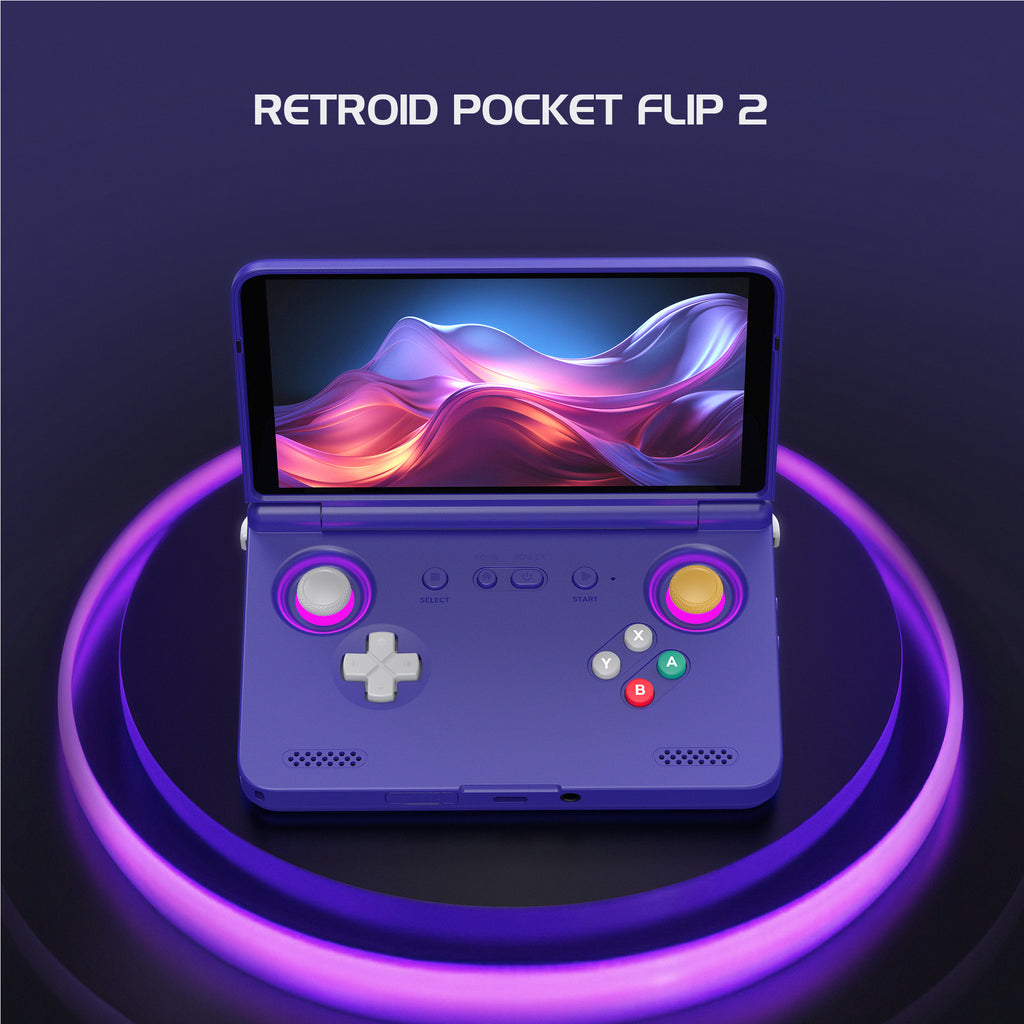
The Retroid Pocket Flip 2 SD865 is a clamshell Android handheld built around a chipset that first shipped in 2020 flagship phones. That is not an insult. The Snapdragon 865 remains the pragmatic sweet spot for emulation, fast enough for the sixth and seventh console generations and cheap enough on the second-hand silicon market to keep the price near $209 to $229. Inside is the familiar 7nm 865 layout, one Cortex-A77 at 2.84GHz, three more at 2.42GHz, and four A55 efficiency cores at 1.8GHz, paired with 8GB of LPDDR4X and 128GB of UFS 3.1 storage. This is the more affordable of the two Flip 2 models Retroid sells, sitting below the Snapdragon 8 Elite version, and it targets buyers who want a folding, screen-protecting DS-style device without paying flagship money for horsepower they will rarely use.
Emulation performance, generation by generation
Everything through the fifth generation runs without drama. PS1 in DuckStation, N64 in Mupen and RetroArch, PSP in PPSSPP, Dreamcast and Naomi in Flycast, and Saturn in the heavier RetroArch cores all hold full speed, usually with upscaling and texture filtering switched on. The Adreno 650 GPU is the star of this chip. GameCube and Wii in Dolphin are where the 865 earns its keep: the large majority of the library runs at full speed at 2x or 3x internal resolution, though genuinely demanding titles such as the Rogue Squadron games or the Metroid Prime trilogy at high resolutions will make you drop settings. PS2 through AetherSX2 or its NetherSX2 fork is similar, with most games excellent and a handful of the notoriously heavy ones not. Nintendo 3DS via Azahar, the successor to Citra and Lime3DS, is solid. Above that, be realistic. Switch emulation on Eden and other post-Yuzu forks will run 2D and lighter 3D titles but chokes on the demanding first-party games, and PS Vita through Vita3K remains a per-game gamble. Treat this as a machine that masters everything up to GameCube and PS2, dabbles above that line, and stops well short of being a dedicated Switch emulator.
Screen, build and controls
The 5.5-inch 1080p AMOLED is the best single reason to pick this over cheaper handhelds. It reaches around 500 nits, uses DC dimming to cut OLED flicker, and its 400 PPI density makes upscaled GameCube and PS2 output genuinely crisp. The 16:9 shape suits widescreen 3D emulation but leaves letterbox bars around 4:3 retro content, which is the trade-off of any 1080p panel. The clamshell hinge folds the screen inward for pocket safety, openly echoing the DS and 3DS it idolizes. Retroid copied the Wii U GamePad layout, stacking both analog sticks above the D-pad and face buttons; it reads oddly in photos but works in hand, and it keeps the recessed Hall-effect sticks from touching the panel when the lid is closed. Those magnetic sticks resist the drift that eventually kills potentiometer-based controllers, and the analog L2 and R2 triggers are a real asset for racing and shooter emulation. At roughly 300 grams it is dense but not heavy, and the folded thickness of 24 to 31 mm makes it a genuinely pocketable object rather than a bag-only device. Connectivity covers the essentials for the class: Wi-Fi 6, Bluetooth 5.1, a USB-C port with video output, and a 3.5mm headphone jack that too many rivals now omit. The 5000mAh battery is sizeable for a device this small, and it charges over USB-C, though heavy Dolphin and PS2 sessions will still drain it in a few hours.
Software and setup
It ships on stock Android 13, so setup means the usual Android chores: sideloading RetroArch and the standalone emulators, installing a frontend such as Daijisho or ES-DE, and pointing them at your ROM folders on a microSD card. Retroid’s own launcher is serviceable out of the box. Because this is a Snapdragon Android device, the Linux custom-firmware names you hear on cheaper hardware, such as muOS, Knulli, ArkOS and OnionOS, do not apply here; those are built for Rockchip and Allwinner Linux handhelds, and EmuDeck is a PC and Steam Deck tool. The alternatives that actually matter on this device are GammaOS, a stripped-down Android build that removes Google bloat and frees up performance and battery, and ROCKNIX, a Linux distribution some owners flash for a console-style, boot-straight-to-games experience. Most people should simply stay on stock Android and tune settings per emulator.
Price, value and who it is for
At roughly $209 to $229 the Flip 2 SD865 is not the cheapest way to emulate PS1 or Game Boy; a $60 Linux handheld does that. You are paying for the AMOLED panel, the folding form factor, the Hall sticks, and enough GPU muscle for confident GameCube and PS2 play. It makes the most sense for someone who wants a modern DS-shaped device that fits in a jacket pocket and clears the sixth generation cleanly, and who does not need bleeding-edge Switch performance. If your wishlist is dominated by demanding Switch or Wii U titles, spend more on the 8 Elite model or a proper PC handheld instead. If your library stops around GameCube and PS2, this is the one to buy, and the clamshell design means the screen survives your bag.
📐 Size & Pocketability
⚖️ Weight vs Other Handhelds
🔋 Real-World Battery Estimator
⭐ Emulation Performance
📊 View How This Score is Calculated
The Hardware Power Score is an absolute metric. Perfect emulation of difficult, modern consoles awards significantly more points than standard retro consoles.
- 15× Multiplier: Modern PC
- 12× Multiplier: Switch, PS3, Xbox 360
- 10× Multiplier: Wii U
- 8× Multiplier: PS2, GameCube, Wii, Xbox
- 5× Multiplier: Saturn, Dreamcast, PSP
- 3× Multiplier: N64, PS1
- 1× Multiplier: SNES, GBA
Gen 8 & PC
Generation 7
Generation 6
Generation 5
Handhelds & Retro
⚡ Performance Benchmarks
Where Retroid Pocket Flip 2 SD865 Adreno 650 lands against the handhelds everyone knows. Every bar shares one scale, so longer genuinely means faster — add up to two rivals to compare.
CPU = Geekbench 6 multi-core · GPU = 3DMark Wild Life. Median real-world scores; every bar shares one scale — add up to two rivals to compare.
📋 Full Specifications
📺 Display
⚙️ Platform
💾 Memory
🕹️ Controls
📏 Body
🔋 Battery
⚖️ Verdict
✅ The Good
- Excellent 5.5-inch 1080p AMOLED with DC dimming and ~500 nits, unusually good for the price
- Snapdragon 865 and Adreno 650 handle GameCube and PS2 confidently, with headroom for 2x-3x upscaling
- Hall-effect analog sticks and analog L2/R2 triggers resist drift and improve racing and shooter feel
- Clamshell design protects the screen and keeps the device genuinely pocketable at ~300g, with Wi-Fi 6, BT 5.1 and a 3.5mm jack
❌ The Bad
- Not a real Switch or PS Vita machine; demanding first-party titles stutter or fail
- 16:9 panel letterboxes 4:3 retro content, and stock Android setup takes more effort than a plug-and-play Linux handheld
- Costs far more than a basic retro handheld while using a 2020-era phone chip, so PS1-and-below buyers overpay
📰 Latest News & Guides
The Ultimate Guide to ARMSX3: Android’s New PS3 Emulator, Competitor Comparisons, and Setup Tutorial
18/08/2026Pokémon Gold, Silver, and Crystal (Gen 2) Recomp Lands on Android
17/08/2026How to Play the Pokémon Red, Blue, or Yellow Recomp on Your Android, Windows, and Linux Devices
16/08/2026🔍 Similar Handhelds
Other handhelds that emulate up to Switch.