
🛒 Where to Buy
⚠️ Golden Rule of Retro Handhelds: Throw away the cheap MicroSD card that comes in the box — it will fail. And never use a high-wattage PD “Fast Charger” on these devices; it can damage the battery. Use a standard 5V/1.5A brick.
Device Overview: Anbernic RG-477M
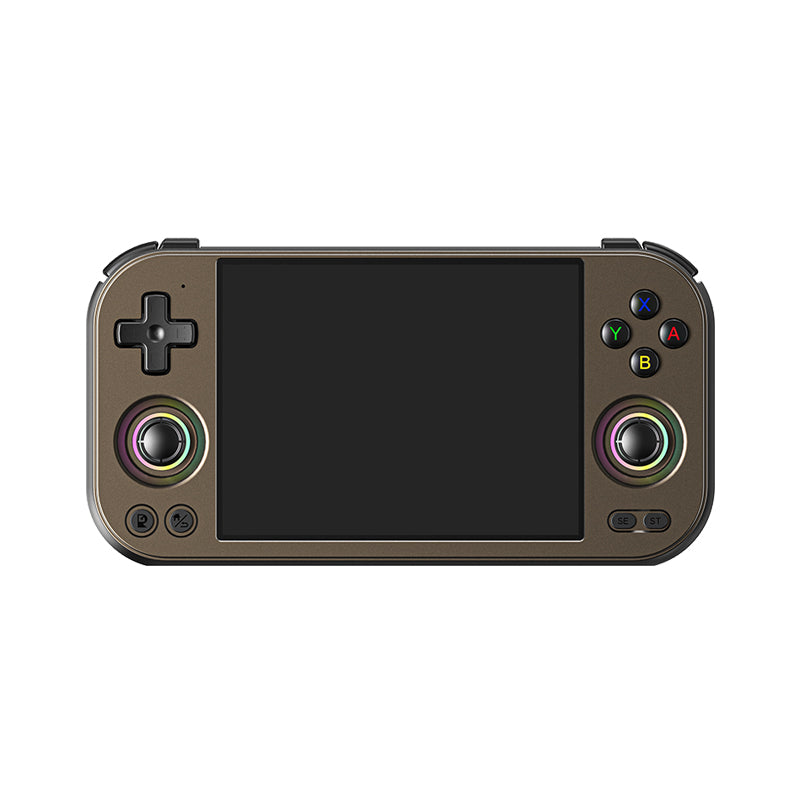
The Anbernic RG-477M is the company’s attempt to build a premium Android emulation handheld without borrowing the phone-slab shape everyone else uses. It pairs a MediaTek Dimensity 8300 – a genuine 2024 flagship-tier mobile chip – with a 4.7-inch 4:3 screen and a full CNC-machined aluminium shell. That combination is unusual. Most Android handhelds in this bracket ship a Snapdragon and a widescreen panel; Anbernic went the other way, betting that retro players care more about a squarish display and a metal chassis than about video in 16:9. It arrived in 2025 in two tiers – 8GB LPDDR5 with 128GB UFS storage, or 12GB with 256GB – both expandable by microSD. At a launch price of $239.99 for the 8GB model, it sits above budget devices and below the RG556, which remains the pick if you specifically want AMOLED contrast and a larger screen.
Emulation performance, generation by generation
The Dimensity 8300 (4nm, one Cortex-A715 at 3.35GHz, three more at 3.20GHz, four A510 cores at 2.2GHz) has the raw CPU to run almost anything up to sixth-generation consoles. In practice the ceiling is set by its Mali-G615 MC6 GPU, not its cores. Mali graphics have historically weaker emulator driver support than Qualcomm’s Adreno, and it shows here. Everything through PlayStation 1, Nintendo 64, Dreamcast and PSP runs at or above full speed under RetroArch and standalone cores. PlayStation 2 via AetherSX2 and GameCube via Dolphin are the sweet spot this device is built for, and most of those libraries hold full speed with upscaling. Push past that and the picture gets honest: Wii is inconsistent, and Switch, PS3 and Wii U are effectively out of reach – the drivers and the GPU simply are not there on a Mali part. Reviewers also measured shaky GPU stability under sustained load, so the most demanding PS2 and GameCube titles can throttle. Treat this as a superb PS1-through-GameCube machine, not a Switch emulator.
Screen, build and controls
The 4.7-inch LTPS In-Cell panel runs 1280×960 – a true 4:3 shape – at up to 120Hz, fully laminated. That aspect ratio is the whole design thesis: SNES, PS1, GameCube and most arcade output map to it cleanly and scale to a sharp 4x, and 120Hz enables black-frame insertion for cleaner motion. The trade-off is real. Widescreen content – PSP, Dreamcast, most modern 3D – gets thick letterboxing, so if half your library is 16:9 this is the wrong screen. The body is CNC aluminium in Chocolate Bronze or Silver Blade, weighs 354g, measures 176 x 89.4 x 16mm, and feels considerably more expensive than plastic rivals. The analogue sticks use Hall-effect sensors, so stick drift should never develop. The d-pad and face buttons are responsive; the notable flaw is the shoulder buttons, which one reviewer called the loudest microswitches they had tested, and the active cooling fan can whine under load. A six-axis gyroscope, RGB stick lighting and a rumble motor round out the controls, fed by a 5300mAh battery good for roughly seven hours of retro play and 27W charging.
Software and setup
This is an Android 14 device, so forget the Linux custom-firmware world – muOS, Knulli, ArkOS, ROCKNIX and Batocera are not part of this ecosystem. Your setup work is app and front-end management instead. It ships with RetroArch, AetherSX2 and Anbernic’s own RG Launcher, though the stock RetroArch arrived with outdated cores and Chinese-language defaults, so a clean reinstall from the Play Store is the first thing most owners do. From there the standard Android emulation stack applies: standalone Dolphin, DraStic for DS, Lime3DS or Citra forks for 3DS, PPSSPP for PSP, and Winlator if you want to experiment with light x86. Front-ends such as Daijisho or ES-DE tidy the library, and the microSD slot handles the large ROM sets that GameCube and PS2 collections demand. Because it is full Android with Wi-Fi 6E and Bluetooth 5.3, game streaming through Moonlight or Xbox Cloud, storefronts and Bluetooth controller pairing all work out of the box – it is a general Android device that happens to have good buttons.
Price, value and who it is for
Pricing runs from $239.99 for 8GB/128GB to roughly $289.99 for the 12GB/256GB version. That is a lot for a device whose emulation stops at the sixth console generation, and the value question hinges entirely on how much you want the metal shell and the 4:3 screen. If you play mostly PS1, N64, GameCube and 2D systems and you want a handheld that feels like a machined object rather than a toy, the RG-477M earns its price. If your backlog is PSP, Vita-era widescreen or you were hoping to touch Switch, look elsewhere – the aspect ratio and the Mali GPU will both frustrate you. It is a specialist’s device: a beautifully built retro console emulator with a deliberately narrow, and deliberately excellent, focus.
📐 Size & Pocketability
⚖️ Weight vs Other Handhelds
🔋 Real-World Battery Estimator
⭐ Emulation Performance
📊 View How This Score is Calculated
The Hardware Power Score is an absolute metric. Perfect emulation of difficult, modern consoles awards significantly more points than standard retro consoles.
- 15× Multiplier: Modern PC
- 12× Multiplier: Switch, PS3, Xbox 360
- 10× Multiplier: Wii U
- 8× Multiplier: PS2, GameCube, Wii, Xbox
- 5× Multiplier: Saturn, Dreamcast, PSP
- 3× Multiplier: N64, PS1
- 1× Multiplier: SNES, GBA
Gen 8 & PC
Generation 7
Generation 6
Generation 5
Handhelds & Retro
📋 Full Specifications
📺 Display
⚙️ Platform
💾 Memory
🕹️ Controls
📏 Body
🔋 Battery
⚖️ Verdict
✅ The Good
- Full CNC-aluminium body in two finishes at 354g – genuinely premium hardware, not plastic pretending to be metal
- True 4:3 1280×960 120Hz screen with black-frame insertion – ideal geometry for retro consoles and clean 4x scaling
- Hall-effect analogue sticks that will not develop drift, plus six-axis gyro and rumble
- Dimensity 8300 comfortably runs PS1, N64, Dreamcast and most PS2 and GameCube libraries
❌ The Bad
- Mali-G615 GPU and weak driver support cap it below Switch/PS3 and cause GPU-stability throttling under sustained load
- The 4:3 screen heavily letterboxes PSP, Dreamcast and other widescreen content
- Loud shoulder microswitches and an audible cooling fan under stress, on a device that starts at $239.99
📰 Latest News & Guides
The Ultimate Guide to ARMSX3: Android’s New PS3 Emulator, Competitor Comparisons, and Setup Tutorial
18/08/2026Pokémon Gold, Silver, and Crystal (Gen 2) Recomp Lands on Android
17/08/2026How to Play the Pokémon Red, Blue, or Yellow Recomp on Your Android, Windows, and Linux Devices
16/08/2026🔍 Similar Handhelds
Other handhelds that emulate up to Switch.