
🛒 Where to Buy
⚠️ Golden Rule of Retro Handhelds: Throw away the cheap MicroSD card that comes in the box — it will fail. And never use a high-wattage PD “Fast Charger” on these devices; it can damage the battery. Use a standard 5V/1.5A brick.
Device Overview: ONEXSUGAR SUGAR 1
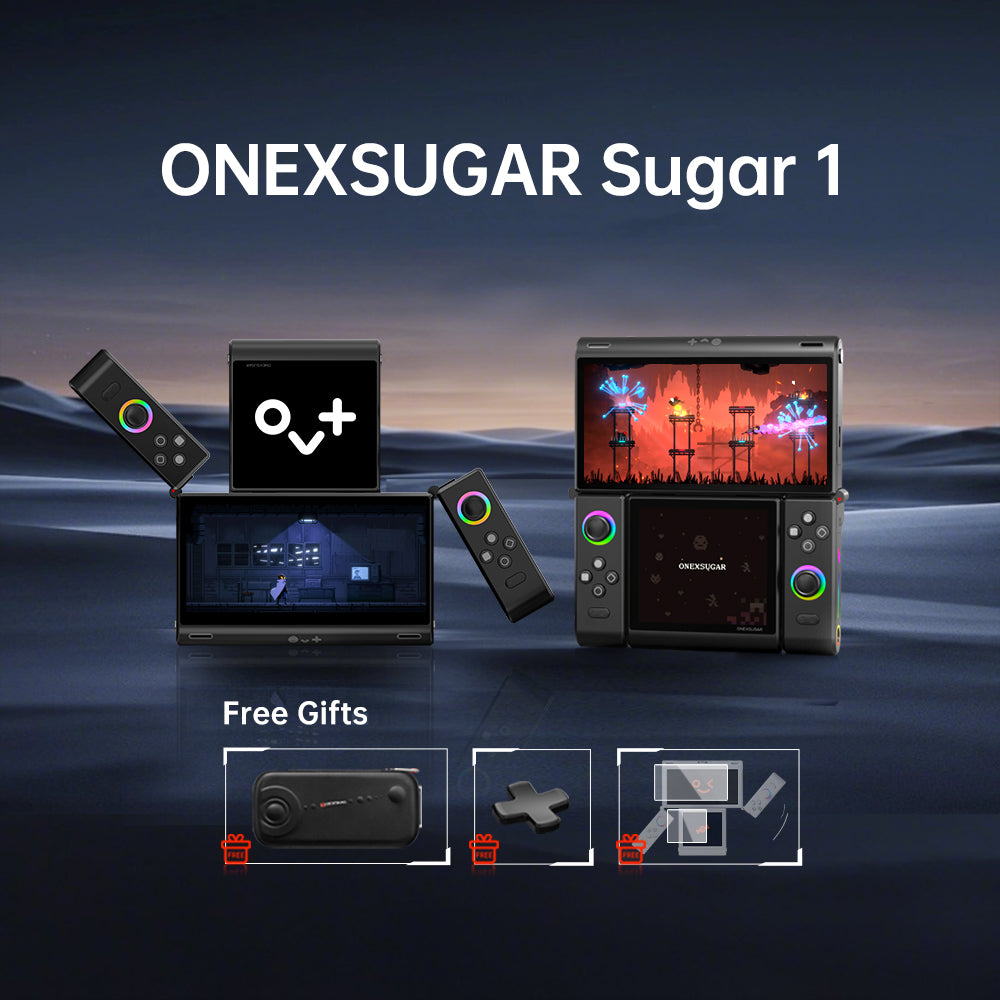
The ONEXSUGAR SUGAR 1 is One-Netbook’s strangest handheld to date: a Snapdragon-powered Android device with two OLED panels that physically slide apart, converting a PlayStation Vita-shaped slab into something that mimics a Nintendo DS. It reached the public through an Indiegogo campaign in mid-2025 starting at $599, with retail configurations climbing to $799, and it is one of the first handhelds to ship with Qualcomm’s Snapdragon G3 Gen 3. The transforming gimmick is not decoration here. The lower 3.92-inch screen is the entire reason to consider this device over a cheaper, simpler competitor, and everything else about the SUGAR 1 should be judged against whether that trick is worth the premium.
Emulation performance, generation by generation
Because this is an ARM Android device and not an x86 Windows machine, treat it as a phone-class chip with a gaming license rather than a Steam Deck rival. The Snapdragon G3 Gen 3 pairs an eight-core Kryo CPU with an Adreno A32 GPU that supports ray tracing, and with 16GB of LPDDR5X behind it, the chip clears everything up to the sixth console generation without breaking a sweat. PS1 through DuckStation, N64 via Mupen64Plus in RetroArch, Dreamcast on Flycast, PSP through PPSSPP and every 2D system run at full speed with headroom left over. PS2 emulation through AetherSX2 or the NetherSX2 fork is the realistic ceiling for near-perfect play: most of the library holds full speed, while the heavy hitters like Gran Turismo 4 and God of War still want per-game tuning. GameCube and Wii on Dolphin land in genuinely strong territory. Nintendo DS is the headline act, because DraStic and melonDS finally get two real physical screens instead of a squashed split view, and Citra-derived 3DS emulators benefit from the same layout. Switch emulation exists through forks such as Citron and Eden, and many titles hover near 30fps, but treat that as a bonus rather than a promise, complete with stutter and per-game hacks.
Screen, build and controls
The main panel is a 6.01-inch AMOLED at 2160×1080 running up to 144Hz, and the secondary is a 3.92-inch AMOLED at 1240×1080 capped at 60Hz. Both are touch-enabled, and both peak around 450 nits, which is bright enough indoors but marginal in direct sunlight. The blacks and colour saturation are the real thing rather than an IPS panel wearing an OLED label. The slide mechanism swaps a single-screen Vita mode for a stacked dual-screen DS mode, and it feels like most of the engineering budget went here. Controls are a mixed report. The Hall-effect analog sticks with RGB rings resist drift, there is a 3-axis gyro, and the D-pad is a swappable magnetic module. The sting is in the triggers: L2 and R2 are digital microswitches with no analog travel, which hurts in racing games and anything expecting variable throttle. At 486 grams the SUGAR 1 is not light, and the tall dual-screen body is awkward in smaller hands. Connectivity is current-generation, with Wi-Fi 7, Bluetooth 5.3 and a USB-C port that carries video out for docked play on a television, and a dual-fan cooling system keeps the chip from throttling during long PS2 or Dolphin sessions.
Software and setup
It ships on Android 14 with One-Netbook’s Sugar Console overlay handling screen-mode switching, touch key-mapping, fan curves and RGB lighting. There is no Linux custom-firmware path here, and that distinction matters. The muOS, Knulli, ArkOS, ROCKNIX and Batocera ecosystem that defines cheap Rockchip handhelds simply does not apply to a Snapdragon Android device, so nobody is flashing an SD card image onto this. What you actually do is install from the Play Store or sideload: RetroArch plus standalone emulators such as DuckStation, PPSSPP, Dolphin, AetherSX2 and melonDS, a front-end like Daijisho or ES-DE to tie the collection together, and cloud apps such as GeForce Now or Xbox for modern AAA. The catch specific to this device is that not every emulator knows what to do with a second physical panel, so routing DS or 3DS output onto the lower screen takes per-app configuration rather than working the moment you launch it.
Price, value and who it is for
This is an expensive and deliberately weird handheld. At the $599 early-bird price it was aggressive, but at the $699 to $799 retail range it sits alongside the Retroid Pocket 5 and AYN Odyssey class of Snapdragon Android devices that cost far less and emulate the same libraries just as capably on a single screen. You are paying the premium for one trick: real dual-screen DS and 3DS play, plus Android multitasking across two panels. If that is the exact itch you have, nothing else on the market scratches it. If you just want a great sub-PS2 emulation machine, cheaper Snapdragon or even Dimensity handhelds deliver most of the same experience for half the money. The SUGAR 1 is for the DS-obsessed and the gadget collector, not the value shopper, and the digital triggers combined with the asking price keep it from being an easy recommendation.
📐 Size & Pocketability
⚖️ Weight vs Other Handhelds
🔋 Real-World Battery Estimator
⭐ Emulation Performance
📊 View How This Score is Calculated
The Hardware Power Score is an absolute metric. Perfect emulation of difficult, modern consoles awards significantly more points than standard retro consoles.
- 15× Multiplier: Modern PC
- 12× Multiplier: Switch, PS3, Xbox 360
- 10× Multiplier: Wii U
- 8× Multiplier: PS2, GameCube, Wii, Xbox
- 5× Multiplier: Saturn, Dreamcast, PSP
- 3× Multiplier: N64, PS1
- 1× Multiplier: SNES, GBA
Gen 8 & PC
Generation 7
Generation 6
Generation 5
Handhelds & Retro
📋 Full Specifications
📺 Display
⚙️ Platform
💾 Memory
🕹️ Controls
📏 Body
🔋 Battery
⚖️ Verdict
✅ The Good
- Genuine dual physical OLED screens make Nintendo DS and 3DS emulation feel native rather than a cramped split view
- Snapdragon G3 Gen 3 with 16GB LPDDR5X comfortably handles everything through PS2, GameCube and Wii
- Two real AMOLED panels (144Hz main, 2160×1080) with strong blacks and saturation, not fake OLED labeling
- Hall-effect sticks resist drift and the D-pad is a swappable magnetic module
❌ The Bad
- Digital-only L2/R2 triggers with no analog travel hurt racing games and variable-throttle titles
- Priced at $699 to $799 retail, far above single-screen Snapdragon handhelds that emulate the same libraries
- At 486g with a tall transforming body it is heavy and awkward in smaller hands, and dual-screen output needs per-emulator setup
📰 Latest News & Guides
The Ultimate Guide to ARMSX3: Android’s New PS3 Emulator, Competitor Comparisons, and Setup Tutorial
18/08/2026Pokémon Gold, Silver, and Crystal (Gen 2) Recomp Lands on Android
17/08/2026How to Play the Pokémon Red, Blue, or Yellow Recomp on Your Android, Windows, and Linux Devices
16/08/2026🔍 Similar Handhelds
Other handhelds that emulate up to CURRENTGEN.