
🛒 Where to Buy
⚠️ Golden Rule of Retro Handhelds: Throw away the cheap MicroSD card that comes in the box — it will fail. And never use a high-wattage PD “Fast Charger” on these devices; it can damage the battery. Use a standard 5V/1.5A brick.
Device Overview: KONKR Pocket Fit
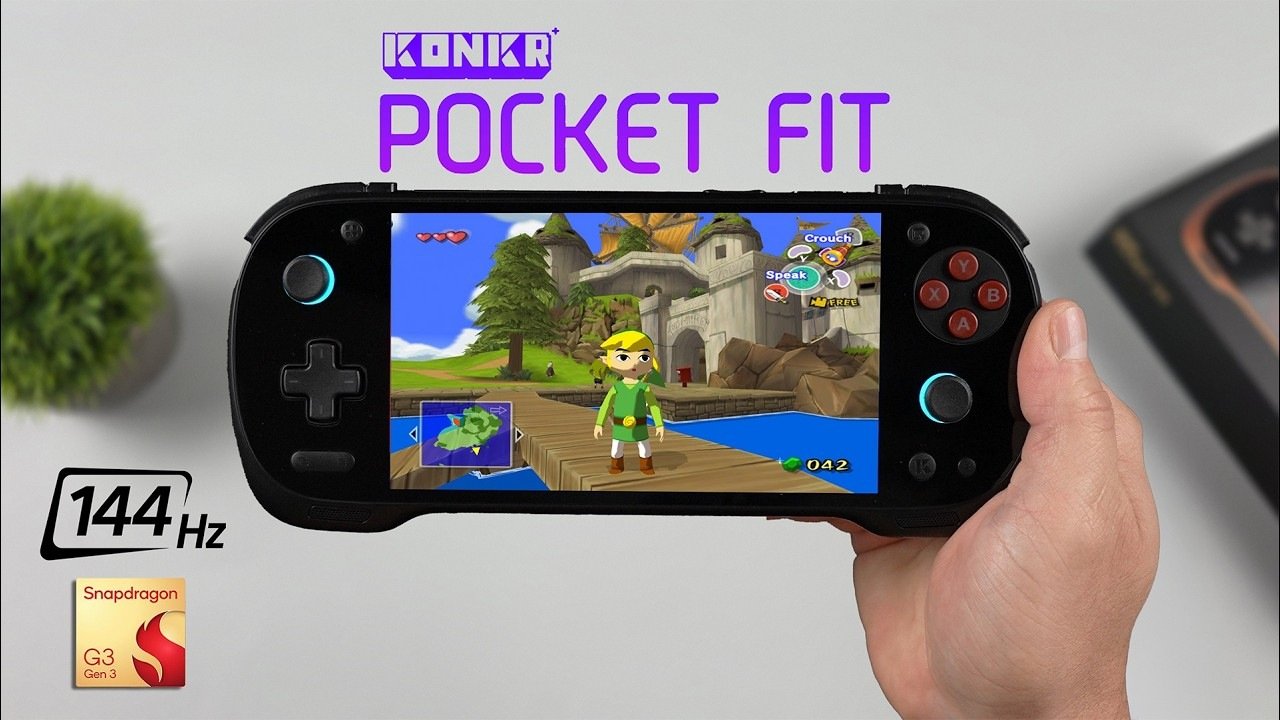
The KONKR Pocket Fit is an Android gaming handheld built by KONKR, a hardware label operating under AYANEO’s umbrella, and it launched through an Indiegogo campaign in late 2025 before moving to direct sale. Its pitch is blunt: take the Qualcomm Snapdragon G3 Gen 3 that powers the pricier AYANEO Pocket S2, wrap it in a plastic shell with ergonomic rear grips, and undercut everything around it. A step-up variant swaps in the Snapdragon 8 Elite, but the G3 Gen 3 model is the one that defines the device and the one most reviewers actually tested. This is not a Nintendo or Sony console, and it is not a cheap Linux emulation brick either; it is a full Android 14 tablet with gamepad grips bolted around a 6-inch 1080p screen.
Emulation performance, generation by generation
The G3 Gen 3, with its eight Kryo cores and Adreno A32-class GPU, sits in the upper tier of Android handheld silicon without reaching the Snapdragon 8 Elite’s heights. Everything from the 8-bit and 16-bit era through PlayStation 1, Nintendo 64, Dreamcast and PSP runs at full speed with headroom for upscaling and shaders. PlayStation 2 on AetherSX2, or its NetherSX2 fork, is the sweet spot: most of the library runs at 2x or 3x internal resolution without dropping frames. GameCube and Wii on Dolphin are genuinely comfortable, often doubling internal resolution on demanding titles. Nintendo Switch emulation through the post-Yuzu forks such as Eden and Citron is playable with per-game tuning rather than plug-and-play, and the heaviest first-party games still stutter. Windows games are not native here; they run through translation layers like Winlator and GameHub, which wrap Box64 and DXVK. That path gets The Witcher 3 to roughly 25-30 fps on medium and GTA V into the mid-30s, but it demands patience with per-game settings. PS3 is possible but rough. Treat PS2 and GameCube as the confident ceiling and Switch as a project.
Screen, build and controls
The 6-inch LCD runs 1920×1080 at up to 144Hz, a sharp 367-PPI panel that reviewers rate highly for an IPS screen while noting it is not OLED, so blacks stay gray. The 16:9 aspect ratio suits PS2-era and modern content but pillarboxes older 4:3 systems. Both analog sticks use Hall effect sensors, which kills stick drift, though they sit on the small side and the stock caps are slick enough that KONKR bundles grippier replacements. The triggers are the standout: a physical flip switch converts each L2/R2 between full analog travel and a short microswitch click, handy for swapping between racing games and shooters. The d-pad is light and pivots cleanly, and the sticks carry RGB rings for anyone who wants the lighting. At around 386 grams with an 8000mAh battery in a 225 x 97mm chassis, it is not featherweight, but the rear grips make the heft manageable, and battery life runs from a couple of hours under a heavy Windows load to over ten hours on light retro cores. Connectivity covers Wi-Fi 6, Bluetooth 5.3, a 3.5mm jack, a microSD slot and USB-C, with the port doubling as video-out to an external display at up to 1440p and 144Hz.
Software and setup
Because this is Android, not a Linux emulation OS, the muOS, Knulli, ArkOS, ROCKNIX and Batocera custom-firmware ecosystem simply does not apply here. There is no equivalent CFW scene, and treating it like an Anbernic or Miyoo device is a category error. Setup instead means installing Android emulators yourself: RetroArch, AetherSX2 or NetherSX2, Dolphin, DuckStation, the Switch forks, and a Windows layer such as Winlator or GameHub. KONKR ships its own launcher, and the bundled GameHub app streamlines grabbing and configuring content, though front-ends like Daijisho, ES-DE or Beacon give a cleaner console-style shelf. EmuDeck’s Android build can automate a lot of this. The upside of Android is Google Play access for native mobile games, cloud streaming and store apps; the downside is the usual Android housekeeping and no single tidy plug-in-a-card experience.
Price, value and who it is for
Pricing is the moving target. Crowdfunding entry pricing sat near $239-269 for the 8GB/128GB G3 Gen 3 model, with 12GB and 16GB tiers around $329 and $429; post-campaign retail on AYANEO’s storefront runs considerably higher, and the Snapdragon 8 Elite configurations climb past $1,000 at the 24GB/1TB top end. At the campaign price the value case was strong, because little else paired this chip with a 1080p 144Hz screen and Hall sticks for the money; at full retail it competes more directly with the AYN Odin 3 and Retroid’s higher-end models. Buy it if you want PS2, GameCube and Wii running flawlessly, are comfortable assembling your own Android emulation stack, and value the flip triggers and drift-free sticks. Skip it if you want an OLED screen, a ready-to-go Linux CFW handheld, or reliable Switch performance out of the box.
📐 Size & Pocketability
⚖️ Weight vs Other Handhelds
🔋 Real-World Battery Estimator
⭐ Emulation Performance
📊 View How This Score is Calculated
The Hardware Power Score is an absolute metric. Perfect emulation of difficult, modern consoles awards significantly more points than standard retro consoles.
- 15× Multiplier: Modern PC
- 12× Multiplier: Switch, PS3, Xbox 360
- 10× Multiplier: Wii U
- 8× Multiplier: PS2, GameCube, Wii, Xbox
- 5× Multiplier: Saturn, Dreamcast, PSP
- 3× Multiplier: N64, PS1
- 1× Multiplier: SNES, GBA
Gen 8 & PC
Generation 7
Generation 6
Generation 5
Handhelds & Retro
📋 Full Specifications
📺 Display
⚙️ Platform
💾 Memory
🕹️ Controls
📏 Body
🔋 Battery
⚖️ Verdict
✅ The Good
- Snapdragon G3 Gen 3 runs PS2, GameCube and Wii at full speed with room to upscale to 2x-3x internal resolution
- Sharp 6-inch 1080p 144Hz IPS panel at 367 PPI, an unusually high display spec for its price bracket
- Hall effect sticks eliminate drift, and the flip-switch triggers toggle each L2/R2 between analog travel and a microswitch click
- Large 8000mAh battery gives 10-plus hours on light retro cores, and the Android base adds Play Store, cloud streaming and native apps
❌ The Bad
- LCD not OLED, so black levels are gray, and the 16:9 panel pillarboxes 4:3 retro systems
- No Linux custom-firmware scene (muOS/Knulli/ArkOS do not apply); you must build and tune the Android emulator stack yourself, and Switch needs per-game work
- Retail pricing has climbed well above the crowdfunding entry cost, and final shipping specs on this newer AYANEO sub-brand still carry some uncertainty
📰 Latest News & Guides
The Ultimate Guide to ARMSX3: Android’s New PS3 Emulator, Competitor Comparisons, and Setup Tutorial
18/08/2026Pokémon Gold, Silver, and Crystal (Gen 2) Recomp Lands on Android
17/08/2026How to Play the Pokémon Red, Blue, or Yellow Recomp on Your Android, Windows, and Linux Devices
16/08/2026🔍 Similar Handhelds
Other handhelds that emulate up to CURRENTGEN.