
🛒 Where to Buy
⚠️ Golden Rule of Retro Handhelds: Throw away the cheap MicroSD card that comes in the box — it will fail. And never use a high-wattage PD “Fast Charger” on these devices; it can damage the battery. Use a standard 5V/1.5A brick.
Device Overview: XURetro XU35 H50
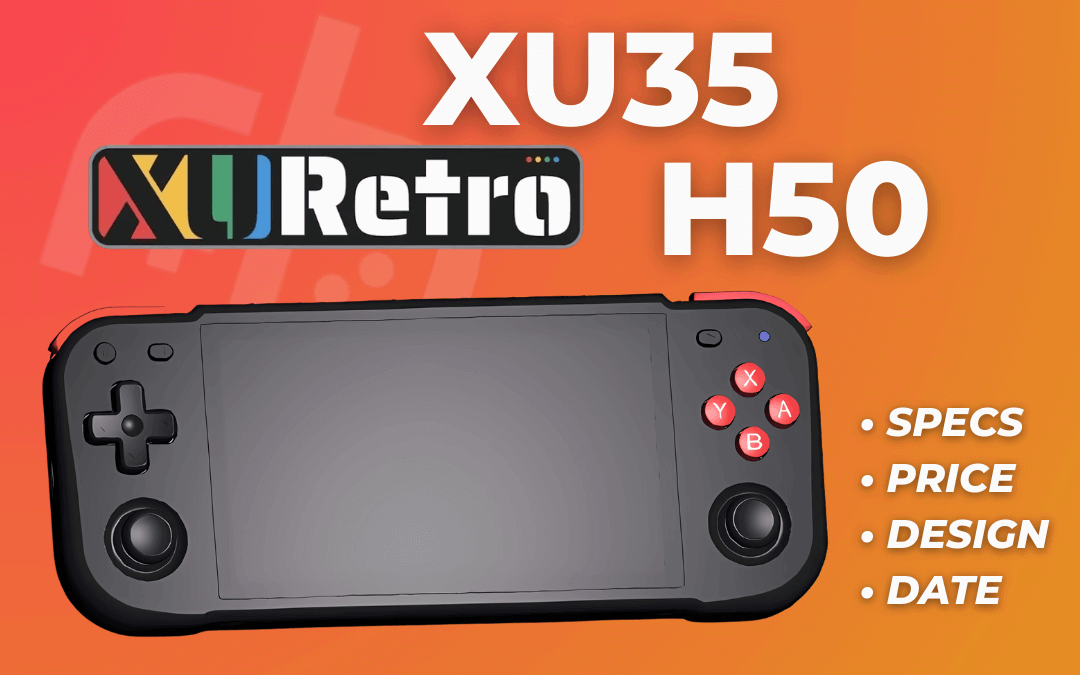
The XURetro XU35 H50 is a budget Android retro handheld announced for an October 2025 launch at $85, with a $75 early-bird price. It is built around the MediaTek Helio G85, a 12nm octa-core Android SoC (two Cortex-A75 cores at 2.0 GHz, six Cortex-A55 cores at 1.8 GHz, Mali-G52 MC2 GPU) that first shipped in 2020-era budget phones like the Redmi Note 9. XU Retro pitches it squarely against the Mangmi Air X, and the whole proposition is simple: a horizontal 5-inch device with Hall-effect controls at the price of an entry-level vertical. That is the honest frame here. This is a value play, not a performance flagship.
Emulation performance, generation by generation
The Helio G85 lands roughly where the Unisoc T618 does, the chip inside the Retroid Pocket 3+ and Anbernic RG552, so set expectations there rather than imagining a Snapdragon device. One caveat: the G85’s Mali-G52 MC2 is a touch weaker than the T618’s GPU in some workloads, so treat T618 as the optimistic ceiling, not a guarantee. Anything from the 8-bit and 16-bit eras up through the arcade boards RetroArch handles (NES, SNES, Genesis, Neo Geo, CPS) is trivial and runs full speed with room to spare. Everything through the fifth console generation is comfortable too. PS1 via DuckStation, N64 via Mupen64Plus FZ, and Sega Saturn via Yaba Sanshiro run at or near full speed. PSP through PPSSPP is a strong point; most of the library holds 60fps at 2x-3x resolution, with the heaviest 3D titles (God of War, the racing sims) needing native res. Dreamcast on Flycast or Redream is essentially solved, and Nintendo DS via DraStic is smooth. The interesting line is the sixth generation. GameCube and PS2 on Dolphin and AetherSX2/NetherSX2 are selective, not blanket: 2D and lighter 3D games are playable, but demanding titles will chug, and the Mali-G52 is the bottleneck. Treat PS2 and GameCube as a bonus you test game-by-game, not a headline feature. Wii-heavy libraries and 3DS emulation (Azahar) are beyond this chip. XU Retro itself name-checks the PS2 Animal Crossing port as a viable pick, which tells you the tier honestly.
Screen, build and controls
The display is a 5-inch 1280×720 panel in a 16:9 layout, and XU Retro has confirmed it protrudes slightly beyond the body, an unusual edge-to-edge look for the class. 720p at 5 inches is a sensible density; it is a clean multiple for 240p sources and sharp enough for PSP. Panel type (IPS versus anything else) and refresh rate have not been published, so assume a standard 60Hz IPS until XU Retro confirms otherwise. The controls are the headline: the dual analog sticks and the triggers both use Hall-effect sensors, which is genuinely uncommon at $75-85 and directly addresses the stick drift that plagues cheap handhelds. A full face-button set, d-pad, and start/select/home round it out. What is missing from the spec sheet matters. Battery capacity, weight, and dimensions are not disclosed, and neither are connectivity specifics beyond it being an Android device (so Wi-Fi and Bluetooth are a safe assumption; HDMI/TV-out is unconfirmed). Buy expecting an Android-standard battery, and verify runtime from reviews before you count on all-day play.
Software and setup
This is an Android handheld, not a Linux one, and that shapes everything about setup. There is no muOS, Knulli, ArkOS, ROCKNIX, or OnionOS scene here; those firmwares target Rockchip and Allwinner Linux devices, not MediaTek Android SoCs. What you actually get is stock Android (version unconfirmed at announcement) with whatever launcher XU Retro preloads. The real work is on you: install RetroArch plus standalone emulators (DuckStation, PPSSPP, Dolphin, Flycast, DraStic) from their own sources, then organize everything behind a frontend. Daijisho and ES-DE are the two community frontends worth your time, and they turn the stock experience into something that feels purpose-built. Because it is open Android, you also get storefronts, streaming apps, and browsers, useful extras, though the G85 will not run modern native Android games well. Batocera and EmuDeck are not relevant to this device; those live on x86 and Linux handhelds.
Price, value and who it is for
At $75 early-bird and $85 retail, the XU35 H50 competes on a single axis: Hall-effect sticks and triggers at a price where rivals ship cheap potentiometer-based ones. If you want a horizontal 5-inch device for PS1-through-PSP-and-Dreamcast and you are allergic to stick drift, that is a real reason to look. The caveats are equally concrete. XU Retro is a small brand with a thinner track record than Anbernic or Retroid, several key specs (battery, weight, panel, OS version) were still unpublished at announcement, and the Helio G85 is a five-year-old budget phone chip, capable for pre-PS2 systems but unreliable above them. If your library leans GameCube, PS2, Wii, or 3DS, spend more on a Snapdragon device instead. If it is a shelf of 8-bit through PSP games and you value drift-free controls over raw power, the XU35 H50 is a defensible pick, provided the unconfirmed details check out at launch.
⭐ Emulation Performance
📊 View How This Score is Calculated
The Hardware Power Score is an absolute metric. Perfect emulation of difficult, modern consoles awards significantly more points than standard retro consoles.
- 15× Multiplier: Modern PC
- 12× Multiplier: Switch, PS3, Xbox 360
- 10× Multiplier: Wii U
- 8× Multiplier: PS2, GameCube, Wii, Xbox
- 5× Multiplier: Saturn, Dreamcast, PSP
- 3× Multiplier: N64, PS1
- 1× Multiplier: SNES, GBA
Generation 7
Generation 6
Generation 5
Handhelds & Retro
📋 Full Specifications
📺 Display
⚙️ Platform
💾 Memory
🕹️ Controls
📏 Body
🔋 Battery
⚖️ Verdict
✅ The Good
- Hall-effect sensors on both the sticks and the triggers at $75-85, rare at this price and a real defense against stick drift.
- Helio G85 (roughly Unisoc T618-class) handles everything through PS1, N64, Saturn, Dreamcast, DS and PSP comfortably.
- Sharp 5-inch 1280×720 16:9 screen with an unusual edge-protruding design; clean scaling for 240p sources and PSP.
- Open Android means RetroArch, standalone emulators, frontends like Daijisho and ES-DE, plus streaming and store apps.
❌ The Bad
- PS2 and GameCube are selective at best and Wii/3DS are out of reach; the Mali-G52 GPU is the ceiling.
- Key specs (battery, weight, panel type, OS version, HDMI/connectivity) were unpublished at announcement, and XU Retro is a small, less-proven brand.
- Being Android, there is no muOS/Knulli/ArkOS Linux firmware scene; emulator installation and configuration are entirely on the user.
📰 Latest News & Guides
The Ultimate Guide to ARMSX3: Android’s New PS3 Emulator, Competitor Comparisons, and Setup Tutorial
18/08/2026Pokémon Gold, Silver, and Crystal (Gen 2) Recomp Lands on Android
17/08/2026How to Play the Pokémon Red, Blue, or Yellow Recomp on Your Android, Windows, and Linux Devices
16/08/2026🔍 Similar Handhelds
Other handhelds that emulate up to Saturn.