
🛒 Where to Buy
⚠️ Golden Rule of Retro Handhelds: Throw away the cheap MicroSD card that comes in the box — it will fail. And never use a high-wattage PD “Fast Charger” on these devices; it can damage the battery. Use a standard 5V/1.5A brick.
Device Overview: TRIMUI Model S
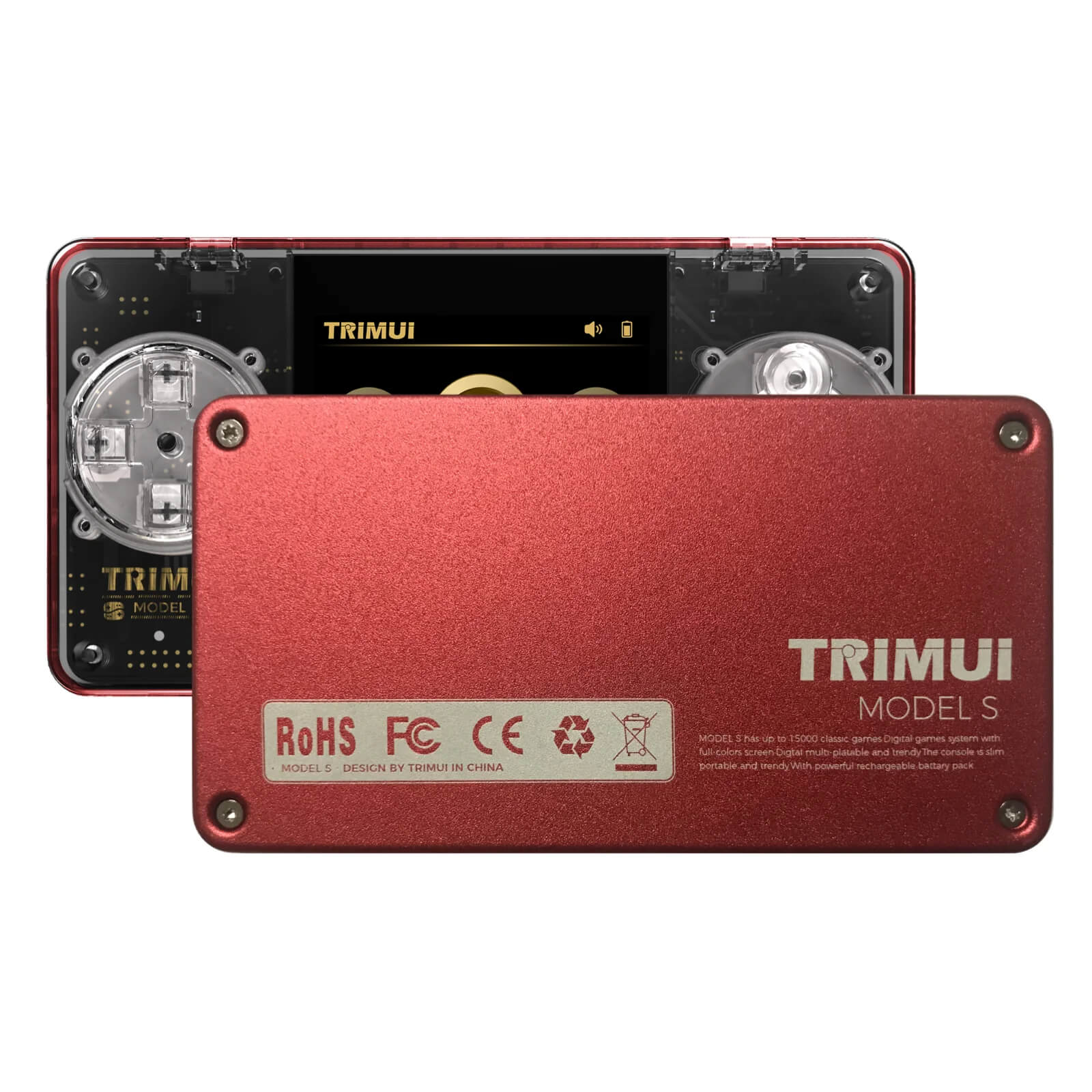
The TRIMUI Model S is one of the smallest serious emulation handhelds you can buy: a horizontal, credit-card-footprint slab measuring about 106.5 x 56.5 x 10 mm and weighing roughly 65 grams. It first appeared at the end of 2020 for around $50, and TRIMUI has since kept it alive with a 2025 re-release (transparent shell, metal back plate) at about $66. This is not a device chasing PlayStation 1 or Dreamcast. It is a deliberately minimal 8- and 16-bit machine built around one of the cheapest capable SoCs on the market, and it should be judged on that scope rather than a spec sheet it never tried to win.
Emulation performance, generation by generation
The heart of the Model S is an Allwinner F1C200S: a single ARM926EJ-S core on the old ARMv5 instruction set, clocked around 720 MHz, with just 64 MB of integrated DDR RAM. That is a genuinely tiny amount of horsepower, and it sets a hard ceiling. Eight-bit systems are where this handheld is completely at home. NES, Game Boy, Game Boy Color, Sega Master System, Game Gear and PC Engine / TurboGrafx-16 all run at full speed with sound intact. Game Boy Advance is the standout: gpSP runs the bulk of the GBA library smoothly, and the 320×240 panel frames the 240×160 GBA image cleanly. Sixteen-bit is where you start negotiating. SNES is playable but selective; lighter titles are fine on the snes9x 2002/2005 cores, while Super FX and other heavy games such as Star Fox or Yoshi’s Island stutter and can crackle audibly. Mega Drive / Genesis is mostly smooth, with the busiest scenes occasionally dipping. Arcade is limited to lightweight Final Burn sets, not CPS2 or Neo Geo. Anything above that generation is off the table. PlayStation 1 is not realistically usable here (community testing pegs it in the low-single-digit “technically boots” range), and N64, Dreamcast and PSP are simply out of reach for an ARMv5 single core. Buy it for what runs, not for a wishlist.
Screen, build and controls
The 2.0-inch IPS display is the star of the build. It is a 4:3, 320×240 panel at 60 Hz and roughly 200 PPI, which is a natural fit for retro content and looks noticeably sharper than the resolution suggests because the pixels are packed into such a small area. Viewing angles and colour are good for the price. The shell is a plastic-and-aluminium combo that feels more solid than a 65-gram device has any right to. Controls are complete for the systems it targets: a circular drop-in d-pad with a raised cross, four domed unlabelled face buttons, Start, Select and a Menu button, plus L1 and R1 shoulder buttons set slightly inboard from the corners. There are no analog sticks and no L2/R2, which matters not at all for the 8- and 16-bit libraries this thing exists to play. The trade-off is feel: the d-pad and buttons are clicky microswitch-style parts that are loud and a little imprecise for tight fighting-game inputs. There is no headphone jack and no Bluetooth, so audio comes from a single small front-facing speaker that is fine for chiptunes and thin for anything else.
Software and setup
Out of the box the Model S runs TRIMUI’s own stock Linux front end, stored on internal NAND. It works but is dated and clunky. The real reason to own this device is that the community bypasses that stock UI entirely by dropping a custom launcher onto the microSD card. The two common choices are the older GmenuNX and, more importantly, MinUI, the clean minimalist front end that has become the default recommendation for this hardware. MinUI keeps the setup dead simple, ships updated emulator cores and re-exposes the per-emulator settings the stock UI hides. It is worth setting expectations honestly here: the F1C200S is too weak and too old to be a target for the big modern firmwares. There is no muOS, Knulli, ROCKNIX or Batocera build for this chip, because those projects target far more powerful ARM SoCs. On the Model S your realistic software world is stock or MinUI, and MinUI is the one to install. Games live on a microSD card loaded over USB-C or a card reader.
Price, value and who it is for
At $50 to $66 depending on when and where you buy, the Model S competes on size and price rather than raw capability. Its obvious rival is the Miyoo Mini / Mini Plus, which uses a stronger chip, has a broader firmware scene (OnionOS) and pushes into competent PS1 play. If you want PS1, buy the Miyoo. The Model S earns its place if what you actually want is the smallest, lightest, cheapest way to carry Game Boy, GBA, NES and most SNES and Genesis games in a shirt pocket. It is a fantastic commute or travel toy and a great first tinker-friendly handheld precisely because MinUI makes it painless. Go in understanding the ceiling, the mono speaker and the clicky buttons, and it is an easy little device to like.
📐 Size & Pocketability
⚖️ Weight vs Other Handhelds
🔋 Real-World Battery Estimator
⭐ Emulation Performance
📊 View How This Score is Calculated
The Hardware Power Score is an absolute metric. Perfect emulation of difficult, modern consoles awards significantly more points than standard retro consoles.
- 15× Multiplier: Modern PC
- 12× Multiplier: Switch, PS3, Xbox 360
- 10× Multiplier: Wii U
- 8× Multiplier: PS2, GameCube, Wii, Xbox
- 5× Multiplier: Saturn, Dreamcast, PSP
- 3× Multiplier: N64, PS1
- 1× Multiplier: SNES, GBA
Generation 5
Handhelds & Retro
📋 Full Specifications
📺 Display
⚙️ Platform
💾 Memory
🕹️ Controls
📏 Body
🔋 Battery
⚖️ Verdict
✅ The Good
- Genuinely pocketable at ~65 g with a credit-card footprint, yet feels solid thanks to the aluminium back
- Sharp, pleasant 2.0-inch 4:3 IPS panel (320×240, ~200 PPI) that suits retro content
- Runs 8-bit systems and GBA at full speed, and handles most SNES and Genesis games
- MinUI custom firmware is easy to install and turns the clunky stock UI into a clean, fast experience
❌ The Bad
- ARMv5 single-core F1C200S with 64 MB RAM caps it below PS1, N64, Dreamcast and PSP
- Loud, clicky microswitch buttons and d-pad, no analog sticks and no L2/R2
- Single front speaker with no headphone jack, no Bluetooth and no Wi-Fi
📰 Latest News & Guides
The Ultimate Guide to ARMSX3: Android’s New PS3 Emulator, Competitor Comparisons, and Setup Tutorial
18/08/2026Pokémon Gold, Silver, and Crystal (Gen 2) Recomp Lands on Android
17/08/2026How to Play the Pokémon Red, Blue, or Yellow Recomp on Your Android, Windows, and Linux Devices
16/08/2026🔍 Similar Handhelds
Other handhelds that emulate up to GBA.