
🛒 Where to Buy
⚠️ Golden Rule of Retro Handhelds: Throw away the cheap MicroSD card that comes in the box — it will fail. And never use a high-wattage PD “Fast Charger” on these devices; it can damage the battery. Use a standard 5V/1.5A brick.
Device Overview: Nintendo New 2DS XL
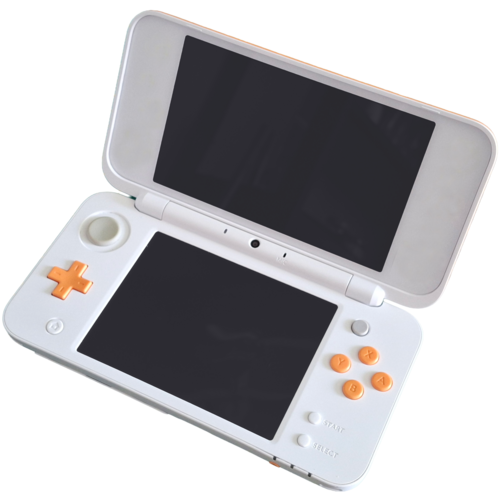
The Nintendo New 2DS XL is the console Nintendo probably should have led its budget line with. It launched in North America and Europe on 28 July 2017 at $149.99 (15 June in Australia and New Zealand, 13 July in Japan), folding the internals of the New Nintendo 3DS XL into a lighter clamshell and throwing out the one feature the platform had staked its name on: stereoscopic 3D. What remains is the cheapest full-speed way into two of the deepest handheld libraries ever assembled. Nobody bought a 2DS XL for a headline gimmick, and after living with the eye-strain of the 3D slider for years, plenty of buyers were happy to see it gone.
The hardware and its library
Internally this is a New Nintendo 3DS, not the older original 3DS, and that distinction matters. A quad-core ARM11 runs at 804 MHz (games get two cores, the OS keeps the rest), paired with a Digital Media Professionals PICA200 GPU at 268 MHz, 256 MB of RAM and 10 MB of VRAM. That “New” tier unlocks the small set of New-3DS-exclusive software: Xenoblade Chronicles 3D, the SNES Virtual Console lineup, and faster loading in games like Pokemon Sun and Moon. The 3DS card slot is backward compatible with DS cartridges, so a single machine plays native 3DS titles (Fire Emblem Awakening, The Legend of Zelda: A Link Between Worlds, Mario Kart 7, the Ace Attorney and Professor Layton ports) and the entire DS back catalog. There is 1 GB of internal storage and a microSDHC slot for the rest. One heritage gap is worth flagging: unlike the original DS and DS Lite, the 3DS family dropped the Game Boy Advance cartridge slot entirely, so GBA here is a matter of emulation or injects, not original carts.
Homebrew, custom firmware and emulation
The custom-firmware scene here is mature, free and well documented. boot9strap plus Luma3DS, installed today through the Seedminer and Universal-Otherapp chain documented at 3ds.hacks.guide, works on every New 2DS XL regardless of system-firmware version. Once on CFW you get region-free play, cartridge dumping to the SD card, the Homebrew Launcher, and a supporting toolkit worth knowing by name: FBI for installing content, Checkpoint for save backups, and Universal-Updater as a store for homebrew apps. For retro emulation, RetroArch and standalone cores (Snes9x, mGBA and gpSP, Genesis Plus GX, FCEUmm, PicoDrive) run 8- and 16-bit systems and GBA well. Be honest about the ceiling: the ARM11 is not fast, so Nintendo 64 and PlayStation are inaccurate and inconsistent. GBA is better handled natively through GBARunner2 or AGB_FIRM CIA injects, and TWiLight Menu++ front-ends DS, Game Boy, GBA, Master System, Game Gear and Genesis. This is an excellent SNES, Genesis and GBA machine and a poor N64 or PS1 one.
Screen, build and revisions
The two panels match the New 3DS XL in size: a 4.88-inch top screen at 400×240 and a 4.18-inch resistive touchscreen below at 320×240. Both are TN LCDs, so off-axis color shift and mediocre black levels are the cost of the low price. Removing the 3D layer does give the top screen a single, sharper image with no parallax-barrier dimming. The clamshell is light at 260 g but plainly built to a budget: a fixed hinge with only a couple of open angles, thin glossy plastic, and screens that sit almost flush with the bezel, so keeping the shipped screen cloth between the halves is non-negotiable unless you want scuffs. A C-Stick nub, ZL and ZR triggers, and amiibo NFC (under the lower screen) are all present. Stereo speakers, a 1400 mAh battery good for roughly 3.5 to 5.5 hours on 3DS games and 7 to 9 on DS titles, and a microSD slot hidden behind a screwed-down back panel round it out. Revisions are cosmetic: black/turquoise and white/orange at launch, then special editions (Poke Ball, Pikachu, Hylian Shield, Persona 5, various bundles) that now carry collector premiums.
Collecting, price and who it is for
Nintendo discontinued the whole 3DS family in September 2020 and closed the eShop on 27 March 2023, so digital purchases are over; CFW or physical cartridges are how you build a library now. Used prices have climbed accordingly. Expect roughly $120 to $180 for a clean standard-color unit, and well above that for boxed special editions, meaning many now cost more than they did new. Watch two details on the used market: Nintendo sold the console without an AC adapter in several regions, so budget for a compatible charger, and a bundled microSD card of any size is a small bonus given the screwed-in slot. Buy this if you want the 3DS and DS libraries together in the smallest, lightest, cheapest package and you never cared about stereoscopic 3D. Skip it if you want the metal-hinged, sturdier feel of a New 3DS XL, or if you plan to lean on N64 and PS1 emulation. As a first custom-firmware handheld, though, it is the value pick of the entire 3DS line.
📐 Size & Pocketability
⚖️ Weight vs Other Handhelds
🔋 Real-World Battery Estimator
⭐ Emulation Performance
📊 View How This Score is Calculated
The Hardware Power Score is an absolute metric. Perfect emulation of difficult, modern consoles awards significantly more points than standard retro consoles.
- 15× Multiplier: Modern PC
- 12× Multiplier: Switch, PS3, Xbox 360
- 10× Multiplier: Wii U
- 8× Multiplier: PS2, GameCube, Wii, Xbox
- 5× Multiplier: Saturn, Dreamcast, PSP
- 3× Multiplier: N64, PS1
- 1× Multiplier: SNES, GBA
Gen 8 & PC
Generation 5
Handhelds & Retro
📋 Full Specifications
📺 Display
⚙️ Platform
💾 Memory
🕹️ Controls
📏 Body
🔋 Battery
⚖️ Verdict
✅ The Good
- Same internals as the New 3DS XL (804 MHz quad-core ARM11, 256 MB RAM), so it runs New-3DS-exclusive games and the full 3DS and DS catalogs at native speed
- Lightest and cheapest way into the 3DS library at 260 g, with a $149.99 launch price and stereoscopic 3D sensibly dropped
- Free, mature CFW via boot9strap and Luma3DS gives region-free play, cartridge dumping, and solid SNES/Genesis/GBA emulation
- C-Stick, ZL/ZR triggers and built-in amiibo NFC are all retained despite the budget positioning
❌ The Bad
- TN LCD panels with weak viewing angles and black levels, and near-flush screens that scratch without the screen cloth
- Cheaper build than the New 3DS XL: glossy plastic, a fixed two-position hinge, and microSD hidden behind a screwed-down panel
- eShop is closed and the line is discontinued, so used prices have risen and N64/PS1 emulation stays out of reach on the ARM11
📰 Latest News & Guides
The Ultimate Guide to ARMSX3: Android’s New PS3 Emulator, Competitor Comparisons, and Setup Tutorial
18/08/2026Pokémon Gold, Silver, and Crystal (Gen 2) Recomp Lands on Android
17/08/2026How to Play the Pokémon Red, Blue, or Yellow Recomp on Your Android, Windows, and Linux Devices
16/08/2026🔍 Similar Handhelds
Other handhelds that emulate up to 3DS.