
🛒 Where to Buy
⚠️ Golden Rule of Retro Handhelds: Throw away the cheap MicroSD card that comes in the box — it will fail. And never use a high-wattage PD “Fast Charger” on these devices; it can damage the battery. Use a standard 5V/1.5A brick.
Device Overview: HardKernel Odroid Go
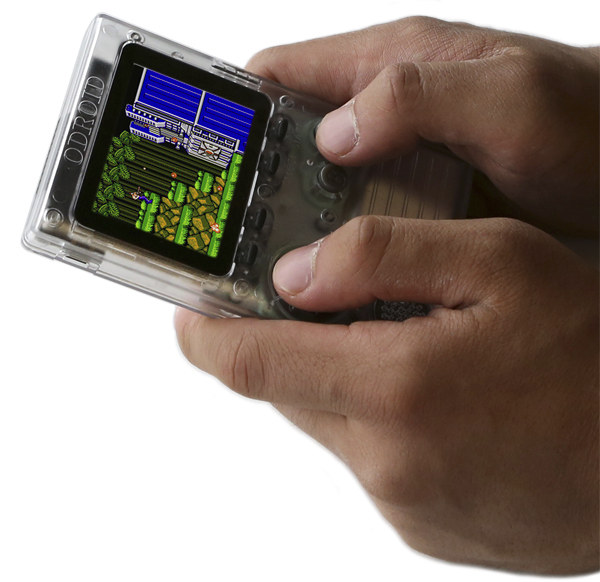
The HardKernel Odroid Go is not a polished retro handheld in the Anbernic mould; it is a solder-free DIY kit that HardKernel shipped in 2018 to mark the company’s tenth anniversary. You buy a bag of parts — a green PCB, a clear plastic shell, a 2.4-inch screen, rubber buttons, a mono speaker, a 1200mAh cell and ten screws — and assemble a working handheld yourself in about twenty minutes with a Phillips driver. At its heart is an Espressif ESP32, the same microcontroller class that runs smart plugs and hobby robots, which tells you most of what you need to know about its ambitions. This is an 8-bit emulation toy and a genuine embedded-development board wearing the same body. HardKernel published the schematics, board files and firmware source, so the whole thing is open and hackable in a way commercial handhelds rarely are.
Emulation performance, generation by generation
Set expectations by the silicon. The ESP32-WROVER module pairs a dual-core Xtensa LX6 clocked up to 240 MHz with just 4 MB of PSRAM and 16 MB of flash, so the ceiling sits firmly in the 8-bit era. Through the community Retro-Go firmware the Odroid Go runs NES, Game Boy, Game Boy Color, Sega Master System, Game Gear, SG-1000, ColecoVision and — impressively for the class — TurboGrafx-16/PC Engine and Atari Lynx at full speed. There is a competent Game & Watch player and even a Doom port. What it cannot do is the 16-bit generation properly: Retro-Go ships experimental SNES and Sega Mega Drive/Genesis cores, but both are explicitly slow, shedding frames and audio on anything demanding. Ignore the occasional blurb claiming Game Boy Advance support; the ESP32 has no realistic path to GBA, SNES-at-speed or PlayStation. Treat it as an NES and Game Boy machine that occasionally surprises you, not a Genesis one.
Screen, build and controls
The 2.4-inch 320×240 TFT panel is driven over SPI, and that bus, not the CPU, is the real limiter — full-frame updates cost real bandwidth, which is part of why the heavier cores stutter. Colours are decent and pixel art looks crisp at this size, though brightness and viewing angles are ordinary rather than IPS-grade. Controls are strictly old-school: a d-pad, A and B, Start and Select, plus Menu and Volume buttons up top. There are no analog sticks, no Hall-effect sensors and no shoulder triggers, which is fine for the 8-bit library it targets and a hard wall for anything that wants L/R. The clear plastic shell is light and genuinely pocketable, closer to a Game Boy Pocket than a modern brick; assembled feel is toy-like but honest for the money. Around the edges sit a microSD slot for ROMs, micro USB for charging and serial flashing, a headphone jack and a 10-pin expansion header — the last a reminder that this is a maker board first.
Software and setup
Two software worlds exist here. HardKernel’s stock Go-Play firmware boots a basic launcher with the official emulator set and works the moment you copy ROMs to a microSD card. Almost everyone then moves to Retro-Go, the actively maintained community firmware by ducalex, which adds systems, save states, in-game menus, box art and a far nicer launcher; you flash it over USB with esptool or the bundled scripts. Because the Odroid Go predates the Linux handheld boom, none of the familiar Linux custom firmwares apply — there is no muOS, Knulli, ArkOS, ROCKNIX or Batocera here, because there is no Linux and no application processor to run them. Instead the device’s second life is as an Arduino- and ESP-IDF-programmable target: HardKernel ships an Arduino library and example sketches, and people have built weather stations, music players and original games on this exact hardware.
Price, value and who it is for
At $32 for the kit the Odroid Go is cheap, but it competes for attention with sub-$40 Anbernic and Miyoo units that arrive assembled and emulate up through PS1 and Dreamcast. Judged purely as a games machine it loses that fight — those Linux handhelds are more capable per dollar and need no assembly. Judged as what it actually is, a build-it-yourself learning kit that happens to play Link’s Awakening and Super Mario Bros. flawlessly, it is charming and still worth owning. Buy it if you want to assemble your own handheld, poke at ESP32 development, or keep a tiny 8-bit player in a bag; the DIY step is the point. Skip it if you want a turnkey emulator or anything past the Game Boy and NES era, since newer pre-built handhelds serve you better for barely more money. Note too that HardKernel has moved on to the Linux-based Go Advance, Super and Ultra successors, so treat the original as a hobby piece rather than a current flagship. On the used market it turns up sealed or built for roughly $30 to $60, and the assembled kits with a good microSD card and Retro-Go already flashed are the ones worth paying a small premium for.
📐 Size & Pocketability
⚖️ Weight vs Other Handhelds
🔋 Real-World Battery Estimator
📋 Full Specifications
📺 Display
⚙️ Platform
💾 Memory
🕹️ Controls
📏 Body
🔋 Battery
⚖️ Verdict
✅ The Good
- $32 kit you assemble yourself in about 20 minutes with just a screwdriver – a real learn-the-hardware project, not only a toy.
- Runs NES, Game Boy/Color, Master System, Game Gear and even PC Engine and Atari Lynx at full speed via the excellent, actively updated Retro-Go firmware.
- Doubles as a genuine ESP32 dev board: Arduino/ESP-IDF programmable with an official library, a 10-pin expansion header, plus built-in WiFi and Bluetooth.
- Small, light, pocketable Game Boy-class body with roughly 10 hours of play from the 1200mAh battery.
❌ The Bad
- Hard 8-bit ceiling: the ESP32 chokes on SNES and Genesis (both flagged "slow" in Retro-Go) and cannot touch GBA, PS1 or anything newer.
- Bare-bones controls and screen: d-pad and face buttons only (no analog sticks, no shoulder triggers) and a plain SPI-driven TFT rather than an IPS panel.
- Now discontinued and superseded by HardKernel's Linux-based Go Advance/Super/Ultra, so it is a hobby/collector piece with no custom firmware beyond Go-Play and Retro-Go.