
🛒 Where to Buy
⚠️ Golden Rule of Retro Handhelds: Throw away the cheap MicroSD card that comes in the box — it will fail. And never use a high-wattage PD “Fast Charger” on these devices; it can damage the battery. Use a standard 5V/1.5A brick.
Device Overview: GAMEMT E6 Max
The GAMEMT E6 Max is a sub-$100 Android emulation handheld that landed on AliExpress in March 2025, and its headline change is the silicon. Where the earlier E6 and E6 Plus leaned on the Rockchip RK3566 that powers half the budget shelf, GAMEMT swapped in the Allwinner A527 – an octa-core Cortex-A55 chip with a Mali-G57 GPU that is far more common in tablets and industrial boards than in retro handhelds. Pair that with 4GB of LPDDR4X (double the E6 Plus), a 5-inch 720p screen and Hall-effect sticks, and you get a device that reads well on a spec sheet. Whether it plays well is a separate question, and one where the reviews get blunt.
Emulation performance, generation by generation
Set expectations by the chip, not the box art. Eight Cortex-A55 cores topping out near 2 GHz with a single-core Mali-G57 is a low-power ARM package – efficient, but nowhere near a Snapdragon G-series part or a Steam Deck. In practice everything through the fifth generation is comfortable: NES, SNES, Genesis, Game Boy Advance, PS1 and full-speed N64 via Mupen64Plus all run without drama through RetroArch. PSP is the sweet spot, with PPSSPP handling most of the library at native or 2x resolution. Dreamcast through Flycast is largely playable, and the Sega Saturn – the system GAMEMT markets as the ceiling – is genuinely hit or miss, since Beetle Saturn leans hard on the CPU and the A55 cores run out of headroom on the heavier titles. The listing’s talk of PlayStation 2 and Nintendo 3DS is marketing overreach: NetherSX2 will boot a few light 2D games and Citra is a slideshow on this class of core. GameCube and Wii through Dolphin sit in the same bucket – a handful of forgiving titles, not a library. Arcade is a bright spot: CPS1/CPS2, Neo Geo and most pre-3D MAME sets run cleanly through FinalBurn Neo, which is where a screen this sharp pays off.
Screen, build and controls
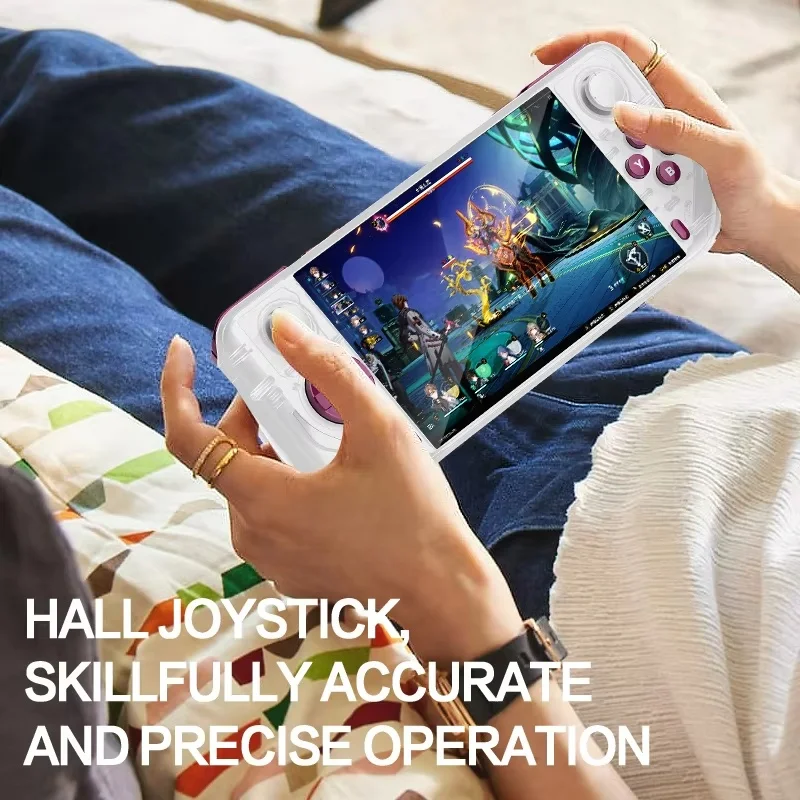
The 5-inch IPS panel is the strongest confirmed component: 1280×720 at 60Hz, roughly 293 PPI, 500 nits peak and a claimed 100% sRGB. That resolution is a real advantage over the 640×480 crowd for PSP and any Android UI, and the 16:9 shape suits PSP and Dreamcast better than the 4:3 systems, which letterbox. The body is transparent plastic in white or black, showing off the board, with stacked shoulder buttons and triggers and a red 8-way d-pad. The sticks are Hall-effect, so drift should not creep in over time. The catch is feel: multiple hands-on reviews describe stiff, unpleasant analog sticks, a mushy d-pad and stiff face buttons, with one reviewer calling the overall build cheap and telling readers to skip it. Weight is not published. Hall sensors fix a long-term problem, but they do nothing for day-one button feel, and that is where this device stumbles.
Software and setup
Out of the box it runs Android 13. That means the usual Android-handheld workflow: sideload RetroArch and the standalone emulators, add a front-end like Daijisho or ES-DE, and wrestle the stock launcher’s bloat into submission. The community answer here is GammaOS Next, a stripped-down Android build for newer Allwinner and Rockchip handhelds that trims Google services, sorts out controller mapping and generally makes the thing behave like a games console rather than a cheap tablet. Note what is not on the menu: because this is an Android device on the A527, the Linux custom-firmware ecosystem that defines the Rockchip scene – muOS, Knulli, ArkOS, ROCKNIX, OnionOS – does not target it, and Batocera and EmuDeck are x86 concerns. So your “custom firmware” path is essentially GammaOS Next or a hand-tuned stock Android, not the deep Linux menu a buyer coming from an RG35XX might expect. Storage is 32GB of eMMC internally, so most owners will run their ROM library off the two microSD slots and leave the internal chip to the OS.
Price, value and who it is for
The E6 Max launched around $75-80, with AliExpress listings drifting between roughly $63 and $95 depending on seller and promotion. At that price the pitch is the hardware sheet: the 720p screen, 4GB of RAM, Wi-Fi 6, a 5000mAh battery good for five to seven hours, mini-HDMI output and dual microSD slots make it unusually well-connected for the money. What you are gambling on is the controls, the one part no firmware update can fix. Buy it if you want a cheap 720p PSP and Dreamcast machine and you are willing to tolerate or mod the buttons, or if you specifically want to tinker with the uncommon A527 platform. Skip it if you want something that feels good the moment you power it on – an Anbernic RG35XX-series unit or a Retroid at a little more money is the safer pick. This is a spec-sheet bargain with a hands-on asterisk, and even Bluetooth support is reported inconsistently across sources, so treat anything beyond the confirmed core specs as unverified.
🔋 Real-World Battery Estimator
⭐ Emulation Performance
📊 View How This Score is Calculated
The Hardware Power Score is an absolute metric. Perfect emulation of difficult, modern consoles awards significantly more points than standard retro consoles.
- 15× Multiplier: Modern PC
- 12× Multiplier: Switch, PS3, Xbox 360
- 10× Multiplier: Wii U
- 8× Multiplier: PS2, GameCube, Wii, Xbox
- 5× Multiplier: Saturn, Dreamcast, PSP
- 3× Multiplier: N64, PS1
- 1× Multiplier: SNES, GBA
Generation 7
Generation 6
Generation 5
Handhelds & Retro
📋 Full Specifications
📺 Display
⚙️ Platform
💾 Memory
🕹️ Controls
📏 Body
🔋 Battery
⚖️ Verdict
✅ The Good
- Sharp 5-inch 1280×720 IPS screen (500 nits, ~100% sRGB) – a real step up from the 480p budget crowd for PSP and Dreamcast
- 4GB LPDDR4X and Wi-Fi 6 – double the RAM of the E6 Plus and faster wireless than most sub-$100 handhelds
- Hall-effect analog sticks that resist the long-term drift common on cheap potentiometer sticks
- Well-connected for the price: 5000mAh battery (5-7 hrs), mini-HDMI 1080p output, USB-C and dual microSD slots
❌ The Bad
- Poor control feel out of the box – reviewers report stiff analog sticks, a mushy d-pad and stiff face buttons that no software update can fix
- The all-Cortex-A55 Allwinner A527 realistically tops out at Dreamcast and PSP; Saturn is inconsistent and the marketed PS2/3DS support is not credible
- Thin, sometimes conflicting documentation for this obscure brand – weight is unpublished and even Bluetooth support is reported inconsistently across sources
📰 Latest News & Guides
The Ultimate Guide to ARMSX3: Android’s New PS3 Emulator, Competitor Comparisons, and Setup Tutorial
18/08/2026Pokémon Gold, Silver, and Crystal (Gen 2) Recomp Lands on Android
17/08/2026How to Play the Pokémon Red, Blue, or Yellow Recomp on Your Android, Windows, and Linux Devices
16/08/2026🔍 Similar Handhelds
Other handhelds that emulate up to Saturn.