
🛒 Where to Buy
⚠️ Golden Rule of Retro Handhelds: Throw away the cheap MicroSD card that comes in the box — it will fail. And never use a high-wattage PD “Fast Charger” on these devices; it can damage the battery. Use a standard 5V/1.5A brick.
Device Overview: Game Console U8
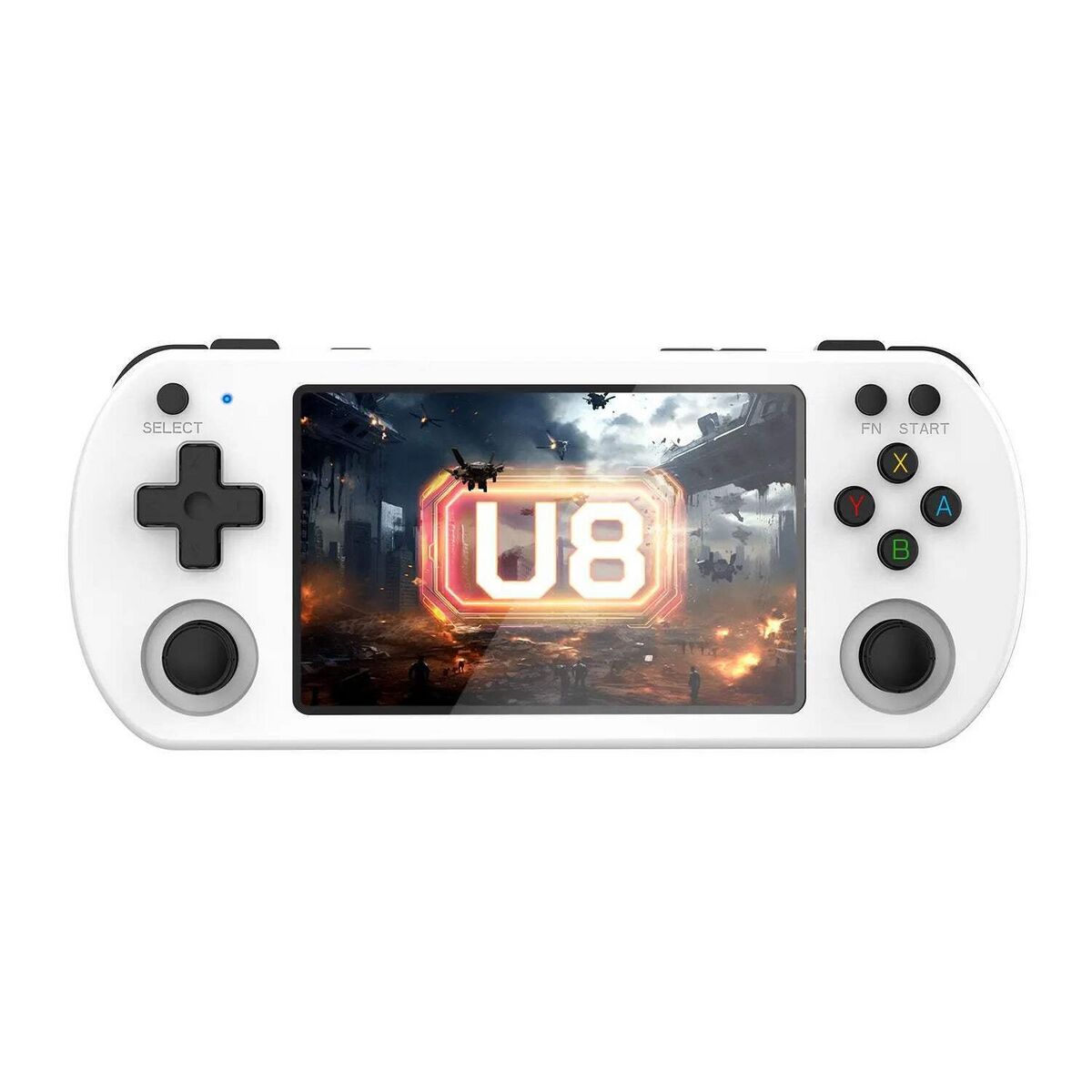
The Game Console U8 is a sub-$50 vertical handheld built on the Rockchip RK3326, the same ageing quad-core chip that powered the Anbernic RG351 line back in 2020. It is not a branded product in any meaningful sense: the U8 ships white-label through AliExpress, Amazon, Banggood and dozens of drop-ship storefronts, sometimes wrongly filed under “Anbernic” by review aggregators. Treat every marketing claim on those listings with suspicion, because they routinely quote a 4-inch screen at three different resolutions and promise “N64 and PS1 perfectly” from silicon that does no such thing. What you are actually buying is a competent 8- and 16-bit machine with a big battery, dual sticks, and a pre-loaded microSD card, sold at a price where expectations should stay low.
Emulation performance, generation by generation
The RK3326 pairs four ARM Cortex-A35 cores at up to 1.5GHz with a Mali-G31 MP2 GPU and 1GB of LPDDR4. That is a modest, well-understood package, and its ceiling is not a mystery. Everything through the 16-bit era runs full speed with headroom: NES, SNES, Mega Drive, Master System, PC Engine, Game Gear, Neo Geo Pocket, and the full Game Boy family including GBA. Arcade via FBNeo and MAME is strong up to CPS1/CPS2 and most pre-3D boards. PlayStation is the practical sweet spot at the top end, with PCSX-ReARMed or a lightweight DuckStation build clearing the large majority of the PS1 catalogue at or near full speed. Above that, the marketing falls apart. Nintendo 64 through Mupen64Plus is a lottery: Mario 64 and a handful of lighter titles are playable, but anything demanding drops frames or breaks. PSP via PPSSPP manages simple 2D and menu-driven games only; 3D titles stutter. Dreamcast, Saturn, and Nintendo DS are effectively off the table, whatever the box art suggests. This is a 32-bit-and-below device, and it is a good one within that lane.
Screen, build and controls
The panel is a 4-inch laminated IPS in the 4:3-ish range; listings cite 800×480, 800×600 and 800×680 interchangeably, so take the exact number as unconfirmed, but lamination and IPS viewing angles are consistent across sources and pixel-art integer scaling looks clean at this size. The body is a chunky vertical (Game Boy-style) plastic shell. Controls include a proper d-pad, ABXY, Select/Start/Fn, shoulder buttons listed as L1/L2/R1/R2 stacked linearly, and two analog sticks placed below the face buttons in a PlayStation-style parallel arrangement. There is no mention of Hall-effect sticks anywhere credible, so assume standard potentiometer sticks that will eventually drift. For a vertical machine, the twin sticks are mostly a checkbox feature: they are usable for PS1 and menu navigation but sit low and cramped, and the form factor was never designed around them. A 3.5mm headphone jack and a single USB-C port for charging and OTG round out the physical layout, with stereo speakers on the front.
Software and setup
Out of the box the U8 boots a custom Linux launcher from a bundled microSD card stuffed with thousands of pre-installed ROMs of dubious legality. It uses a two-slot design, typically one card for the OS and one for storage, with no internal eMMC. The stock firmware is functional but generic: a grid launcher over RetroArch, minimal configuration, and the usual budget-handheld quirks around save states and scraping. The real upside of choosing an RK3326 device in 2026 is the custom-firmware scene. This exact chip is one of the best-supported in the hobby, with mature community builds including ArkOS, ROCKNIX (the successor to JELOS), AmberELEC and Batocera. The important caveat is board specificity: those images target known devices like the RG351V/RG351MP, and there is no guarantee of a maintained build matched to the U8’s particular screen resolution and button wiring. You may get a clean fit, or you may fight display and input mapping. Note that muOS, Knulli and OnionOS are not RK3326 firmwares (they target Allwinner and Miyoo hardware respectively), so ignore any listing that name-drops them. Realistically, most buyers will run the stock card, and tinkerers should verify a working U8 image exists before counting on CFW.
Price, value and who it is for
The U8 sells for roughly $35 to $45 depending on the 64GB or 128GB card. The 3500mAh battery is the standout: real-world runtime lands around 4 to 5.5 hours of mixed use, well ahead of the tiny 2000mAh cells in many cheaper verticals, even if the “8 hours” official figure is optimistic. At this price you are buying a capable Game Boy, SNES, Genesis, GBA and PS1 machine with a decent screen and long legs, not a 3D powerhouse. Buy it if you want an inexpensive, pocketable retro player for 2D libraries and can accept generic support, uncertain CFW, and drift-prone sticks. Skip it if N64, PSP, Dreamcast or DS matter to you, or if you want a named brand with a warranty and a community wiki. For that, a used Anbernic RG35XX Plus or an H700-based device is the smarter buy at a similar cost.
🔋 Real-World Battery Estimator
⭐ Emulation Performance
📊 View How This Score is Calculated
The Hardware Power Score is an absolute metric. Perfect emulation of difficult, modern consoles awards significantly more points than standard retro consoles.
- 15× Multiplier: Modern PC
- 12× Multiplier: Switch, PS3, Xbox 360
- 10× Multiplier: Wii U
- 8× Multiplier: PS2, GameCube, Wii, Xbox
- 5× Multiplier: Saturn, Dreamcast, PSP
- 3× Multiplier: N64, PS1
- 1× Multiplier: SNES, GBA
Generation 6
Generation 5
Handhelds & Retro
⚡ Performance Benchmarks
Where Game Console U8 Mali-G31 MP2 lands against the handhelds everyone knows. Every bar shares one scale, so longer genuinely means faster — add up to two rivals to compare.
CPU = Geekbench 6 multi-core · GPU = 3DMark Wild Life. Median real-world scores; every bar shares one scale — add up to two rivals to compare.
📋 Full Specifications
📺 Display
⚙️ Platform
💾 Memory
🕹️ Controls
📏 Body
🔋 Battery
⚖️ Verdict
✅ The Good
- Strong, reliable emulation for everything through PS1, including SNES, Genesis, GBA and CPS arcade at full speed
- Large 3500mAh battery delivers a genuine 4 to 5.5 hours, unusual at this price
- Laminated 4-inch IPS panel with clean integer scaling for pixel art
- Runs on the RK3326, a chip with a mature custom-firmware scene (ArkOS, ROCKNIX, AmberELEC) if a matching build exists
❌ The Bad
- Marketing wildly overstates the ceiling: N64 is hit-or-miss and PSP, Dreamcast, Saturn and DS are effectively unusable
- Generic white-label device with no real brand, inconsistent published specs (screen resolution varies by listing) and no guaranteed U8-specific CFW image
- Potentiometer analog sticks (no Hall effect) placed low on a vertical shell, prone to drift and awkward for 3D games
📰 Latest News & Guides
The Ultimate Guide to ARMSX3: Android’s New PS3 Emulator, Competitor Comparisons, and Setup Tutorial
18/08/2026Pokémon Gold, Silver, and Crystal (Gen 2) Recomp Lands on Android
17/08/2026How to Play the Pokémon Red, Blue, or Yellow Recomp on Your Android, Windows, and Linux Devices
16/08/2026🔍 Similar Handhelds
Other handhelds that emulate up to DS.