
🛒 Where to Buy
⚠️ Golden Rule of Retro Handhelds: Throw away the cheap MicroSD card that comes in the box — it will fail. And never use a high-wattage PD “Fast Charger” on these devices; it can damage the battery. Use a standard 5V/1.5A brick.
Device Overview: Nintendo New 3DS
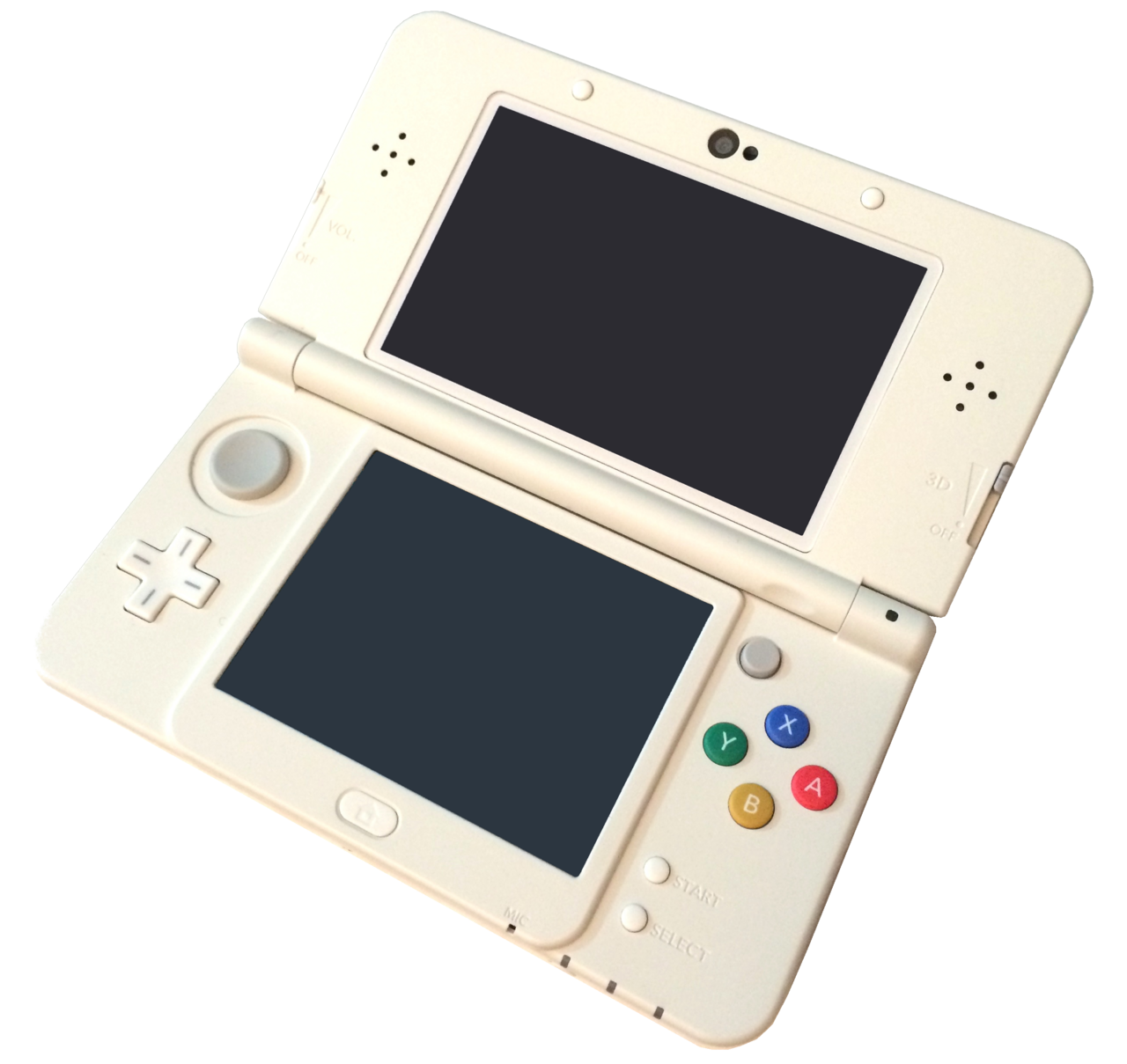
The Nintendo New 3DS is the compact, faceplate-swapping member of the “New” 3DS refresh that Nintendo shipped in Japan on 11 October 2014 for ¥16,000 and rolled out to Europe and Australia on 13 February 2015. It is the small one: 142 mm wide, 253 grams, with interchangeable cover plates rather than the fixed metallic shell of the New 3DS XL. North America never got it as a plain standalone at launch, the XL was the region’s default at $199.99, and the small model only arrived on 25 September 2015 inside a $219.99 Animal Crossing: Happy Home Designer bundle. That regional quirk is why the standard New 3DS feels rarer in the US than its size and age suggest.
The hardware and its library
Under the hood this is a genuinely different machine from a 2011 3DS, not a cosmetic reissue. The CPU jumps from a dual-core ARM11 at 268 MHz to a quad-core ARM11 MPCore clocked at 804 MHz, RAM doubles to 256 MB, and VRAM grows to 10 MB, all driving the same DMP PICA200 GPU. Nintendo used that headroom for faster eShop and browser loading, snappier menus, and a handful of titles the old hardware simply cannot run: Xenoblade Chronicles 3D is New-only, and SNES Virtual Console (Super Mario World, EarthBound, A Link to the Past) was locked to this generation. It also added a right-hand C-Stick nub, ZL and ZR shoulder buttons, built-in NFC for amiibo, and “Super-Stable 3D,” which uses the inner camera to track your face so the autostereoscopic effect stops collapsing when you move your head. The library is the real reason to own one: A Link Between Worlds, Fire Emblem Awakening and Fates, Pokemon X/Y through Ultra Sun/Ultra Moon, Monster Hunter 4 Ultimate and Generations, Animal Crossing: New Leaf, Kid Icarus: Uprising, Bravely Default, plus full backward compatibility with the entire DS and DSi catalogs.
Homebrew, custom firmware and emulation
The 3DS scene is mature and, unusually, both free and flashcart-free. Following 3ds.hacks.guide, a software exploit (SSLoth-Browser, or safecerthax and ntrboot on locked units) installs boot9strap and then Luma3DS, the de-facto custom firmware. Every firmware version up to the final 11.17 is exploitable, so a used unit’s system menu number is no barrier. From there the Homebrew Launcher, FBI, GodMode9, Checkpoint and Universal-Updater cover installs, backups and saves. For retro emulation the New 3DS is the best of the family precisely because of that quad-core chip: RetroArch cores handle NES, SNES (snes9x runs far closer to full speed here than on an old 3DS), Game Boy and Game Boy Color, Master System, Genesis via PicoDrive, and PC Engine comfortably. Game Boy Advance is the standout, open_agb_firm runs GBA ROMs on the console’s real GBA-compatible silicon in DS mode, so it is native playback rather than emulation. DS titles likewise run natively, and TWiLight Menu++ with nds-bootstrap loads them straight off the microSD card. Be honest about the ceiling, though: Nintendo 64 and PlayStation are rough. mupen and PCSX-ReARMed exist but choke on anything demanding, so treat N64 and PS1 as a bonus for light titles, not a headline feature.
Screen, build and revisions
The clamshell carries a 3.88-inch autostereoscopic top screen at 800×240 (400×240 per eye for the glasses-free 3D) and a 3.33-inch resistive touchscreen at 320×240 below. Both are LCD, and there is a genuine lottery here: Nintendo mixed IPS and TN panels across production, so two identical-looking units can differ noticeably in viewing angle and black level. The cover plates are the signature feature, 38 designs existed at the Japanese launch, and swapping them means removing the back plate with a small screwdriver, which is also the only way to reach the microSD slot (a 4 GB card is included, alongside 1 GB of internal storage). The battery is a 1400 mAh cell rated at roughly 3.5 to 6 hours on 3DS software and up to 10.5 hours on DS games. One notable stinginess: no AC adapter in the box in Japan and Europe, since Nintendo assumed you were upgrading from an older 3DS.
Collecting, price and who it is for
The eShop shut for good in March 2023, so digital purchases are over; anything you want now comes from cartridges, pre-existing accounts, or homebrew. On the used market the small New 3DS has quietly become the enthusiast’s pick, its portability and swappable plates push prices above the more common XL, and clean boxed units with sought-after cover plates command real premiums. If you want the largest screen and the biggest battery, buy the XL or the later New 2DS XL instead. But if you value pocketability, a machine that plays the whole 3DS and DS libraries, and the single best 3DS for RetroArch cores and native GBA, the standard New 3DS is the one to hunt down, ideally an IPS-panel unit, and ideally one you plan to soft-mod on day one.
📐 Size & Pocketability
⚖️ Weight vs Other Handhelds
🔋 Real-World Battery Estimator
⭐ Emulation Performance
📊 View How This Score is Calculated
The Hardware Power Score is an absolute metric. Perfect emulation of difficult, modern consoles awards significantly more points than standard retro consoles.
- 15× Multiplier: Modern PC
- 12× Multiplier: Switch, PS3, Xbox 360
- 10× Multiplier: Wii U
- 8× Multiplier: PS2, GameCube, Wii, Xbox
- 5× Multiplier: Saturn, Dreamcast, PSP
- 3× Multiplier: N64, PS1
- 1× Multiplier: SNES, GBA
Gen 8 & PC
Generation 5
Handhelds & Retro
📋 Full Specifications
📺 Display
⚙️ Platform
💾 Memory
🕹️ Controls
📏 Body
🔋 Battery
⚖️ Verdict
✅ The Good
- Quad-core 804 MHz ARM11 makes it the strongest 3DS for RetroArch, SNES Virtual Console, and New-only titles like Xenoblade Chronicles 3D
- Native GBA playback via open_agb_firm plus native DS support means one pocket device covers the GBA, DS and 3DS libraries
- Compact 253 g body with swappable cover plates, added C-Stick, ZL/ZR buttons and built-in amiibo NFC
- Free, flashcart-free custom firmware (boot9strap plus Luma3DS) backed by a mature, well-documented homebrew scene
❌ The Bad
- Nintendo 64 and PlayStation emulation is poor; the chip stalls on demanding titles
- Reaching the microSD slot or swapping plates requires unscrewing the back cover, and no AC adapter was included in Japan or Europe
- Mixed IPS/TN panel lottery, the March 2023 eShop closure, and rising used prices make a good standard unit harder to buy
📰 Latest News & Guides
The Ultimate Guide to ARMSX3: Android’s New PS3 Emulator, Competitor Comparisons, and Setup Tutorial
18/08/2026Pokémon Gold, Silver, and Crystal (Gen 2) Recomp Lands on Android
17/08/2026How to Play the Pokémon Red, Blue, or Yellow Recomp on Your Android, Windows, and Linux Devices
16/08/2026🔍 Similar Handhelds
Other handhelds that emulate up to 3DS.