
🛒 Where to Buy
⚠️ Golden Rule of Retro Handhelds: Throw away the cheap MicroSD card that comes in the box — it will fail. And never use a high-wattage PD “Fast Charger” on these devices; it can damage the battery. Use a standard 5V/1.5A brick.
Device Overview: HardKernel Odroid Go Ultra
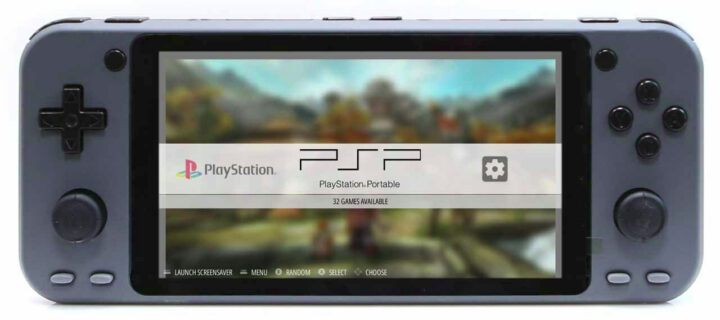
HardKernel is a Korean single-board-computer company, and the Odroid Go Ultra is what happens when an SBC maker builds a handheld: it is essentially the guts of the Odroid-N2+ dev board folded into the Odroid Go Super shell. Launched in October 2022 at $111, it runs the Amlogic S922X, a hexa-core chip with four Cortex-A73 cores at 2.2 GHz, two Cortex-A53 cores at 2.0 GHz, and a Mali-G52 MP4 GPU clocked at 846 MHz, paired with 2 GB of LPDDR4 and 16 GB of eMMC. HardKernel sells it as both a console and a development kit, and that framing matters: this is a hackable Linux box first and a polished gaming product second.
Emulation performance, generation by generation
The S922X is a genuinely strong ARM SoC for its price, roughly double the throughput of the RK3326 in cheaper 2020-era handhelds, and it shows across the mid-tier libraries. Everything 8-bit and 16-bit (NES, SNES, Genesis, PC Engine, Game Boy Advance) runs at full speed with headroom to spare through RetroArch cores; there is no reason these systems should ever stutter here. Nintendo 64 is where most buyers start caring, and Mupen64Plus-Next handles the bulk of the library at full speed, with the usual awkward titles needing per-game tweaks. PlayStation via Beetle PSX or PCSX-ReARMed is effortless. PSP through PPSSPP is the headline: many games run at native or 2x internal resolution, though heavy 3D titles like God of War want frameskip or a slight underclock. Dreamcast on Flycast runs well once you pick the right settings, and the optional libmali Vulkan driver noticeably helps Dreamcast, Saturn and PSP. Saturn itself (Beetle Saturn or YabaSanshiro) is playable but demanding and inconsistent. The ceiling is honest and firm: this is not a PS2, GameCube or Wii machine. A handful of the simplest 3D titles from those systems will technically boot and crawl, but the vast majority will not, and buying this device for sixth-generation home consoles is a mistake.
Screen, build and controls
The 5-inch panel is a 854×480 TFT, and it is the weakest part of the hardware. Reviewers consistently call it dull, with mediocre brightness and a pixel density that looks soft at that diagonal. The body is large and chunky at 204 x 86 x 25 mm and 299 grams, a proper two-handed landscape slab rather than something pocketable. Controls are a mixed story. You get a d-pad, ABXY, dual analog sticks, four digital shoulder buttons (L1/L2/R1/R2, none of them pressure-sensitive triggers), and a row of F1 through F6 function buttons. The sticks are conventional potentiometer units, not Hall effect, and they are the recurring complaint: stiff, awkwardly placed, and in at least one review the left stick only reached about 92 percent at full deflection, which is enough to make analog-heavy PSP and N64 games frustrating. Audio is a single 0.5 W mono speaker plus a 3.5 mm jack. The 4,000 mAh battery is good for roughly six hours on light systems and around three under a heavy PSP or Dreamcast load. Charging is handled over USB-C, but a dual-PMIC quirk means a fully drained unit charges slowly unless you use the bundled Y-cable.
Software and setup
Out of the box it ships Ubuntu 20.04 with HardKernel’s own EmulationStation frontend over Libretro. Underneath is a full Linux userland you can SSH into and tinker with, which is the point of the device for a lot of its owners. The glaring stock-experience gap is wireless: there is no built-in WiFi or Bluetooth at all. You must add a USB dongle (HardKernel’s RTL8821CU is the tested option) before you get netplay, box-art scraping, or Bluetooth pads, and that is a real setup tax competitors do not charge. Most owners move off the stock image quickly. The relevant custom-firmware options for this S922X device are ROCKNIX (the successor to JELOS), Batocera, and ArkOS, all of which support it and generally organize systems and squeeze performance better than the factory build. Note that firmwares like muOS, Knulli and OnionOS target other chips and do not apply here, so ignore that advice if you see it.
Price, value and who it is for
At $111 direct from HardKernel or ameriDroid, the raw silicon is a bargain and the N64-through-Dreamcast-and-PSP performance is legitimately good. But the value math is dragged down by the dull screen, the stiff non-Hall sticks, the missing wireless, and a support community that is small next to Anbernic’s or Retroid’s. It is not the device to recommend to someone who wants to open a box and have polish. It is the device for existing Odroid and Linux tinkerers, for people who specifically want an open, documented, hackable handheld and will happily add a WiFi dongle, swap firmware, and tune Flycast by hand. If that describes you, the S922X earns its keep. If you want turnkey PS2 or a bright modern display, look elsewhere.
📐 Size & Pocketability
⚖️ Weight vs Other Handhelds
🔋 Real-World Battery Estimator
⭐ Emulation Performance
📊 View How This Score is Calculated
The Hardware Power Score is an absolute metric. Perfect emulation of difficult, modern consoles awards significantly more points than standard retro consoles.
- 15× Multiplier: Modern PC
- 12× Multiplier: Switch, PS3, Xbox 360
- 10× Multiplier: Wii U
- 8× Multiplier: PS2, GameCube, Wii, Xbox
- 5× Multiplier: Saturn, Dreamcast, PSP
- 3× Multiplier: N64, PS1
- 1× Multiplier: SNES, GBA
Generation 7
Generation 6
Generation 5
Handhelds & Retro
⚡ Performance Benchmarks
Where HardKernel Odroid Go Ultra ARM Mali-G52 MP6 lands against the handhelds everyone knows. Every bar shares one scale, so longer genuinely means faster — add up to two rivals to compare.
CPU = Geekbench 6 multi-core · GPU = 3DMark Wild Life. Median real-world scores; every bar shares one scale — add up to two rivals to compare.
📋 Full Specifications
📺 Display
⚙️ Platform
💾 Memory
🕹️ Controls
📏 Body
🔋 Battery
⚖️ Verdict
✅ The Good
- Powerful-for-its-price Amlogic S922X handles N64, PSP, Dreamcast and PS1 comfortably
- Fully open Linux/EmulationStation devkit with strong ROCKNIX, Batocera and ArkOS custom-firmware support
- Large 4,000 mAh battery delivers about six hours on lighter systems
- Sold direct at a low $111 with 2 GB RAM and 16 GB eMMC included
❌ The Bad
- No built-in WiFi or Bluetooth; you must add a USB dongle
- Stiff potentiometer analog sticks (not Hall effect) with poor full-deflection range hurt PSP and N64 games
- Dull, low-brightness 854×480 screen that trails competing panels
📰 Latest News & Guides
The Ultimate Guide to ARMSX3: Android’s New PS3 Emulator, Competitor Comparisons, and Setup Tutorial
18/08/2026Pokémon Gold, Silver, and Crystal (Gen 2) Recomp Lands on Android
17/08/2026How to Play the Pokémon Red, Blue, or Yellow Recomp on Your Android, Windows, and Linux Devices
16/08/2026🔍 Similar Handhelds
Other handhelds that emulate up to PSP.