
🛒 Where to Buy
⚠️ Golden Rule of Retro Handhelds: Throw away the cheap MicroSD card that comes in the box — it will fail. And never use a high-wattage PD “Fast Charger” on these devices; it can damage the battery. Use a standard 5V/1.5A brick.
Device Overview: Game Console R36S
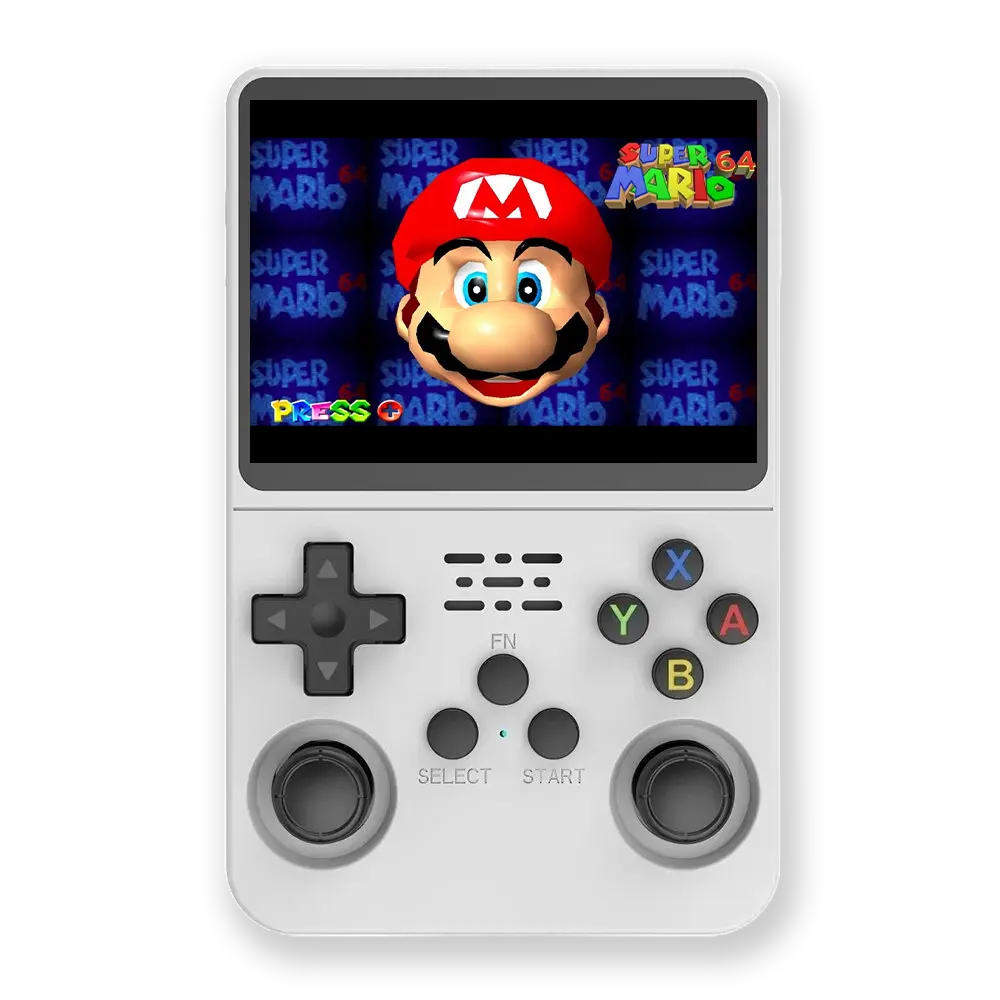
The Game Console R36S is the handheld that turned a $40 price tag into a genuine cultural moment. It is an unlicensed vertical clone of Anbernic’s RG351V, built around the Rockchip RK3326 — the same aging system-on-chip that powered a whole generation of budget retro devices — and it arrived in late 2023 with no marketing, no warranty, and no single manufacturer to point to. What it offered instead was a solid plastic shell, a sharp 4:3 screen, and enough horsepower to run everything up to the original PlayStation. That combination made it a runaway seller and, unfortunately, a magnet for fakes.
Emulation performance, generation by generation
Set expectations by the chip, not the hype. The RK3326 is a quad-core ARM Cortex-A35 clocked around 1.3 to 1.5 GHz with a Mali-G31 MP2 GPU and 1 GB of DDR3 RAM. This is a low-power ARM board, not a pocket PC, and its ceiling is the 32-bit era. Everything from the 8-bit and 16-bit generations runs perfectly: NES, Game Boy and Game Boy Color, Master System, Genesis, SNES, and PC Engine all hold a locked 60 fps under RetroArch cores like Snes9x and Genesis Plus GX. Game Boy Advance through mGBA or gpSP is flawless, and the 640×480 panel lets you integer-scale GBA and SNES for clean, unblurred pixels. PlayStation 1 is where the R36S earns its reputation — PCSX ReARMed clears the vast majority of the library at full speed, with only the heaviest 3D titles needing a touch of frameskip. Beyond that, honesty matters. Nintendo 64 via Mupen64Plus is a lottery: Super Mario 64 and a handful of others are playable, but most of the library stutters. Dreamcast on Flycast, PSP on PPSSPP, and Saturn are effectively out of reach except for a few lightweight games. Nintendo DS through DraStic runs some 2D titles, though the single-screen layout is awkward. Treat PS1 and SNES as the headline acts and you will not be disappointed.
Screen, build and controls
The 3.5-inch IPS display is the star. At 640×480 in a true 4:3 ratio and roughly 228 PPI, it is dense, bright, and correctly proportioned for retro content — no letterboxing on square-ish systems, and genuine units use an OCA-laminated panel that removes the air gap and looks noticeably better than the cheaper screens on fakes. The body is all plastic, about 187 grams and 82 by 130 mm, sized to sit vertically in one hand like a chunky Game Boy. Behind the shell sits a removable Li-ion pack rated around 3200 to 3500 mAh depending on the batch, good for roughly five to six hours of 8-bit and 16-bit play and closer to three to four hours once you push PS1 emulation. The controls are the part to understand going in: dual symmetrical analog sticks sit below a top-mounted d-pad, but they are conventional potentiometer sticks, not Hall effect, so drift over the years is a real possibility. The shoulders are digital L1/R1 and L2/R2 with no analog travel, and there are no L3/R3 clicks. For PS1 and 16-bit games none of that matters; for anything needing precise analog aim, it shows its budget roots.
Software and setup
Connectivity is deliberately bare: no Wi-Fi, no Bluetooth, no video out. You get USB-C, a 3.5 mm headphone jack, and dual microSD slots — one for the operating system, one for your games. The stock firmware that ships on the device is rough and best treated as a placeholder. Genuine units boot an ArkOS-based system whose ROM partition is labelled EASYROMS, which happens to be the community’s quickest authenticity tell. The real move is to reflash. ArkOS is the flagship custom firmware here and the one most guides target; ROCKNIX (the successor to JELOS) and AmberELEC are strong alternatives, all three built specifically for RK3326 hardware. Note that the muOS and Knulli you may have read about are for Allwinner devices and do not run on this chip, so ignore that advice. Because there is no Wi-Fi, you load ROMs and firmware by pulling the microSD and using a card reader on a PC — slightly more manual than a connected device, but a one-time chore.
Price, value and who it is for
At roughly $40 to $60 depending on seller and storage, the R36S is one of the cheapest ways to carry a competent PS1-and-back machine, and its screen genuinely punches above the price. The catch is the clone problem. The market is flooded with counterfeits carrying 512 MB of RAM instead of 1 GB, weaker RK3128 chips, stuck-on decal buttons, and dimmer panels that will not run standard custom firmware. Buy from a seller with clear return terms, confirm the EASYROMS partition and two RAM chips on the board, and you have a bargain. This is the device for someone who wants a dedicated 8-bit-through-PS1 handheld, is comfortable flashing an SD card once, and does not need Wi-Fi, analog triggers, or anything past the PlayStation. If your wishlist includes PSP, Dreamcast, or drift-proof sticks, spend more elsewhere.
📐 Size & Pocketability
⚖️ Weight vs Other Handhelds
🔋 Real-World Battery Estimator
⭐ Emulation Performance
📊 View How This Score is Calculated
The Hardware Power Score is an absolute metric. Perfect emulation of difficult, modern consoles awards significantly more points than standard retro consoles.
- 15× Multiplier: Modern PC
- 12× Multiplier: Switch, PS3, Xbox 360
- 10× Multiplier: Wii U
- 8× Multiplier: PS2, GameCube, Wii, Xbox
- 5× Multiplier: Saturn, Dreamcast, PSP
- 3× Multiplier: N64, PS1
- 1× Multiplier: SNES, GBA
Generation 6
Generation 5
Handhelds & Retro
⚡ Performance Benchmarks
Where Game Console R36S Mali-G31 MP2 lands against the handhelds everyone knows. Every bar shares one scale, so longer genuinely means faster — add up to two rivals to compare.
CPU = Geekbench 6 multi-core · GPU = 3DMark Wild Life. Median real-world scores; every bar shares one scale — add up to two rivals to compare.
📋 Full Specifications
📺 Display
⚙️ Platform
💾 Memory
🕹️ Controls
📏 Body
🔋 Battery
⚖️ Verdict
✅ The Good
- Sharp 640×480 4:3 IPS panel, OCA-laminated on genuine units, that outclasses nearly everything else under $60
- Runs all 8-bit and 16-bit systems flawlessly and clears most of the PS1 library at full speed
- Removable battery and dual microSD, with fully supported ArkOS, ROCKNIX and AmberELEC custom firmware
- Very low price (around $40 to $60) for the screen quality and performance on offer
❌ The Bad
- Potentiometer analog sticks (no Hall effect) prone to eventual drift, plus digital-only triggers and no L3/R3
- No Wi-Fi or Bluetooth, so ROM loading is card-reader-only with no netplay or wireless updates
- Rampant counterfeits (512 MB RAM, RK3128 chips, worse panels) make buying a genuine unit a gamble without careful checking
📰 Latest News & Guides
The Ultimate Guide to ARMSX3: Android’s New PS3 Emulator, Competitor Comparisons, and Setup Tutorial
18/08/2026Pokémon Gold, Silver, and Crystal (Gen 2) Recomp Lands on Android
17/08/2026How to Play the Pokémon Red, Blue, or Yellow Recomp on Your Android, Windows, and Linux Devices
16/08/2026🔍 Similar Handhelds
Other handhelds that emulate up to DS.