
🛒 Where to Buy
⚠️ Golden Rule of Retro Handhelds: Throw away the cheap MicroSD card that comes in the box — it will fail. And never use a high-wattage PD “Fast Charger” on these devices; it can damage the battery. Use a standard 5V/1.5A brick.
Device Overview: Game Console My Mini
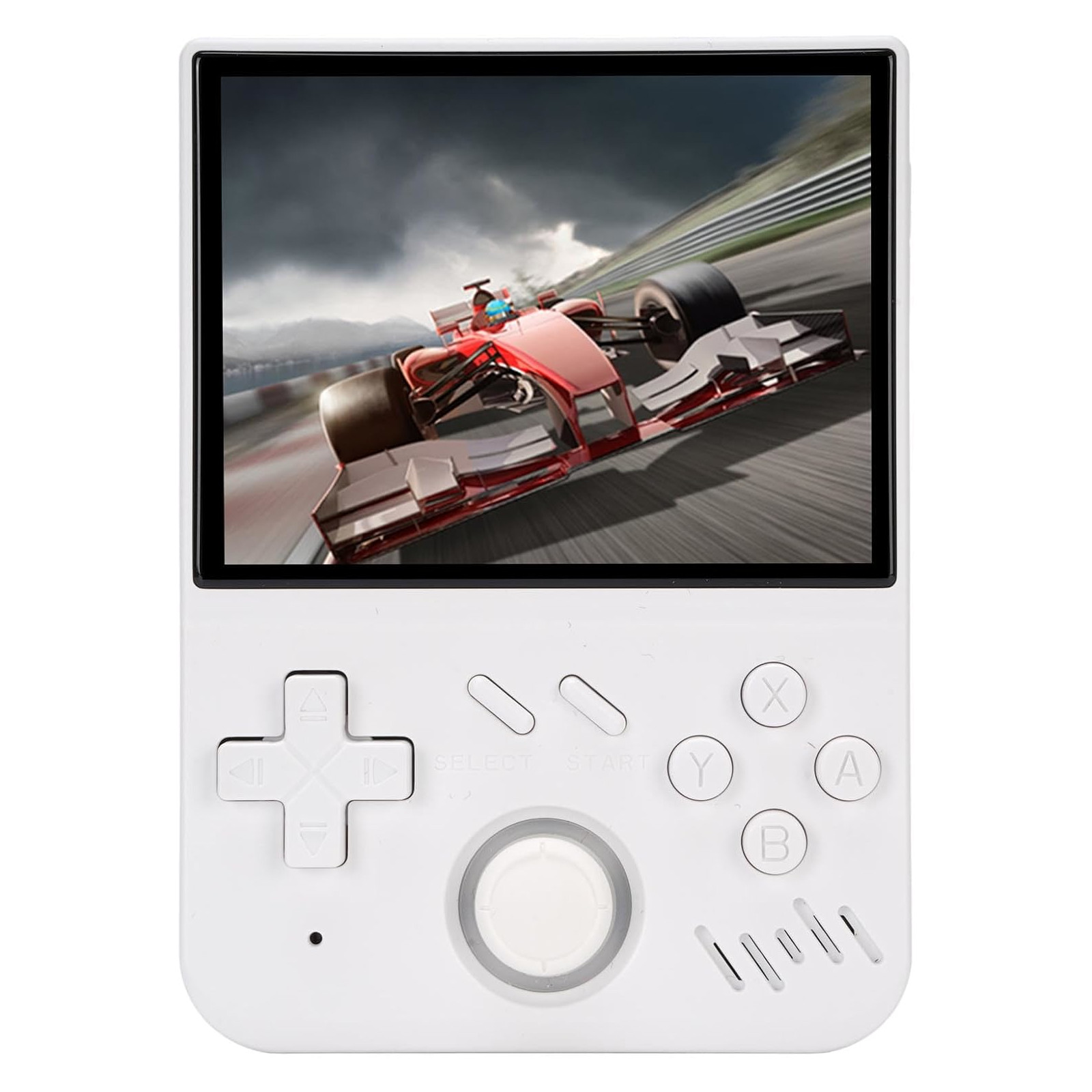
The Game Console My Mini is a 2025 budget emulation handheld built on the Rockchip RK3326 — the same quad-core Cortex-A35 (up to 1.5GHz) with Mali-G31 graphics that powered Anbernic’s RG351 line back in 2020. It sells for roughly $30 to $42 depending on the AliExpress seller, shipped from March 2025, and pairs that five-year-old chip with a sharp 3.5-inch 640×480 IPS panel and a chunky 4000mAh removable battery. Nothing here is new silicon; what you are buying is a familiar, thoroughly documented platform in a fresh vertical shell with a clickable analog stick. If you already know what an RG351P does, you already know this device’s ceiling.
Emulation performance, generation by generation
The RK3326 is a low-power ARM SoC, not a pocket PC, so set expectations at the 32-bit era. Everything through the 16-bit generation runs flawlessly: NES, SNES, Genesis/Mega Drive, Game Boy/Color/Advance, Master System and PC Engine all hold full speed with headroom. GBA through mGBA is perfect. PlayStation 1 via PCSX ReArmed is the comfortable headline — most of the library runs at full speed, though a few heavy 3D titles want tuning, and the modest 1GB of RAM leaves little slack for the hungrier cores. Arcade emulation through FBNeo and MAME2003-Plus covers CPS1/CPS2, Neo Geo and the pre-3D catalog cleanly. Above that line the wheels come off. Nintendo 64 on Mupen64Plus-Next is a lottery: Mario 64 and a handful of first-party titles are playable, most of the library is not. PSP on PPSSPP manages only the lightest 2D games, and Dreamcast (Flycast) and Saturn are effectively out of reach. This is a machine for 8-bit through PS1, full stop; anyone promising smooth N64 or PSP on an RK3326 is selling you frameskip.
Screen, build and controls
The 3.5-inch IPS screen is the strongest single component. 640×480 at a native 4:3 ratio and 60Hz is a genuinely good match for retro content, sharp at roughly 228 PPI, with none of the stretching that plagues 16:9 budget units. The build is all plastic, 110 x 78 x 21mm and about 176 grams — pocketable, light, unremarkable. Audio comes from a single front-facing 1W mono speaker that is loud enough but thin, so headphones through the 3.5mm jack are the better call. The controls are where the corners show. There is a single clickable analog stick using a conventional switch/potentiometer mechanism, not Hall-effect sensors, so expect eventual drift. Reviewers describe the d-pad as scratchy with an inconsistent pivot, the face buttons as small and stiff, and the shoulder buttons as hard-tensioned. It is serviceable for D-pad-driven 2D games, which is fortunately exactly what the chip is good at, but it is not a precision instrument.
Software and setup
Out of the box it runs EmuELEC 4.7, a Linux distribution with an EmulationStation front end, preloaded on the internal 8GB eMMC. That stock image is fine for browsing and launching, but the real value of an RK3326 device is its custom-firmware scene, and the My Mini inherits it wholesale because the chip is so well-trodden. ArkOS (via the RG351MP-family “arkos4clone” builds) is the go-to for stability and simplicity; ROCKNIX, the successor to 351ELEC/JELOS, is the choice if you want the most current cores and a cleaner update path. Batocera runs on this platform too. You flash the firmware to a second microSD card — the device has two card slots plus a 3.5mm jack and two USB-C ports — and keep your ROMs on the other, which is a tidier arrangement than the single-slot competition. Note there is no built-in Wi-Fi; wireless needs a USB dongle, so plan on loading content over the card reader rather than scraping box art over the air. The upside of buying into such an old chip is that none of this is guesswork — the RK3326 install guides, per-core settings and shader packs written for the RG351 family transfer almost verbatim.
Price, value and who it is for
At $30 to $42 the My Mini is priced honestly for what it is: an entry-level 2D-through-PS1 handheld with a very good screen and a large battery. Its problem is the company it keeps. The Miyoo Mini Plus, the Anbernic RG35XX Plus/H, and the Powkiddy RGB30 sit in the same band with newer chips, better-regarded buttons, and far larger communities — and on these devices community firmware support is what keeps them alive. Buy the My Mini if the 640×480 4:3 panel and the removable 4000mAh battery specifically appeal to you and you can find it near the low end of its price range. Skip it if you want reliable N64/PSP, if stick precision matters, or if you would rather ride a bigger scene. It is a competent RK3326 device in 2025 — but being competent on 2020 silicon is exactly the caveat.
📐 Size & Pocketability
🔋 Real-World Battery Estimator
⭐ Emulation Performance
📊 View How This Score is Calculated
The Hardware Power Score is an absolute metric. Perfect emulation of difficult, modern consoles awards significantly more points than standard retro consoles.
- 15× Multiplier: Modern PC
- 12× Multiplier: Switch, PS3, Xbox 360
- 10× Multiplier: Wii U
- 8× Multiplier: PS2, GameCube, Wii, Xbox
- 5× Multiplier: Saturn, Dreamcast, PSP
- 3× Multiplier: N64, PS1
- 1× Multiplier: SNES, GBA
Generation 6
Generation 5
Handhelds & Retro
⚡ Performance Benchmarks
Where Game Console My Mini Mali-G31 MP2 lands against the handhelds everyone knows. Every bar shares one scale, so longer genuinely means faster — add up to two rivals to compare.
CPU = Geekbench 6 multi-core · GPU = 3DMark Wild Life. Median real-world scores; every bar shares one scale — add up to two rivals to compare.
📋 Full Specifications
📺 Display
⚙️ Platform
💾 Memory
🕹️ Controls
📏 Body
🔋 Battery
⚖️ Verdict
✅ The Good
- Excellent 3.5-inch 640×480 4:3 IPS panel, sharp and correctly shaped for retro content with no stretching
- Large 4000mAh battery that is removable and user-replaceable, uncommon at this price
- Mature, well-documented RK3326 platform: ArkOS, ROCKNIX and Batocera all run on it out of the gate
- Genuinely cheap at roughly $30 to $42 for solid 8-bit through PlayStation 1 emulation
❌ The Bad
- 2020-era Rockchip RK3326 means N64, PSP, Dreamcast and Saturn are unreliable to unplayable
- Mediocre controls: scratchy d-pad, small stiff face buttons, and a non-Hall analog stick that will eventually drift
- No built-in Wi-Fi (needs a USB dongle) and a smaller enthusiast following than same-priced rivals like the Miyoo Mini Plus or RG35XX
📰 Latest News & Guides
The Ultimate Guide to ARMSX3: Android’s New PS3 Emulator, Competitor Comparisons, and Setup Tutorial
18/08/2026Pokémon Gold, Silver, and Crystal (Gen 2) Recomp Lands on Android
17/08/2026How to Play the Pokémon Red, Blue, or Yellow Recomp on Your Android, Windows, and Linux Devices
16/08/2026🔍 Similar Handhelds
Other handhelds that emulate up to DS.