
🛒 Where to Buy
⚠️ Golden Rule of Retro Handhelds: Throw away the cheap MicroSD card that comes in the box — it will fail. And never use a high-wattage PD “Fast Charger” on these devices; it can damage the battery. Use a standard 5V/1.5A brick.
Device Overview: KinHank K36
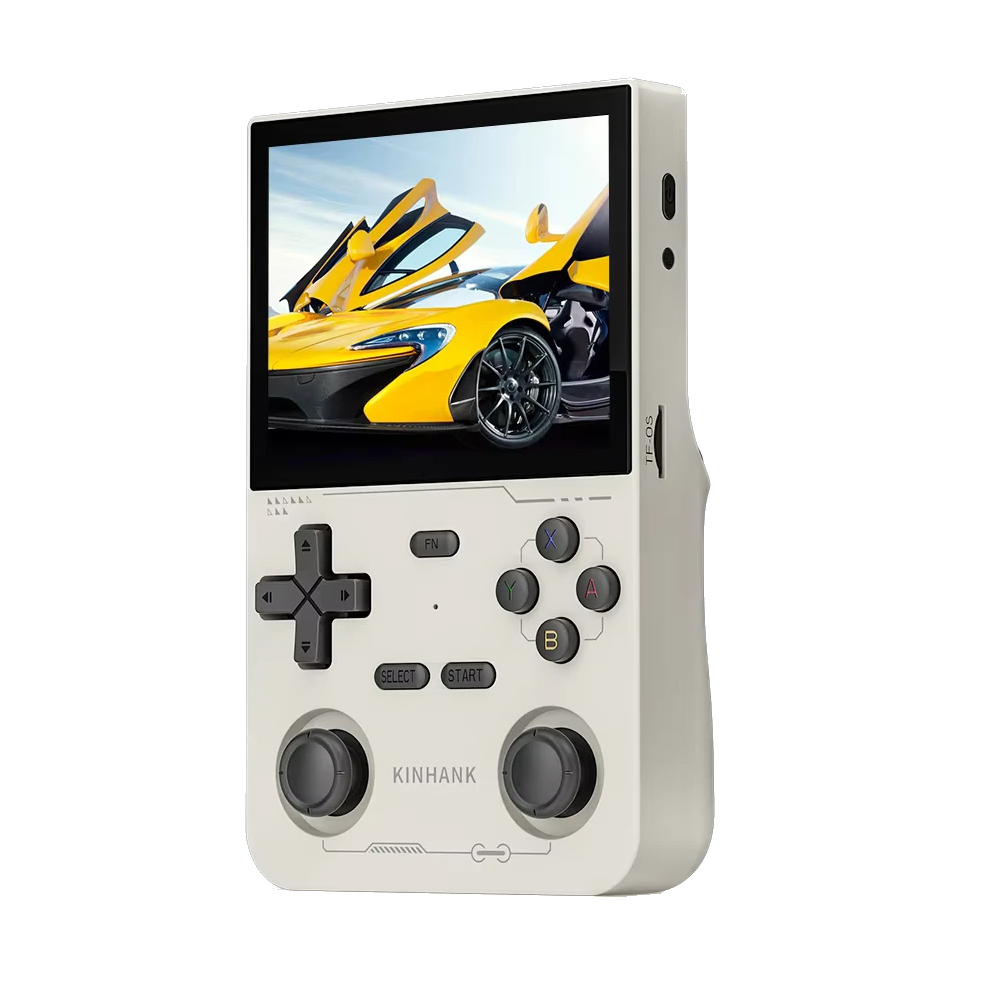
The KinHank K36 is a sub-$40 vertical handheld built on the same Rockchip RK3326 platform that powers the R36S and the wider ocean of “R36” clones. It is not a new idea so much as a new shell around an old chip: a quad-core ARM Cortex-A35 that tops out around 1.3 to 1.5 GHz, a Mali-G31 MP2 GPU, and a single gigabyte of RAM. What KinHank actually changed is the body. The K36 uses a curved, upright case with an offset stick layout aimed at people who find the flat, slab-shaped R36S uncomfortable. Everything about how this device performs, though, is dictated by that 2018-era silicon, and no amount of “9000+ games” box copy moves that ceiling.
Emulation performance, generation by generation
This is a strictly 8-bit, 16-bit, and selective 32-bit machine. NES, SNES, Genesis, Master System, PC Engine, Game Boy/Color and Game Boy Advance all run at full speed through RetroArch cores, and that d-pad-friendly library is where the K36 genuinely earns its keep. Nintendo 64 is the pleasant surprise: mupen64plus handles the friendlier end of the catalog, Mario 64 and Ocarina of Time included, at acceptable speeds, though anything RDP-heavy will chug. PlayStation 1 through PCSX ReARMed is playable but not pristine, with occasional judders and audio crackle rather than a locked frame rate. Above that line the wall is hard and worth stating plainly. Dreamcast (Flycast), PSP (PPSSPP), and Sega Saturn are not in playable states on this chip, and arcade platforms such as Atomiswave are effectively unusable. Treat N64 and PS1 as the honest ceiling and the K36 rarely disappoints; expect a Switch-tier portable and you will be annoyed within an hour.
Screen, build and controls
The 3.5-inch IPS panel runs 640×480 at a rated 500 nits. That native 4:3 shape suits the retro library far better than a stretched widescreen would, the pixels are clean, and it is noticeably brighter than most budget rivals. There is no HDMI output, so these games stay on the handheld. Build quality is where KinHank put in real effort. The d-pad has proper travel and, in side-by-side reviewer testing, beats the mushy pads on the R36S and D-R35+. Face buttons are genuine switches rather than the membrane style found on cheaper clones. The analog sticks are advertised as Hall-effect, a claim worth a grain of salt at this price, but they have enough range for 3D control. The rounded, clicky shoulder buttons are the weakest input here. A single down-firing speaker handles audio, there is a 3.5mm headphone jack, and there is no Wi-Fi or Bluetooth on this class of device. It weighs roughly 180 to 188 grams and charges over USB-C at 5V/2A, with a 3500mAh battery good for about four hours. One caveat on the vertical form: larger-handed reviewers liked the curved back, while smaller hands found the rear bumps more awkward than ergonomic, so the shape is polarizing rather than universally comfortable.
Software and setup
This is the K36’s real weak point. It ships on a KinHank-skinned build of EmuELEC, and it is rough, with clumsy menus, questionable defaults, and the usual grey-market ROM baggage preloaded on the bundled 64GB microSD (8GB is soldered internally, and the slot reads cards up to 512GB). The saving grace is that RK3326 is one of the best-supported chips in the entire hobby. ArkOS has a community K36 image via AeolusUX’s fork, though that project is now best-effort and effectively wound down. ROCKNIX is the more current route: flash the RK3326 “b” nightly and patch the stock DTB, and you get a maintained, modern front end. Batocera also publishes an image covering “K36, R36 Max/Pro, MyMini and other EmuELEC clones.” Plan on reflashing a fresh card on day one; the stock experience is the exact thing most reviewers tell you to walk away from.
Price, value and who it is for
Street price swings widely, from roughly $20 to $30 on AliExpress up to $40 to $55 on Amazon and KinHank’s own store depending on bundle and color, which spans black, grey, and transparent purple. At the low end it is a genuinely cheap entry into portable emulation with a better d-pad and a brighter screen than much of the R36 crowd. At the high end you are within reach of an Anbernic RG35XX H or another Allwinner H700 device that runs muOS and does everything the K36 does with far less fuss. Buy the K36 if you specifically want the upright shape, you are comfortable flashing ROCKNIX yourself, and your library realistically stops at N64 and PS1. If you want wireless, PSP-and-up horsepower, or something pleasant straight out of the box, spend your money elsewhere.
📐 Size & Pocketability
⚖️ Weight vs Other Handhelds
🔋 Real-World Battery Estimator
⭐ Emulation Performance
📊 View How This Score is Calculated
The Hardware Power Score is an absolute metric. Perfect emulation of difficult, modern consoles awards significantly more points than standard retro consoles.
- 15× Multiplier: Modern PC
- 12× Multiplier: Switch, PS3, Xbox 360
- 10× Multiplier: Wii U
- 8× Multiplier: PS2, GameCube, Wii, Xbox
- 5× Multiplier: Saturn, Dreamcast, PSP
- 3× Multiplier: N64, PS1
- 1× Multiplier: SNES, GBA
Generation 6
Generation 5
Handhelds & Retro
⚡ Performance Benchmarks
Where KinHank K36 Mali-G31 MP2 lands against the handhelds everyone knows. Every bar shares one scale, so longer genuinely means faster — add up to two rivals to compare.
CPU = Geekbench 6 multi-core · GPU = 3DMark Wild Life. Median real-world scores; every bar shares one scale — add up to two rivals to compare.
📋 Full Specifications
📺 Display
⚙️ Platform
💾 Memory
🕹️ Controls
📏 Body
🔋 Battery
⚖️ Verdict
✅ The Good
- Bright 500-nit 3.5-inch 640×480 IPS panel with a native 4:3 shape that fits retro games
- Genuinely good d-pad and clicky switch face buttons that beat most R36S-class clones
- Excellent custom-firmware support (ROCKNIX, ArkOS, Batocera) thanks to the well-worn RK3326 chip
- Very cheap, often $20 to $30 on AliExpress, for full-speed 8/16-bit and workable N64/PS1
❌ The Bad
- Ships on a rough KinHank-skinned EmuELEC build that most reviewers say to reflash immediately
- Hard emulation ceiling: Dreamcast, PSP and Saturn are not playable, and PS1 has judders and audio crackle
- No Wi-Fi, no Bluetooth and no HDMI out, plus a polarizing curved shape that smaller hands find awkward
📰 Latest News & Guides
The Ultimate Guide to ARMSX3: Android’s New PS3 Emulator, Competitor Comparisons, and Setup Tutorial
18/08/2026Pokémon Gold, Silver, and Crystal (Gen 2) Recomp Lands on Android
17/08/2026How to Play the Pokémon Red, Blue, or Yellow Recomp on Your Android, Windows, and Linux Devices
16/08/2026🔍 Similar Handhelds
Other handhelds that emulate up to DS.