
🛒 Where to Buy
⚠️ Golden Rule of Retro Handhelds: Throw away the cheap MicroSD card that comes in the box — it will fail. And never use a high-wattage PD “Fast Charger” on these devices; it can damage the battery. Use a standard 5V/1.5A brick.
Device Overview: Anbernic Win600
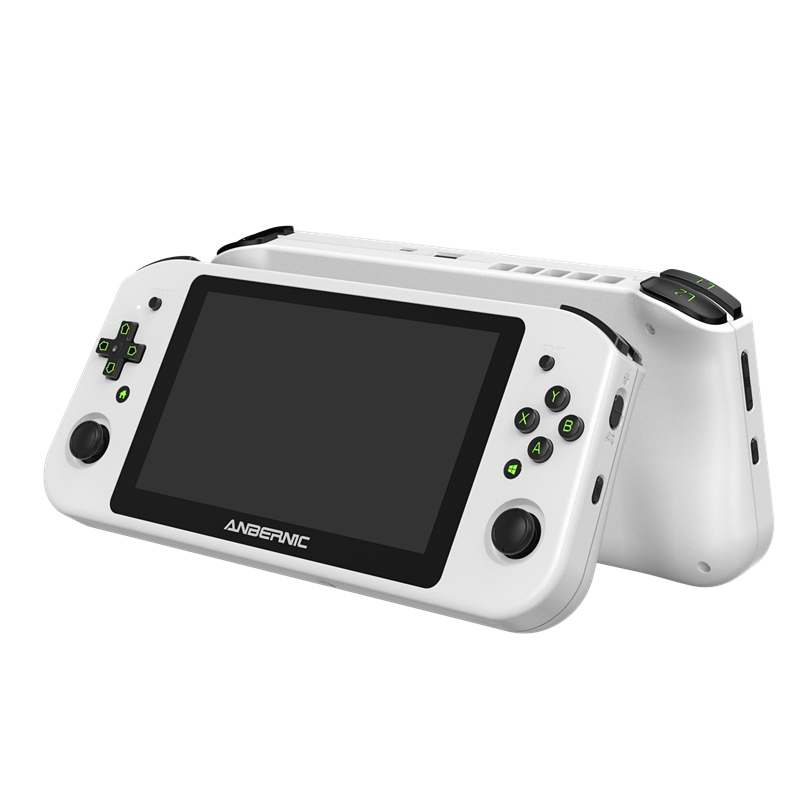
The Anbernic Win600 was the company’s first x86 Windows handheld, launched in July 2022 as a budget answer to the Steam Deck rather than a genuine rival to it. Instead of a modern gaming APU, Anbernic reached for AMD’s Athlon Silver 3020e or 3050e, chips built for cheap Chromebooks and thin-client desktops. That single decision defines the device: it is a real PC you can install any emulator or Windows program on, but its ceiling sits closer to a 2016 tablet than to the Deck it superficially resembles. At roughly $300 for the entry model it undercut the Deck by half, and the compromises land exactly where you would expect.
Emulation performance, generation by generation
The 3050e is a two-core, four-thread Zen part topping out at 2.8 GHz, paired with a three-compute-unit Radeon RX Vega 3 iGPU. That is weak silicon, and the results track honestly. Everything from the NES through the 16-bit era, plus arcade, runs flawlessly with headroom to spare. PlayStation 1 (DuckStation), PSP (PPSSPP), Sega Saturn, Nintendo 64, Nintendo DS and Dreamcast (Flycast) all hold full speed, often with upscaling. GameCube through Dolphin is where the chip starts negotiating: many titles keep 60 fps, but demanding ones like F-Zero GX or Rogue Squadron drop frames. Note that the cheaper 3020e model uses the identical Radeon RX Vega 3 iGPU, so its GPU-bound emulation ceiling is barely different; you pay for the 3050e mostly in CPU-bound cases. Wii is hit-or-miss. PlayStation 2 is the notorious weak point, with PCSX2 stuttering on all but the lightest games, which stings because a machine of this vintage ought to manage it. Citra (3DS) is playable but inconsistent, while Cemu (Wii U) and Switch emulation are effectively off the table. Because it runs full Windows you use the real desktop emulators here, RetroArch, Dolphin, PCSX2 and Cemu, not cut-down ARM ports, and you can even coax lighter native Steam and older PC titles through at 720p low.
Screen, build and controls
The screen is a 5.94-inch, 1280×720 IPS panel with OCA full lamination and 10-point touch: sharp, colour-accurate and a good match for 720p-and-below content, though it is a plain 60 Hz panel with no HDR ambitions. The chassis is large, 236mm wide, 103mm tall and 22mm thick at 490 grams, closer to a small tablet with grips than a pocketable handheld; the width spreads your hands wide but the moulded grips are comfortable for long sessions. Controls sit in a PlayStation-style layout, with offset analog sticks below the d-pad and face buttons. Those sticks are conventional potentiometer units, not Hall effect, so stick drift over time is a real risk. The shoulders are stacked digital buttons, L1/L2 and R1/R2 all clicky switches with no analog triggers, which hurts racing and shooters that expect a variable pull. The face buttons are membrane-based and feel distinctly SNES-like, which retro players tend to like. A fan on the top edge runs nearly constantly; it is not loud, but it is always audible.
Software and setup
The Win600 ships with Windows 10 and will run 11, and out of the box that is both its strength and its headache. You get a full desktop, driver support and Steam, but also Windows overhead on a 2-core CPU and just 8GB of RAM in the base trim, so navigating the OS by stick and touch can feel sluggish. The community answer is to bypass Windows for gaming: Batocera, JELOS and ChimeraOS all boot on the Win600 and turn it into a console-style front end, and EmuDeck works if you stay on Windows. Batocera is the popular pick, giving a clean EmulationStation interface and easy per-system TDP tuning; throttling the chip toward 6W meaningfully extends battery on retro content. The M.2 SSD is user-replaceable, and RAM runs from 8GB up to 16GB DDR4 on the higher configurations.
Price, value and who it is for
Battery is the other hard limit: two 4500mAh cells, about 39Wh, deliver only 2 to 2.5 hours in a demanding 3D game, stretching toward five hours on throttled SNES-era emulation, with 45W fast charging to soften the blow. Connectivity covers dual-band Wi-Fi 5, Bluetooth 4.2 and USB-C. At its roughly $300 launch price, rising to around $390 for the 8GB/256GB 3050e model, the Win600 makes sense for one specific buyer: someone who wants a genuine x86 Windows machine to run everything up through Dreamcast, PSP and most GameCube at a fraction of the Steam Deck’s cost, and who accepts the poor PS2 performance, short battery and basic sticks. Against pricier contemporaries like the GPD Win Max or the Aya Neo lineup, the Win600 is deliberately the cheap seat, and it shows in the chip rather than the build quality. If your library skews sixth-generation and newer, spend more elsewhere. If it is PS1, PSP and retro, this is a lot of open-platform flexibility for the money.
📐 Size & Pocketability
⚖️ Weight vs Other Handhelds
🔋 Real-World Battery Estimator
⭐ Emulation Performance
📊 View How This Score is Calculated
The Hardware Power Score is an absolute metric. Perfect emulation of difficult, modern consoles awards significantly more points than standard retro consoles.
- 15× Multiplier: Modern PC
- 12× Multiplier: Switch, PS3, Xbox 360
- 10× Multiplier: Wii U
- 8× Multiplier: PS2, GameCube, Wii, Xbox
- 5× Multiplier: Saturn, Dreamcast, PSP
- 3× Multiplier: N64, PS1
- 1× Multiplier: SNES, GBA
Gen 8 & PC
Generation 7
Generation 6
Generation 5
Handhelds & Retro
📋 Full Specifications
📺 Display
⚙️ Platform
💾 Memory
🕹️ Controls
📏 Body
🔋 Battery
⚖️ Verdict
✅ The Good
- A true x86 Windows PC: install any desktop emulator, Steam, or Windows software, with no locked-down firmware
- Runs 8/16-bit, PS1, PSP, N64, Saturn, DS and Dreamcast at full speed, and most GameCube titles are playable
- Sharp 5.94-inch 720p fully-laminated IPS touchscreen with comfortable SNES-style membrane buttons and d-pad
- User-replaceable M.2 SSD and a low entry price around $300, roughly half the cost of a Steam Deck
❌ The Bad
- PS2 emulation is genuinely weak and Wii U/Switch are out of reach, so the ceiling is lower than the "PC handheld" label suggests
- Short battery life of about 2 to 2.5 hours in 3D games, plus a fan that runs almost constantly
- Potentiometer sticks (no Hall effect), stacked digital shoulders with no analog triggers, and a heavy 490g body
📰 Latest News & Guides
The Ultimate Guide to ARMSX3: Android’s New PS3 Emulator, Competitor Comparisons, and Setup Tutorial
18/08/2026Pokémon Gold, Silver, and Crystal (Gen 2) Recomp Lands on Android
17/08/2026How to Play the Pokémon Red, Blue, or Yellow Recomp on Your Android, Windows, and Linux Devices
16/08/2026🔍 Similar Handhelds
Other handhelds that emulate up to 3DS.