
🛒 Where to Buy
⚠️ Golden Rule of Retro Handhelds: Throw away the cheap MicroSD card that comes in the box — it will fail. And never use a high-wattage PD “Fast Charger” on these devices; it can damage the battery. Use a standard 5V/1.5A brick.
Device Overview: Anbernic RG-351V
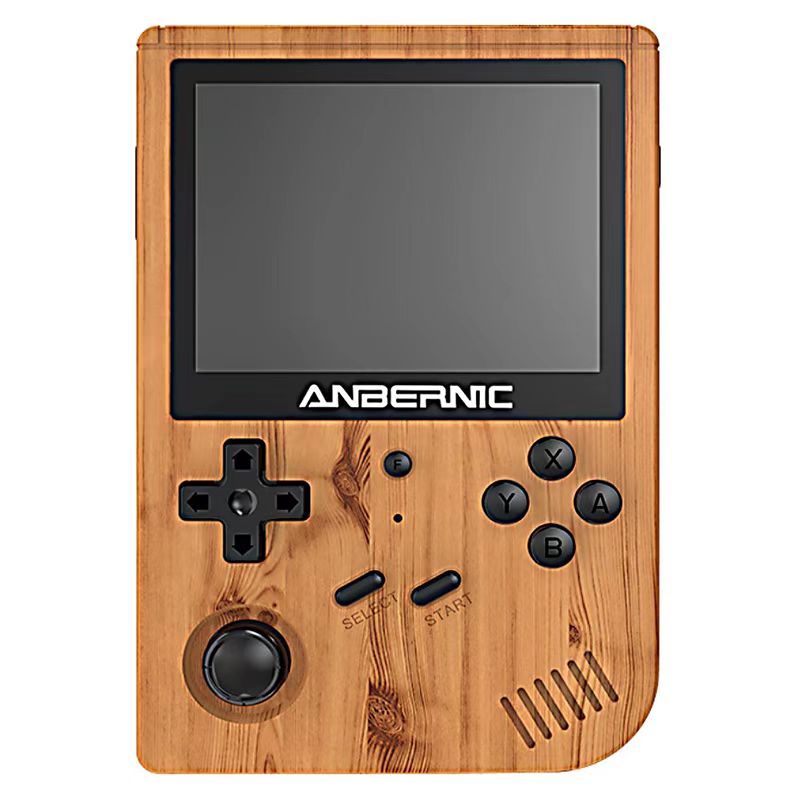
The Anbernic RG-351V is the vertical, Game Boy-shaped member of the RK3326 family that Anbernic scattered across the whole RG351 line in 2020 and 2021. Where the RG351P and RG351M laid their controls out horizontally, the RG-351V stacks a 3.5-inch 4:3 screen on top of the buttons in a tall, metallic-look plastic shell. It runs the same Rockchip RK3326 as its siblings, so the silhouette changes nothing about what it can actually emulate. What you pay the vertical premium for is the taller screen and the jacket-pocket footprint, not more horsepower. A 3900 mAh Li-polymer cell keeps it running for roughly six hours between charges.
Emulation performance, generation by generation
The RK3326 is a quad-core Cortex-A35 clocked to 1.5 GHz with a Mali-G31 MP2 GPU and just 1 GB of DDR3L. That is a low-power ARM chip, not a pocket PC, and the ceiling reflects it. Everything up to and including the 32-bit generation runs comfortably: NES, SNES, Genesis, Game Boy through Game Boy Advance, Neo Geo and TurboGrafx all hold full speed under Snes9x, Genesis Plus GX, mGBA and PicoDrive with headroom left over. PlayStation 1 is the sweet spot. PCSX ReARMed and DuckStation keep 60 fps across the overwhelming majority of the library, and the 4:3 panel frames those games the way CRTs did. Above PS1 the story turns honest. PSP through PPSSPP handles the lighter 2D and menu-driven catalogue but chokes on 3D-heavy titles, and 480p games get downscaled onto the 640×480 screen. Nintendo 64 via Mupen64Plus is a per-game lottery: Mario 64 and Ocarina of Time are playable, but anything demanding drops frames. Dreamcast on Flycast and Nintendo DS on DraStic are the practical wall, where a handful of light games work and most stutter. Sega Saturn is effectively off the table given the RAM budget, while arcade boards through FinalBurn Neo and MAME run the 2D-era sets fine but choke on anything 3D. Treat the RG-351V as a flawless machine up to PS1 and an occasional dabbler beyond it.
Screen, build and controls
The display is the reason to buy this shape. It is a 3.5-inch 640×480 IPS panel with OCA full lamination, so the glass sits directly on the pixels with no air gap, and the 4:3 ratio suits the systems this chip actually runs. The plastic shell comes in grey, transparent black or wood-grain, measures roughly 94 x 140 x 27 mm and weighs a little over 200 grams, dense enough to feel solid and small enough to forget you are carrying. The controls are where the compromises live. There is a single analog stick perched at the top left, a standard potentiometer unit rather than a Hall-effect sensor, so expect some drift over years of use. Below it sit a proper d-pad and an SNES-style diamond of face buttons. The four shoulder buttons are the oddity: L1 and R1 on the corners with L2 and R2 stacked a few millimetres above them on the inside, a layout that takes retraining. With only one stick and buttons packed closer than most people are used to, N64 and PSP games that lean on camera control feel awkward regardless of raw speed.
Software and setup
Out of the box the RG-351V ships with Anbernic’s own EmuELEC-derived image on the bundled microSD card. It is serviceable but dated. The device’s real value is unlocked by community firmware, all of which targets the RK3326 directly. AmberELEC, the project formerly known as 351ELEC, is the popular pick, with clean per-system defaults and RetroAchievements support built in. ArkOS is the kitchen-sink alternative for people who want to configure every knob, and ROCKNIX, the continuation of JELOS, is the actively maintained third option. Batocera also boots on this chip. Setup is the standard routine: flash the image to a second microSD, drop it in the console’s spare card slot and add your own legally dumped ROMs. The RG-351V carries two microSD slots specifically so the operating system and your game library live on separate cards. The built-in WiFi is 2.4 GHz only and slow, fine for scraping box art and metadata but useless for streaming.
Price, value and who it is for
The RG-351V launched around $110 to $120 and now floats near $90 on Anbernic’s own store when discounted. At that price it competes with its own successor, the RG353V, and with the cheaper RG35XX line, both of which are newer. Buy the RG-351V if you specifically want a vertical, 4:3, Game-Boy-pocket form factor and your library stops at PlayStation 1, because that is the machine it nails. If you care about N64, Dreamcast, PSP or dual-stick comfort, spend a little more on a newer chip. This is a focused handheld for a collector who values the shape and the laminated screen over raw reach.
📐 Size & Pocketability
⚖️ Weight vs Other Handhelds
🔋 Real-World Battery Estimator
⭐ Emulation Performance
📊 View How This Score is Calculated
The Hardware Power Score is an absolute metric. Perfect emulation of difficult, modern consoles awards significantly more points than standard retro consoles.
- 15× Multiplier: Modern PC
- 12× Multiplier: Switch, PS3, Xbox 360
- 10× Multiplier: Wii U
- 8× Multiplier: PS2, GameCube, Wii, Xbox
- 5× Multiplier: Saturn, Dreamcast, PSP
- 3× Multiplier: N64, PS1
- 1× Multiplier: SNES, GBA
Generation 6
Generation 5
Handhelds & Retro
⚡ Performance Benchmarks
Where Anbernic RG-351V Mali-G31 MP2 lands against the handhelds everyone knows. Every bar shares one scale, so longer genuinely means faster — add up to two rivals to compare.
CPU = Geekbench 6 multi-core · GPU = 3DMark Wild Life. Median real-world scores; every bar shares one scale — add up to two rivals to compare.
📋 Full Specifications
📺 Display
⚙️ Platform
💾 Memory
🕹️ Controls
📏 Body
🔋 Battery
⚖️ Verdict
✅ The Good
- Superb 3.5-inch 640×480 OCA-laminated 4:3 IPS screen that frames 8, 16 and 32-bit games the way they were meant to look
- Flawless, full-speed emulation up to and including PlayStation 1 (PCSX ReARMed / DuckStation at a genuine 60 fps)
- Genuinely pocketable vertical shell at just over 200 grams, offered in grey, transparent black and wood-grain finishes
- Strong custom-firmware support (AmberELEC, ArkOS, ROCKNIX) plus dual microSD slots that keep the OS and ROM library on separate cards
❌ The Bad
- The RK3326 and 1 GB of RAM hit a hard wall above PS1, so N64, Dreamcast, DS and PSP are all hit-or-miss
- Only one potentiometer analog stick (no Hall effect) and an unusual stacked shoulder-button layout make demanding controls awkward
- 2.4 GHz WiFi is too slow for streaming, and the stock EmuELEC image really needs replacing to get the best of the hardware
📰 Latest News & Guides
The Ultimate Guide to ARMSX3: Android’s New PS3 Emulator, Competitor Comparisons, and Setup Tutorial
18/08/2026Pokémon Gold, Silver, and Crystal (Gen 2) Recomp Lands on Android
17/08/2026How to Play the Pokémon Red, Blue, or Yellow Recomp on Your Android, Windows, and Linux Devices
16/08/2026🔍 Similar Handhelds
Other handhelds that emulate up to DS.