
🛒 Where to Buy
⚠️ Golden Rule of Retro Handhelds: Throw away the cheap MicroSD card that comes in the box — it will fail. And never use a high-wattage PD “Fast Charger” on these devices; it can damage the battery. Use a standard 5V/1.5A brick.
Device Overview: Anbernic RG-351MP
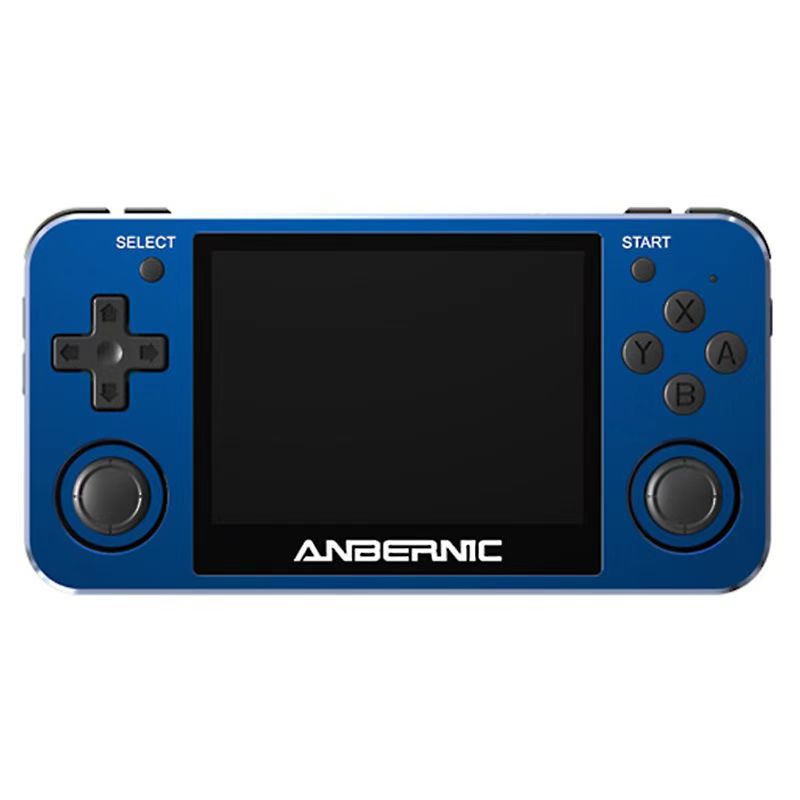
The RG-351MP was Anbernic’s 2021 send-off for the Rockchip RK3326, the quad-core chip that quietly powered half the company’s catalog that year. What separated the MP from its siblings, the plastic RG351P and the earlier metal RG351M, was the screen: a 3.5-inch, 640×480 IPS panel in a true 4:3 ratio, laminated straight to the glass. It arrived as a landscape counterpoint to Anbernic’s earlier vertical RG350 line, aimed at players who wanted a horizontal layout for console emulation. For anyone whose emulation diet is Super Nintendo, Genesis, Game Boy Advance and PlayStation, that aspect ratio matters more than another few hundred megahertz of clock speed, and Anbernic knew it.
Emulation performance, generation by generation
The RK3326 is a modest part by 2026 standards: four Cortex-A35 cores at 1.5 GHz, a Mali-G31 MP2 GPU and just 1GB of DDR3L. Judge it as the low-power ARM SoC it is, not as a pocket PC. Within that envelope it is genuinely capable. Everything from the 8- and 16-bit era runs locked to full speed through RetroArch cores: NES, SNES, Genesis, Master System, PC Engine, the full Game Boy line up to GBA, and Neo Geo. Arcade coverage is broad too, with CPS1, CPS2 and most pre-3D MAME sets running comfortably. PlayStation is the headline act and the real reason to buy. DuckStation and PCSX-ReARMed clear the vast majority of the PS1 library at full frame rate, and the 4:3 screen frames those games the way they were drawn. N64 and Dreamcast are where honesty is required. The N64 runs via ParaLLEl or Mupen64Plus and it is game-by-game: Mario 64 and Ocarina are fine, but demanding titles like Perfect Dark or Rogue Squadron chug or need per-game tweaking. Dreamcast through Flycast is the same shape of story, playable in lighter fighters but not a system you buy this device for. PSP via PPSSPP handles 2D and lighter 3D games while the heavy 3D catalog turns to slideshow, and Saturn is mostly out of reach. Treat the MP as a machine that tops out cleanly at PS1, with N64, PSP and Dreamcast as bonus rounds rather than promises.
Screen, build and controls
The panel is the best thing here. At 640×480 across 3.5 inches it is dense enough that SNES and PS1 sprites look crisp, and the OCA full lamination kills the air gap that makes cheaper handhelds look murky. The 4:3 shape means no pillarboxing and no stretching on the systems that defined the format. The trade-off is scale: 3.5 inches is small, and text-heavy PS1 RPGs will have you leaning in. The shell is CNC-milled aluminum and it feels like it, at 267 grams with real density, no creak and no flex, in matte black, ocean blue or mint green. Controls are conventional Anbernic: a proper cross D-pad, A/B/X/Y face buttons, and two clickable analog sticks sitting below them. Those sticks are ordinary potentiometer units, not Hall effect, so factor in eventual drift over years of hard use. The shoulders are digital buttons rather than analog triggers, with L1/R1 curling naturally under the fingers and L2/R2 set further inboard, needing a deliberate reach.
Software and setup
Out of the box the RG-351MP ships with an EmuELEC-derived stock image, which boots and plays but is not where the device shines. The RK3326 has one of the healthiest custom-firmware scenes of any Anbernic chip. ArkOS is the usual first pick, a clean Linux front-end with excellent per-system configuration; AmberELEC, the former 351ELEC, offers an EmulationStation build with strong scraping; and JELOS, now carried on as ROCKNIX, is the other serious option. You will not find muOS or Knulli here, since those target Anbernic’s newer Allwinner H700 hardware, not this chip. Setup is the standard ritual: flash your firmware of choice to a microSD with Balena Etcher, drop ROMs onto the second card, and boot. The dual-SD design keeps the operating system and your library on separate cards, which is genuinely convenient. The catch is connectivity. There is no built-in WiFi and no Bluetooth at all; box-art scraping and netplay depend on the bundled USB WiFi dongle plugged into the OTG port, which works but is clumsy.
Price, value and who it is for
The RG-351MP launched in September 2021 at roughly $140 to $150. Years on it is an aging chip, and newer handhelds with faster SoCs and built-in WiFi have moved the goalposts, so the case for it now is specific rather than general. Buy the MP if you want a metal-bodied, 4:3, PS1-and-below machine and you value that laminated square screen more than N64 or PSP muscle. It is a focused retro box for the 8-bit through PlayStation span, and inside that span it is excellent. If your list demands reliable N64, PSP or Dreamcast, or you refuse to babysit a WiFi dongle, a newer H700 or RK3566 device makes more sense. But for SNES and PlayStation on a solid aluminum brick, very few small handhelds feel this good in the hand.
📐 Size & Pocketability
⚖️ Weight vs Other Handhelds
🔋 Real-World Battery Estimator
⭐ Emulation Performance
📊 View How This Score is Calculated
The Hardware Power Score is an absolute metric. Perfect emulation of difficult, modern consoles awards significantly more points than standard retro consoles.
- 15× Multiplier: Modern PC
- 12× Multiplier: Switch, PS3, Xbox 360
- 10× Multiplier: Wii U
- 8× Multiplier: PS2, GameCube, Wii, Xbox
- 5× Multiplier: Saturn, Dreamcast, PSP
- 3× Multiplier: N64, PS1
- 1× Multiplier: SNES, GBA
Generation 6
Generation 5
Handhelds & Retro
⚡ Performance Benchmarks
Where Anbernic RG-351MP Mali-G31 MP2 lands against the handhelds everyone knows. Every bar shares one scale, so longer genuinely means faster — add up to two rivals to compare.
CPU = Geekbench 6 multi-core · GPU = 3DMark Wild Life. Median real-world scores; every bar shares one scale — add up to two rivals to compare.
📋 Full Specifications
📺 Display
⚙️ Platform
💾 Memory
🕹️ Controls
📏 Body
🔋 Battery
⚖️ Verdict
✅ The Good
- Superb 3.5-inch 640×480 IPS panel in a true 4:3 ratio with OCA full lamination, ideal for SNES and PS1
- CNC-milled aluminum shell at 267g that feels genuinely premium with no creak or flex
- Runs everything through PS1 at full speed, including DuckStation and broad CPS/MAME arcade coverage
- Excellent custom-firmware support (ArkOS, AmberELEC, JELOS/ROCKNIX) with a convenient dual-SD OS/ROM split
❌ The Bad
- No built-in WiFi and no Bluetooth; scraping and netplay require the bundled USB dongle
- Aging RK3326 with 1GB RAM struggles with heavier N64, PSP, Dreamcast and Saturn titles
- Standard potentiometer analog sticks rather than Hall effect, so stick drift is a long-term risk
📰 Latest News & Guides
The Ultimate Guide to ARMSX3: Android’s New PS3 Emulator, Competitor Comparisons, and Setup Tutorial
18/08/2026Pokémon Gold, Silver, and Crystal (Gen 2) Recomp Lands on Android
17/08/2026How to Play the Pokémon Red, Blue, or Yellow Recomp on Your Android, Windows, and Linux Devices
16/08/2026🔍 Similar Handhelds
Other handhelds that emulate up to DS.