
🛒 Where to Buy
⚠️ Golden Rule of Retro Handhelds: Throw away the cheap MicroSD card that comes in the box — it will fail. And never use a high-wattage PD “Fast Charger” on these devices; it can damage the battery. Use a standard 5V/1.5A brick.
Device Overview: Game Console R36H
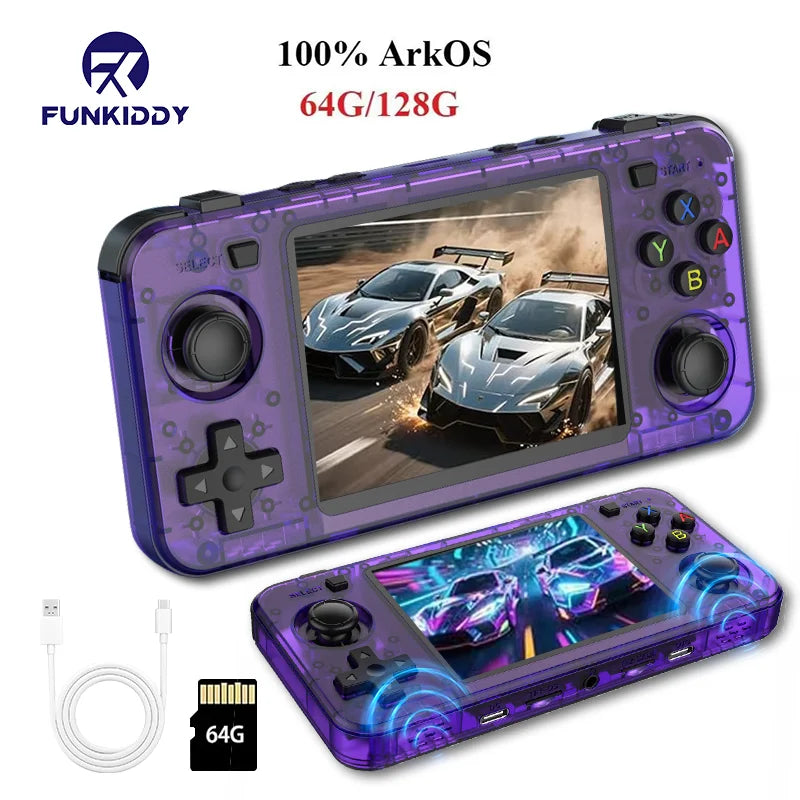
The Game Console R36H is a sub-$40 horizontal retro handheld that arrived in January 2025 as the landscape sibling to the wildly cloned R36S. Strip away the “15,000+ games” marketing and what you actually have is a familiar recipe: a Rockchip RK3326, a 3.5-inch 4:3 screen, a removable battery, and a Linux emulation stack. This is not a new design so much as a repackaging of silicon Anbernic first shipped in the RG351P back in 2019. The “Game Console” branding is effectively a white-label name, and you will find the same hardware sold under a rotating cast of storefronts. The horizontal layout borrows heavily from Anbernic’s RG35XX H, right down to the side-by-side shoulder buttons. Knowing that pedigree tells you almost everything about what the R36H can and cannot do.
Emulation performance, generation by generation
The RK3326 is a quad-core Arm Cortex-A35 clocked around 1.3-1.5GHz with a Mali-G31 MP2 GPU and 1GB of DDR3L. In practice, everything through the 16-bit era runs without a fight. NES, SNES, Genesis, Master System, Game Boy through GBA, PC Engine, and Neo Geo all hit full speed under RetroArch cores with room to spare. Arcade coverage through FinalBurn Neo and MAME is strong for CPS1, CPS2, and Neo Geo MVS, and only trips up on the most demanding late-90s boards. PlayStation 1 is the device’s comfortable ceiling: PCSX ReARMed pushes the large majority of the library at 60fps, with only the heaviest 3D titles and full-motion video showing occasional stutter. Above that line, expectations drop sharply. Nintendo 64 through Mupen64Plus is a game-by-game lottery: Mario 64 and Ocarina are playable, but anything leaning hard on the RDP will want frame-skip. Dreamcast on Flycast and PSP on PPSSPP are technically present and occasionally impressive on 2D or lightweight titles, but treat them as bonus rounds, not a supported tier. Nintendo DS via DraStic runs, though the single small screen makes dual-display games awkward. Anyone expecting Saturn, GameCube, or Wii should look at a different chip entirely.
Screen, build and controls
The 3.5-inch IPS panel is the R36H’s strongest asset. At 640×480 it holds a native 4:3 shape and roughly 229 PPI, exactly what you want for 8- and 16-bit sprite work and for PS1: no letterboxing, no awkward scaling. Colours are punchy and viewing angles are wide. The body measures 145 x 69 x 16mm and weighs 186 grams, a genuinely pocketable slab. The controls are where the budget shows. The d-pad sits lower-left and is decent for platformers and fighters, but the two analog sticks are an asymmetric, offset Xbox-style pair with short throw and no Hall-effect sensors; they will drift eventually, and their placement is awkward for systems that predate analog. Shoulder buttons are digital only, with no analog L2/R2, and the Start/Select buttons are stiff and loud. The rear grips are comfortable for long sessions, and reviewers note the device stays cool under load.
Software and setup
Out of the box the R36H ships with ArkOS 2.0 on a preloaded microSD, fronted by EmulationStation. ArkOS is a genuinely good Rockchip distribution with clean per-emulator control, but the bundled card is the usual grey-market pile of ROMs, and stock navigation can feel sluggish. Because the RK3326 is such a well-worn platform, you are not locked in: the device runs the full RK3326 custom-firmware ecosystem, so ArkOS, ROCKNIX (the JELOS successor), and Batocera all boot from a fresh card, and burning your own image with your own legally dumped games is the sane move. Note that muOS and OnionOS are not options here, as those target Allwinner H700 and Miyoo hardware respectively, so ignore any listing that claims them. Setup friction is real: there is no WiFi and no Bluetooth, so every ROM and firmware image moves by pulling the microSD and using a card reader. The dual-slot layout, one card for the OS and one for ROMs, is convenient once configured but clunky to reach. USB-C handles charging and OTG; HDMI-out is advertised but its reliability is disputed by owners.
Price, value and who it is for
At roughly $35 to $50 depending on seller and bundled card size, the R36H competes on price rather than capability. It is the right purchase for someone who wants a cheap, pocketable machine to play NES-through-PS1 on a sharp 4:3 screen and does not care about wireless features or anything more demanding than late-1990s consoles. It is the wrong purchase if you want reliable N64, Dreamcast, or PSP, Hall-effect sticks that won’t drift, or a clean out-of-the-box legal setup. Buyers cross-shopping should weigh the Anbernic RG35XX H, which uses the newer H700 chip and adds WiFi for a little more money. As a $40 impulse buy on a known, mature platform, the R36H is honest value, provided you understand you are holding 2019 silicon in a 2025 shell.
📐 Size & Pocketability
⚖️ Weight vs Other Handhelds
🔋 Real-World Battery Estimator
⭐ Emulation Performance
📊 View How This Score is Calculated
The Hardware Power Score is an absolute metric. Perfect emulation of difficult, modern consoles awards significantly more points than standard retro consoles.
- 15× Multiplier: Modern PC
- 12× Multiplier: Switch, PS3, Xbox 360
- 10× Multiplier: Wii U
- 8× Multiplier: PS2, GameCube, Wii, Xbox
- 5× Multiplier: Saturn, Dreamcast, PSP
- 3× Multiplier: N64, PS1
- 1× Multiplier: SNES, GBA
Generation 6
Generation 5
Handhelds & Retro
⚡ Performance Benchmarks
Where Game Console R36H Mali-G31 MP2 lands against the handhelds everyone knows. Every bar shares one scale, so longer genuinely means faster — add up to two rivals to compare.
CPU = Geekbench 6 multi-core · GPU = 3DMark Wild Life. Median real-world scores; every bar shares one scale — add up to two rivals to compare.
📋 Full Specifications
📺 Display
⚙️ Platform
💾 Memory
🕹️ Controls
📏 Body
🔋 Battery
⚖️ Verdict
✅ The Good
- Sharp 3.5-inch 640×480 IPS panel in native 4:3, ideal for 8/16-bit and PS1 with no scaling artifacts
- Runs everything through PlayStation 1 at full speed, and the whole RK3326 custom-firmware library (ArkOS, ROCKNIX, Batocera) is open to it
- Removable 3000mAh battery plus dual microSD slots make it easy to swap cells and keep the OS separate from ROMs
- Genuinely pocketable at 186g with comfortable rear grips, and it stays cool over long sessions for around $35-50
❌ The Bad
- Asymmetric offset analog sticks with no Hall-effect sensors: awkward placement for retro titles and prone to drift over time
- No WiFi and no Bluetooth, so every ROM and firmware update means physically pulling the microSD card
- 2019-era RK3326 hits a hard wall above PS1: N64, Dreamcast, and PSP are a title-by-title gamble, and Saturn/GameCube are off the table
📰 Latest News & Guides
The Ultimate Guide to ARMSX3: Android’s New PS3 Emulator, Competitor Comparisons, and Setup Tutorial
18/08/2026Pokémon Gold, Silver, and Crystal (Gen 2) Recomp Lands on Android
17/08/2026How to Play the Pokémon Red, Blue, or Yellow Recomp on Your Android, Windows, and Linux Devices
16/08/2026🔍 Similar Handhelds
Other handhelds that emulate up to DS.