
🛒 Where to Buy
⚠️ Golden Rule of Retro Handhelds: Throw away the cheap MicroSD card that comes in the box — it will fail. And never use a high-wattage PD “Fast Charger” on these devices; it can damage the battery. Use a standard 5V/1.5A brick.
Device Overview: Nintendo DSi XL
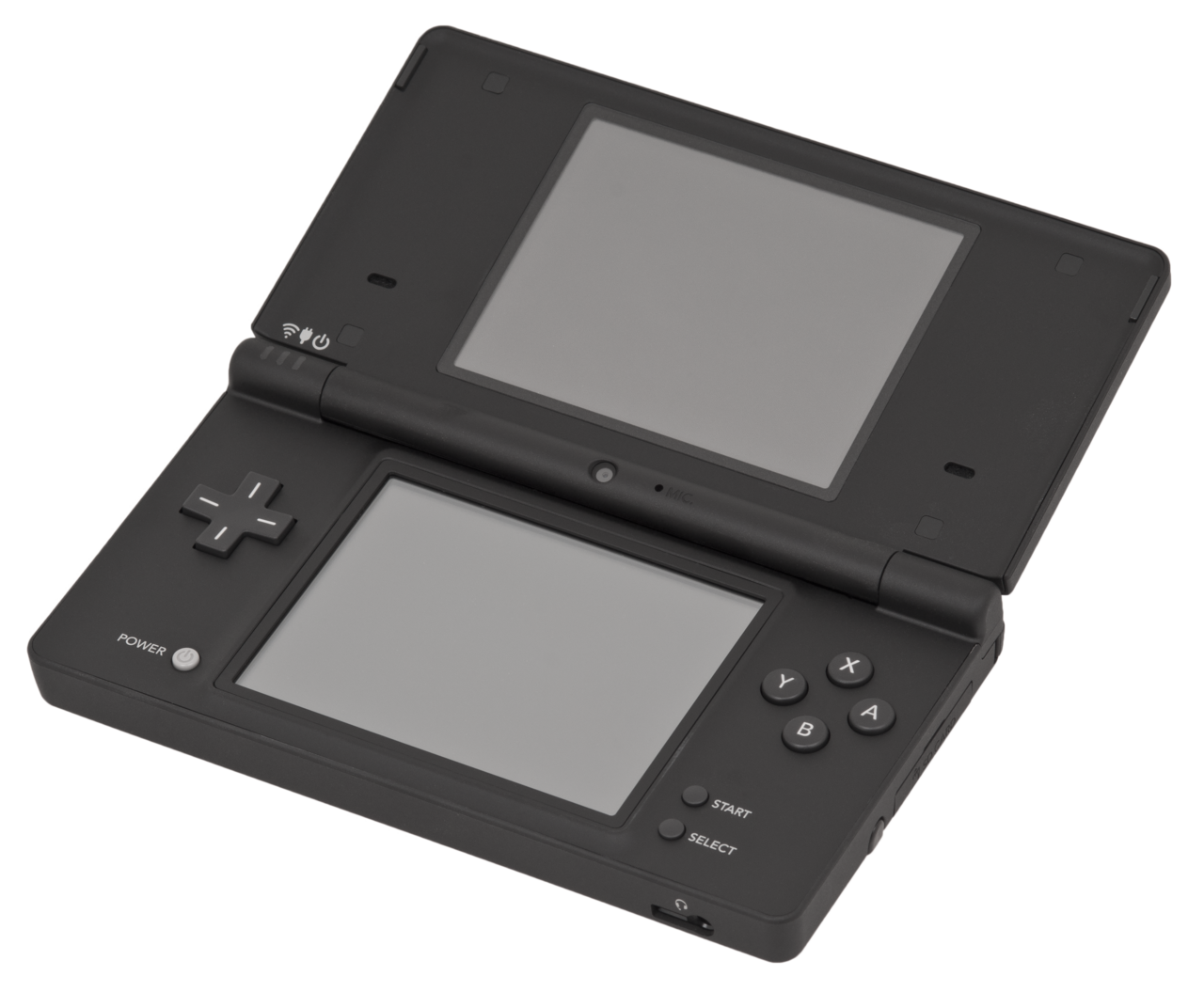
The Nintendo DSi XL is the supersized member of the DS family: the same silicon as the standard DSi poured into a much bigger shell with two 4.2-inch screens. Nintendo launched it in Japan as the DSi LL on 21 November 2009, brought it to Europe in early March 2010, and released it in North America on 28 March 2010 at $189.99. It was pitched less as a pocket portable and more as a shared, coffee-table console you could hand across a room, and the pack-in software (Brain Age Express titles, a dictionary, a photo clock) leaned hard into an older, casual audience. Today it is the DS you buy when you want the biggest, most legible screens Nintendo ever put on the platform.
The hardware and its library
Internally this is a DSi, full stop. It runs an ARM946E-S at 133 MHz paired with an ARM7TDMI at 33 MHz, backed by 16 MB of RAM, a meaningful jump over the original DS’s 4 MB and the reason DSi-enhanced games and DSiWare exist at all. It plays the entire Nintendo DS card library through Slot-1, plus DSiWare bought from the now-shuttered DSi Shop. What it lacks is the Slot-2 cartridge slot, so unlike the DS Lite it cannot play Game Boy Advance cartridges natively; Nintendo dropped that hardware with the DSi generation. Two 0.3-megapixel VGA cameras and an SD card slot round out the additions. The native catalogue is the real draw: Pokemon Black and White, the DS Zelda and Mario games, Advance Wars, and the Ace Attorney and Professor Layton series all run exactly as intended, and the enlarged screens make the DS’s dual-screen and stylus designs genuinely more comfortable to use.
Homebrew, custom firmware and emulation
The DSi’s softmod scene is mature and, importantly, entirely free. The entry point is Memory Pit, a camera-app exploit that works on every DSi including the XL and needs nothing but an SD card. From there most people install Unlaunch, a bootcode exploit that seizes the console at power-on and unlocks full hardware access, then add TWiLight Menu++ as a front-end. With nds-bootstrap underneath it, TWiLight Menu++ runs DS ROMs straight from the SD card, so a single memory card of your own dumps replaces a shelf of cartridges.
Set expectations honestly on emulation, because 133 MHz is not much to work with. The 8-bit machines are the comfort zone: NES, Game Boy and Game Boy Color run at full speed, and Sega Master System and Game Gear are fine. SNES and Genesis are only partly playable, with heavy frameskip, thinned-out audio, and plenty of games that simply chug. GBA is the awkward case, because gbaRunner2 exists but the DSi stripped out the native GBA hardware and the extra memory older DS models exposed, so compatibility and speed are hit-and-miss. If Game Boy Advance is the goal, a DS Lite or a GBA SP is the honest recommendation. Treat the DSi XL as a superb DS and DSiWare machine that also handles 8-bit retro, not as a 16-bit emulator.
Screen, build and revisions
The headline here is size, not sharpness. Both panels are 4.2-inch TFT LCDs, but the resolution is still 256×192 per screen, identical to the DSi and DS Lite, so you are looking at the same pixels simply blown up larger. Text and sprites are bigger and easier on the eyes, with slightly softer edges and noticeably wider viewing angles than the smaller DSi. The trade-off is bulk: at roughly 314 grams it is the heaviest DS ever made, too big for a jeans pocket and awkward to hold one-handed for long. The payoff is endurance. The larger chassis swallows a 1050 mAh cell that Nintendo rated at up to 13 to 17 hours on the dimmest brightness, far beyond the DSi. A longer stylus and a side-mounted pen holder suit bigger hands. The XL, model number UTL-001, had no internal revisions; the variety is purely cosmetic, from launch Burgundy and Bronze to later Yellow, Blue, Green, Red and licensed Mario editions.
Collecting, price and who it is for
On the used market the DSi XL typically runs somewhere in the $60 to $120 range depending on condition and colour, with boxed units and special editions climbing higher; the launch colours are cheap and everywhere. Before buying, check the hinges and the top screen for the stress cracking DS clamshells are prone to, and confirm the shoulder buttons still click cleanly. Buy this one if you mostly want to play the DS and DSiWare libraries on the largest, most comfortable screens available, or if you want a cheap, endlessly moddable handheld for 8-bit homebrew with all-day battery life. Skip it if you need GBA cartridge support, where a DS Lite is the answer, or if you expect smooth SNES emulation, which this chip cannot deliver. For relaxed, sofa-bound DS gaming, nothing else in the family is this easy on the eyes.
📐 Size & Pocketability
⚖️ Weight vs Other Handhelds
🔋 Real-World Battery Estimator
⭐ Emulation Performance
📊 View How This Score is Calculated
The Hardware Power Score is an absolute metric. Perfect emulation of difficult, modern consoles awards significantly more points than standard retro consoles.
- 15× Multiplier: Modern PC
- 12× Multiplier: Switch, PS3, Xbox 360
- 10× Multiplier: Wii U
- 8× Multiplier: PS2, GameCube, Wii, Xbox
- 5× Multiplier: Saturn, Dreamcast, PSP
- 3× Multiplier: N64, PS1
- 1× Multiplier: SNES, GBA
Gen 8 & PC
Handhelds & Retro
📋 Full Specifications
📺 Display
⚙️ Platform
💾 Memory
🕹️ Controls
📏 Body
🔋 Battery
⚖️ Verdict
✅ The Good
- Largest screens in the DS family, two 4.2-inch panels that make DS and DSiWare games far easier to read than any DS Lite or DSi
- Longest battery life of any DS model, up to 13 to 17 hours on low brightness from its 1050 mAh cell
- Free, mature softmod path (Memory Pit to Unlaunch to TWiLight Menu++) runs the whole DS library from an SD card at no cost
- Cheap and abundant on the used market, with a longer stylus and side pen holder that suit bigger hands
❌ The Bad
- No Slot-2, so no native Game Boy Advance cartridges, and gbaRunner2 emulation is unreliable on DSi hardware
- Same 256×192 per-screen resolution as the smaller models, so the bigger panels look softer rather than sharper
- Heaviest DS ever at roughly 314 grams, not pocketable, and its 133 MHz CPU cannot manage smooth SNES or Genesis emulation
📰 Latest News & Guides
The Ultimate Guide to ARMSX3: Android’s New PS3 Emulator, Competitor Comparisons, and Setup Tutorial
18/08/2026Pokémon Gold, Silver, and Crystal (Gen 2) Recomp Lands on Android
17/08/2026How to Play the Pokémon Red, Blue, or Yellow Recomp on Your Android, Windows, and Linux Devices
16/08/2026🔍 Similar Handhelds
Other handhelds that emulate up to DS.