
🛒 Where to Buy
⚠️ Golden Rule of Retro Handhelds: Throw away the cheap MicroSD card that comes in the box — it will fail. And never use a high-wattage PD “Fast Charger” on these devices; it can damage the battery. Use a standard 5V/1.5A brick.
Device Overview: Game Console R36 Max
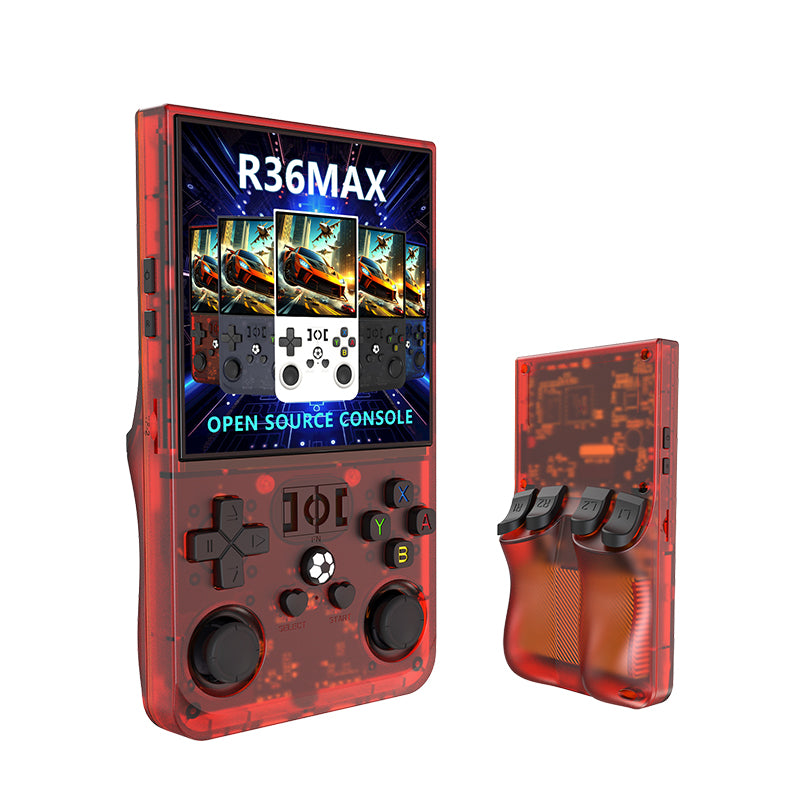
The Game Console R36 Max is one branch of the sprawling R36 family, a line of sub-$40 handhelds that clone each other’s shells and swap in whatever Rockchip silicon is cheapest that quarter. “Game Console” is not a description here; it is the literal brand stamped on the retail box, which tells you most of what you need to know about the outfit behind it. What separates the Max from its R36S and R36H siblings is the display: a square 4-inch, 720×720 IPS panel instead of the usual 640×480 rectangle. Everything else is standard RK3326 fare, and that chip sets both the strengths and the hard ceiling.
Emulation performance, generation by generation
The Rockchip RK3326 is a quad-core ARM Cortex-A35 clocked around 1.3GHz with a Mali-G31 MP2 GPU, paired with 1GB of DDR3L RAM. This is a low-power mobile chip from 2018, not a pocket PC, so calibrate expectations accordingly. Eight- and 16-bit systems are effortless: NES, SNES, Genesis, Master System, PC Engine, Game Boy through Game Boy Advance, and Neo Geo all run at full speed in RetroArch using cores like Nestopia, Snes9x, Genesis Plus GX and mGBA. Arcade boards up to CPS1/CPS2/CPS3 and most Neo Geo MVS titles are comfortable, as is Sega CD. PlayStation 1 is the realistic comfort ceiling; PCSX-ReARMed clears the vast majority of the library at full frame rate. Above that, things get selective. Nintendo 64 through Mupen64Plus and Dreamcast through Flycast are a coin flip, playable for lighter titles but dropping frames on demanding ones, and both need per-game tuning. PSP via PPSSPP handles 2D and simpler 3D games at reduced resolution, while heavier 3D chugs. Sega Saturn is effectively off the table. In practice that means Symphony of the Night, Final Fantasy VII and Crash Bandicoot are a clean yes, while Mario 64 runs but Conker’s Bad Fur Day does not. Treat this as a strong retro-to-PS1 machine that occasionally reaches one generation further, and stop expecting it to behave like anything more.
Screen, build and controls
The 720×720 square panel is the headline and the caveat in one. It is bright and sharp, and for content that fits its 1:1 shape, it is genuinely great: vertical arcade shooters, Game Boy and Game Boy Color, and pinball fill the glass. The problem is that most consoles output 4:3 or wider, so SNES, Genesis and PS1 games sit letterboxed with black bars above and below, wasting a chunk of a panel you paid for. Whether that trade is worth it depends entirely on what you play. The build is plastic and light, with a curved back that some find comfortable and others find awkward. Controls are the weak point. The dual analog sticks are cheap potentiometer units, not Hall effect, and reviewers note one often feels loose out of the box. The D-pad is stiff, the L1/L2/R1/R2 shoulder buttons are loud and clacky, and the face buttons use odd rounded convex squares instead of proper domes. A front-firing speaker is surprisingly loud and clean, and there is a 3.5mm headphone jack, dual microSD slots and USB-C charging.
Software and setup
Out of the box the R36 Max ships on an EmuElec-based Linux image loaded onto the bundled card, with a preinstalled pile of ROMs of dubious legality that most owners wipe and replace. The stock firmware works but is rough, and the real story is the custom-firmware scene that RK3326 devices inherit. ROCKNIX is the standout, offering a clean, actively maintained build with good controller mapping and RetroArch integration. ArkOS forks and community “arkos4clone” images also boot, though owners report ArkOS running noticeably slower on the Max than on the original R36S, likely tied to the 720×720 panel. Note what does not apply: muOS and Knulli target Allwinner H700 hardware, so despite being popular in this price bracket they are not options here. Batocera and EmuDeck are likewise irrelevant to an ARM SBC-class device like this. Expect to flash a second microSD, spend an evening on setup and scraping artwork, and keep the stock card only as a backup. The second slot is handy for exactly this, letting you leave a working ROM library untouched while you experiment on the other card.
Price, value and who it is for
Street pricing sits roughly between $33 and $45 depending on sales, with listings ranging up to about $70 on marketplaces bundling a 128GB card. At the low end it is a lot of retro machine for the money, and the square screen is a legitimately differentiated feature that no mainstream handheld offers. But it is not a device that pushes the category forward; it is a familiar RK3326 board wrapped around an unusual panel, with mediocre controls and no Wi-Fi, Bluetooth or video output on documented units. Buy it if you specifically want a square-screen handheld for vertical shmups, Game Boy and PS1-and-below libraries, and you are willing to swap firmware. If you want reliable N64, Dreamcast or PSP, or you want to keep games in their native widescreen framing, spend more on an H700-class device and skip this one.
📐 Size & Pocketability
🔋 Real-World Battery Estimator
⭐ Emulation Performance
📊 View How This Score is Calculated
The Hardware Power Score is an absolute metric. Perfect emulation of difficult, modern consoles awards significantly more points than standard retro consoles.
- 15× Multiplier: Modern PC
- 12× Multiplier: Switch, PS3, Xbox 360
- 10× Multiplier: Wii U
- 8× Multiplier: PS2, GameCube, Wii, Xbox
- 5× Multiplier: Saturn, Dreamcast, PSP
- 3× Multiplier: N64, PS1
- 1× Multiplier: SNES, GBA
Generation 6
Generation 5
Handhelds & Retro
⚡ Performance Benchmarks
Where Game Console R36 Max Mali-G31 MP2 lands against the handhelds everyone knows. Every bar shares one scale, so longer genuinely means faster — add up to two rivals to compare.
CPU = Geekbench 6 multi-core · GPU = 3DMark Wild Life. Median real-world scores; every bar shares one scale — add up to two rivals to compare.
📋 Full Specifications
📺 Display
⚙️ Platform
💾 Memory
🕹️ Controls
📏 Body
🔋 Battery
⚖️ Verdict
✅ The Good
- Square 720×720 IPS screen is genuinely great for vertical arcade shooters, Game Boy and pinball
- Very cheap, roughly $33 to $45, for a capable retro-to-PS1 emulation machine
- Loud, clean front-firing speaker plus dual microSD slots, 3.5mm jack and USB-C charging
- Inherits the RK3326 custom-firmware scene, with ROCKNIX and ArkOS forks as solid upgrades over stock
❌ The Bad
- Weak controls: non-Hall potentiometer sticks (one often loose), stiff D-pad, clacky triggers, odd convex face buttons
- RK3326 chip caps out at PS1; N64, Dreamcast and PSP are inconsistent and Saturn is off the table
- The 1:1 panel letterboxes most 4:3 and widescreen games, and there is no Wi-Fi, Bluetooth or video out
📰 Latest News & Guides
The Ultimate Guide to ARMSX3: Android’s New PS3 Emulator, Competitor Comparisons, and Setup Tutorial
18/08/2026Pokémon Gold, Silver, and Crystal (Gen 2) Recomp Lands on Android
17/08/2026How to Play the Pokémon Red, Blue, or Yellow Recomp on Your Android, Windows, and Linux Devices
16/08/2026🔍 Similar Handhelds
Other handhelds that emulate up to DS.