
🛒 Where to Buy
⚠️ Golden Rule of Retro Handhelds: Throw away the cheap MicroSD card that comes in the box — it will fail. And never use a high-wattage PD “Fast Charger” on these devices; it can damage the battery. Use a standard 5V/1.5A brick.
Device Overview: Anbernic RG-351P
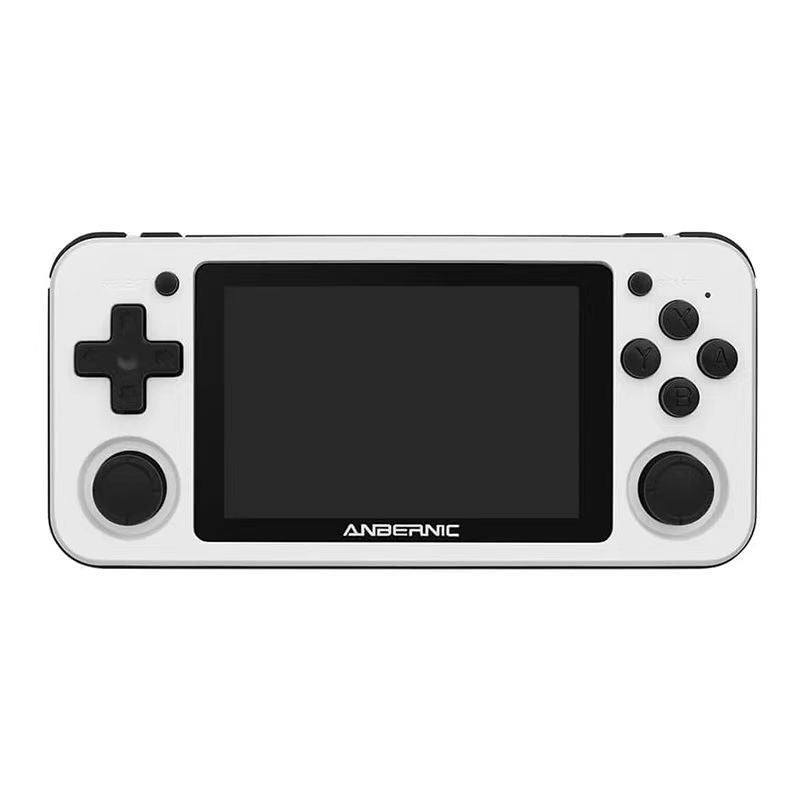
The Anbernic RG-351P arrived in September 2020 as the device that dragged Anbernic out of the cheap-plastic RG350 era into something you could genuinely hand a newcomer. It is a horizontal handheld built around the Rockchip RK3326, a quad-core ARM Cortex-A35 that tops out near 1.5 GHz, paired with a Mali-G31 MP2 GPU and 1GB of DDR3L RAM. That is not a fast chip by 2020 phone standards, but Anbernic wrapped it in a comfortable shell with a genuinely good 3.5-inch screen and dual analog sticks, and priced it around $99. For roughly two years it was the default answer to “what retro handheld should I buy first,” and the used market still treats it that way. Anbernic also sold an aluminium-shelled sibling, the RG351M, with identical internals and a heavier premium feel, but the plastic P is the one most people actually bought.
Emulation performance, generation by generation
The RK3326 has a hard, well-understood ceiling, and pretending otherwise helps nobody. Everything up to and including the 16-bit and Game Boy Advance era runs at full speed with headroom: NES, SNES, Genesis, Master System, Game Boy/Color/Advance, PC Engine and Neo Geo all behave. Arcade emulation through FinalBurn Neo and MAME 2003-Plus covers CPS-1, CPS-2 and Neo Geo comfortably, and Sega CD runs clean. PlayStation 1 through PCSX ReARMed is the sweet spot and runs essentially the entire library at full speed. Above that, you are negotiating. Sega Saturn is effectively off the table on this chip, so do not count it as a target at all. Nintendo 64 is a coin-flip: Super Mario 64, Banjo-Kazooie and Mario Kart 64 are fine on a standalone Mupen64Plus core, while heavier titles stutter or glitch. Dreamcast via Flycast is playable on many 2D-heavy games but usually needs half-resolution rendering and per-game tuning. PSP through PPSSPP is the genuine edge: light 2D and simple 3D titles hit full speed, but demanding polygonal games need frameskip and still dip below 30fps. Nintendo DS via DraStic works well, helped by the 3:2 screen. Treat this as a machine that masters everything through PS1 and merely dabbles above it.
Screen, build and controls
The 3.5-inch IPS panel runs 480×320 at a 3:2 aspect ratio, and it is the single best reason to pick this over the older RG350. That 3:2 shape is close to the native ratio of many classic systems, so Game Boy and DS content sit nicely without gross letterboxing, and the OCA-laminated glass looks crisp. The body measures 151.5 x 70 x 18 mm and weighs about 189 grams, pocketable and light without feeling hollow. Controls are the real upgrade over its predecessor: two symmetrical analog sticks below a D-pad, plus L1/R1/L2/R2 on the back. Be clear-eyed about the sticks, though. These are conventional potentiometer sticks, not Hall-effect, so drift over time is a real possibility, and the L2/R2 shoulders are digital clicks rather than analog triggers. The face buttons and D-pad are good; the shoulders are merely acceptable.
Software and setup
The RG-351P’s stock firmware, an EmuELEC-derived image on the bundled microSD, is functional but nobody serious stays on it. The device’s whole value proposition is its open Linux platform and the custom-firmware scene that grew around it. ArkOS is the community favourite for balance and ease of use, with tidy per-emulator settings and over-the-air core updates; 351ELEC (which became AmberELEC, now continued as ROCKNIX) is the EmulationStation-flavoured alternative with slicker presentation. Batocera also runs on the hardware if you prefer that ecosystem. All of them flash to a microSD card, and the P has a second card slot dedicated to ROMs, so the OS and your games stay separate; a beginner can be up and running with the imager tool and a card in fifteen minutes. One important caveat: the RG-351P has no built-in Wi-Fi. You add networking with a cheap USB Wi-Fi dongle through the USB-C port, which matters for scraping box art and pulling updates. There is no Bluetooth either.
Price, value and who it is for
At its ~$99 launch price the RG-351P was a fair deal; today, used, it is a bargain that has been quietly superseded. The same RK3326 chip shows up in the RG351V, the RG351MP and countless clones, and newer sub-$100 handhelds on faster H700 or Snapdragon-class silicon now emulate Dreamcast and PSP far more confidently. So buy the RG-351P if you want a proven, comfortable, no-nonsense machine for everything up to PlayStation, you value that 3:2 screen and dual sticks, and you are happy living inside ArkOS or ROCKNIX. Do not buy it expecting reliable N64, Dreamcast or PSP, and do not pay near the original retail, because this is a $40-to-$60 used purchase now. As a first handheld or a dedicated PS1-and-below machine it still earns its keep; as your only device in 2026 it will frustrate anyone chasing sixth-generation systems.
📐 Size & Pocketability
⚖️ Weight vs Other Handhelds
🔋 Real-World Battery Estimator
⭐ Emulation Performance
📊 View How This Score is Calculated
The Hardware Power Score is an absolute metric. Perfect emulation of difficult, modern consoles awards significantly more points than standard retro consoles.
- 15× Multiplier: Modern PC
- 12× Multiplier: Switch, PS3, Xbox 360
- 10× Multiplier: Wii U
- 8× Multiplier: PS2, GameCube, Wii, Xbox
- 5× Multiplier: Saturn, Dreamcast, PSP
- 3× Multiplier: N64, PS1
- 1× Multiplier: SNES, GBA
Generation 6
Generation 5
Handhelds & Retro
⚡ Performance Benchmarks
Where Anbernic RG-351P Mali-G31 MP2 lands against the handhelds everyone knows. Every bar shares one scale, so longer genuinely means faster — add up to two rivals to compare.
CPU = Geekbench 6 multi-core · GPU = 3DMark Wild Life. Median real-world scores; every bar shares one scale — add up to two rivals to compare.
📋 Full Specifications
📺 Display
⚙️ Platform
💾 Memory
🕹️ Controls
📏 Body
🔋 Battery
⚖️ Verdict
✅ The Good
- Excellent 3.5-inch 480×320 IPS panel whose 3:2 aspect ratio suits Game Boy, DS and arcade content far better than 16:9 rivals
- Flawless emulation up to and including PlayStation 1, running the full PS1 library at full speed
- Comfortable, pocketable 189g shell with dual symmetrical analog sticks and a solid D-pad
- Deep, mature custom-firmware support (ArkOS, 351ELEC/AmberELEC/ROCKNIX) plus a dedicated second microSD slot for ROMs
❌ The Bad
- No built-in Wi-Fi or Bluetooth, so you need a USB dongle just to scrape art or download updates
- RK3326 chip stalls above PS1: N64, Dreamcast and PSP are hit-or-miss and often need per-game tuning
- Conventional potentiometer analog sticks (not Hall-effect) that can develop drift, plus digital-only L2/R2 shoulder buttons
📰 Latest News & Guides
The Ultimate Guide to ARMSX3: Android’s New PS3 Emulator, Competitor Comparisons, and Setup Tutorial
18/08/2026Pokémon Gold, Silver, and Crystal (Gen 2) Recomp Lands on Android
17/08/2026How to Play the Pokémon Red, Blue, or Yellow Recomp on Your Android, Windows, and Linux Devices
16/08/2026🔍 Similar Handhelds
Other handhelds that emulate up to DS.